
Sign in
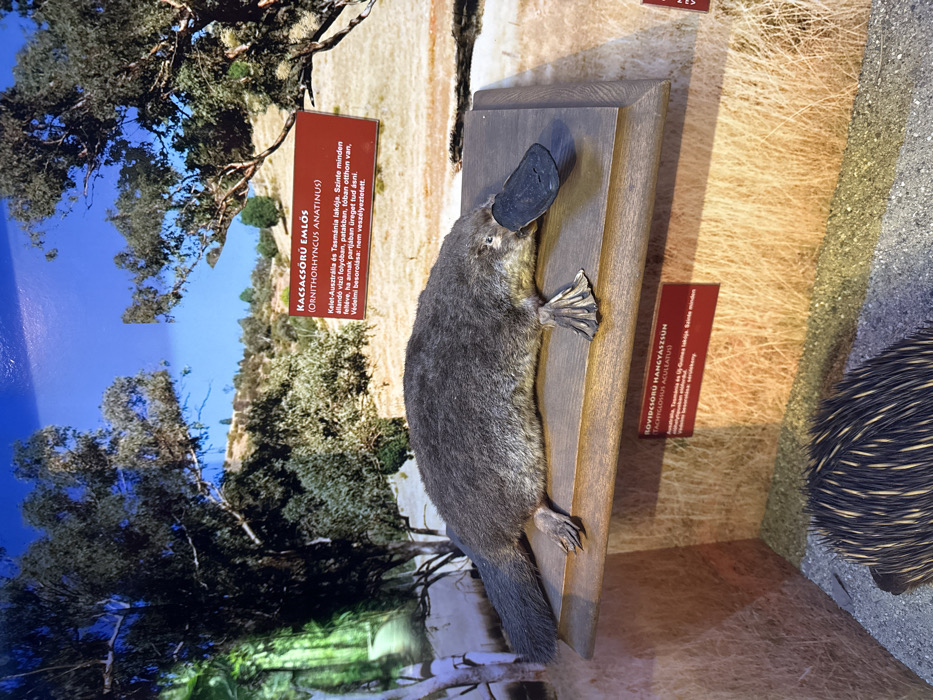
This image depicts an exhibit inside the Hungarian Natural History Museum in Budapest, Hungary. A taxidermied platypus (*Ornithorhynchus anatinus*), dark grey-brown with webbed feet and a prominent black bill, is displayed horizontally on a rectangular wooden block. Above the platypus, a red rectangular informational plaque with white Hungarian text identifies it as "KACSACSŐRŰ EMLŐS" (Duck-billed Mammal) and provides details on its habitat in Eastern Australia and Tasmania, along with its conservation status as not endangered.

Below the platypus, partially visible in the lower left on a sandy-textured base, is a taxidermied short-beaked echidna (*Tachyglossus aculeatus*) covered in sharp, yellowish-brown and black spines. A corresponding red plaque in Hungarian identifies it as "RÖVIDCSŐRŰ HANGYÁSZSUN" (Short-beaked Echidna) and lists its habitat as Australia, Tasmania, and New Guinea, classifying it as vulnerable. The background consists of a large, brightly illuminated photographic mural depicting an Australian landscape featuring eucalyptus trees, dry grassy hills, and a clear blue sky, simulating the animals' natural habitat. No individuals are present in the scene.
Gokos

Mar 19, 2026

Budapest, Hungary

Stake attention in this memory

Curiosity
Intrigue
Educational
Awe
Nostalgia

This image depicts an exhibit inside the Hungarian Natural History Museum in Budapest, Hungary. A taxidermied platypus (*Ornithorhynchus anatinus*), dark grey-brown with webbed feet and a prominent black bill, is displayed horizontally on a rectangular wooden block. Above the platypus, a red rectangular informational plaque with white Hungarian text identifies it as "KACSACSŐRŰ EMLŐS" (Duck-billed Mammal) and provides details on its habitat in Eastern Australia and Tasmania, along with its conservation status as not endangered. Below the platypus, partially visible in the lower left on a sandy-textured base, is a taxidermied short-beaked echidna (*Tachyglossus aculeatus*) covered in sharp, yellowish-brown and black spines. A corresponding red plaque in Hungarian identifies it as "RÖVIDCSŐRŰ HANGYÁSZSUN" (Short-beaked Echidna) and lists its habitat as Australia, Tasmania, and New Guinea, classifying it as vulnerable. The background consists of a large, brightly illuminated photographic mural depicting an Australian landscape featuring eucalyptus trees, dry grassy hills, and a clear blue sky, simulating the animals' natural habitat. No individuals are present in the scene.

transactions
revenues
stakers
Earliest
Latest
Highest stake

No transactions found

More from this user

More from Budapest

Gokos

Mar 19, 2026

Budapest, Hungary

Licensed under Creative Commons Attribution 4.0 International License. You are free to share and adapt this content with proper attribution.