
Sign in
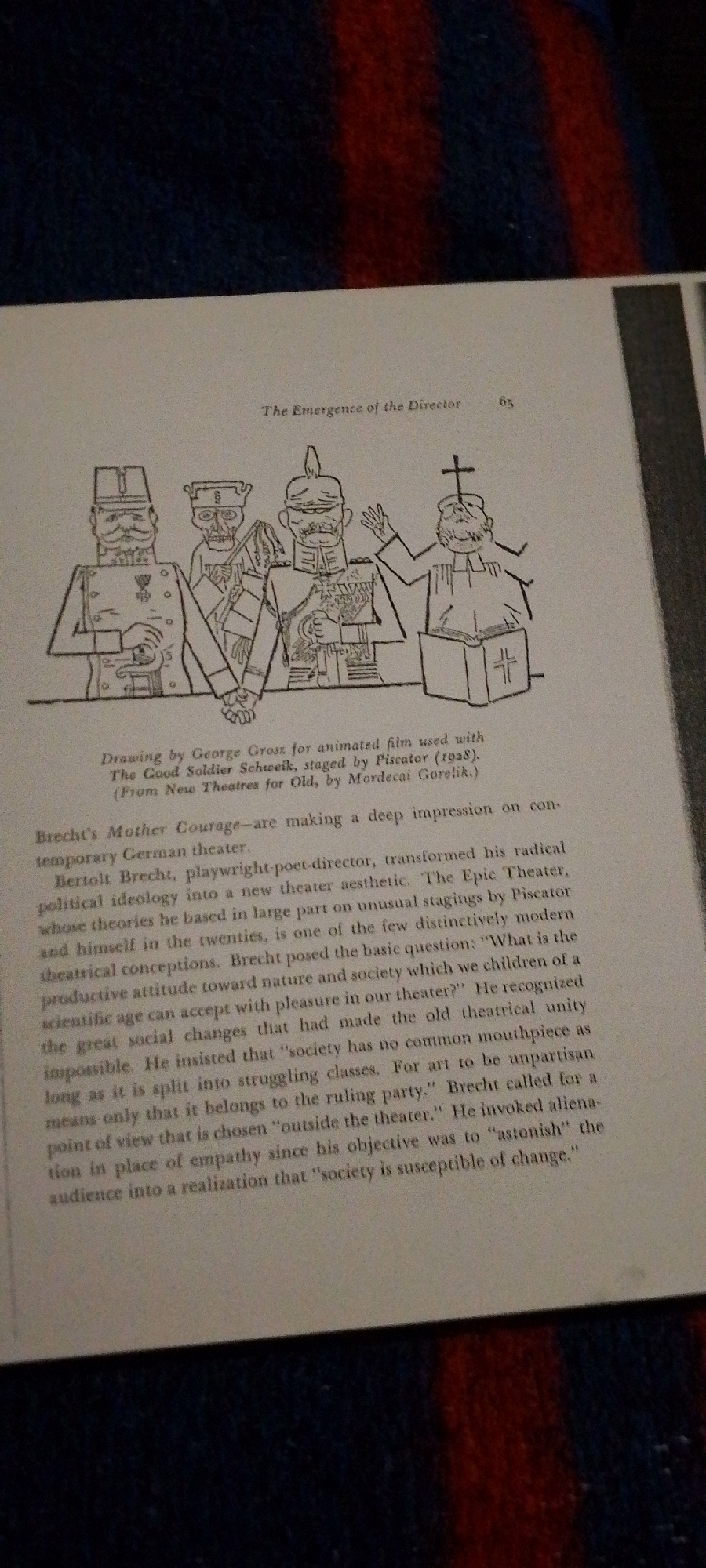
The image shows a page from a book, featuring a drawing and text. The drawing is a political cartoon by George Grosz, depicting four figures. From left to right, the figures appear to be military officers in uniform, one with a distinguished medal, and another with a spiked helmet. The third figure resembles a skeleton or a representation of death, holding hands with the military figures. The fourth figure is a clergyman with a cross on his head and holding an open book. The figures are depicted in a simplified, angular style, characteristic of Grosz's work.

The text accompanying the drawing identifies it as being for an animated film used with "The Good Soldier Schweik," staged by Piscator in 1938, and sourced from "New Theatres for Old" by Mordecai Gorelik.

Below the drawing, the text discusses Bertolt Brecht and his "Epic Theater." It describes how Brecht transformed his political ideology into a new theatrical aesthetic, drawing on Piscator's stagings. The text highlights Brecht's focus on questioning the audience's attitude towards nature and society, his recognition of the impossibility of old theatrical unity due to social changes, and his assertion that art cannot be unpartisan. It also mentions his call for a perspective "outside the theater" and his use of alienation to "astonish" the audience into realizing that "society is susceptible of change."

The page is likely from an academic or historical text discussing theater history, political art, or the works of Bertolt Brecht and George Grosz. The overall tone of the text is analytical and informative. There is no indication of time of day, weather, or specific location within the book's content. The provided location context "Jauro Yinu, Nigeria" does not appear to relate to the content of the image itself.
wwwww

Jul 1, 2026, 10:09 PM

Jauro Yinu, Nigeria

Stake attention in this memory

satirical
cynical
critical
provocative
serious

The image shows a page from a book, featuring a drawing and text. The drawing is a political cartoon by George Grosz, depicting four figures. From left to right, the figures appear to be military officers in uniform, one with a distinguished medal, and another with a spiked helmet. The third figure resembles a skeleton or a representation of death, holding hands with the military figures. The fourth figure is a clergyman with a cross on his head and holding an open book. The figures are depicted in a simplified, angular style, characteristic of Grosz's work. The text accompanying the drawing identifies it as being for an animated film used with "The Good Soldier Schweik," staged by Piscator in 1938, and sourced from "New Theatres for Old" by Mordecai Gorelik. Below the drawing, the text discusses Bertolt Brecht and his "Epic Theater." It describes how Brecht transformed his political ideology into a new theatrical aesthetic, drawing on Piscator's stagings. The text highlights Brecht's focus on questioning the audience's attitude towards nature and society, his recognition of the impossibility of old theatrical unity due to social changes, and his assertion that art cannot be unpartisan. It also mentions his call for a perspective "outside the theater" and his use of alienation to "astonish" the audience into realizing that "society is susceptible of change." The page is likely from an academic or historical text discussing theater history, political art, or the works of Bertolt Brecht and George Grosz. The overall tone of the text is analytical and informative. There is no indication of time of day, weather, or specific location within the book's content. The provided location context "Jauro Yinu, Nigeria" does not appear to relate to the content of the image itself.

Loading AttnAds…

transactions
revenues
stakers
Earliest
Latest
Highest stake

No transactions found

More from this user

More from Jauro Yinu

wwwww

Jul 1, 2026, 10:09 PM

Jauro Yinu, Nigeria

Licensed under Creative Commons Attribution 4.0 International License. You are free to share and adapt this content with proper attribution.