
Stake attention in this memory
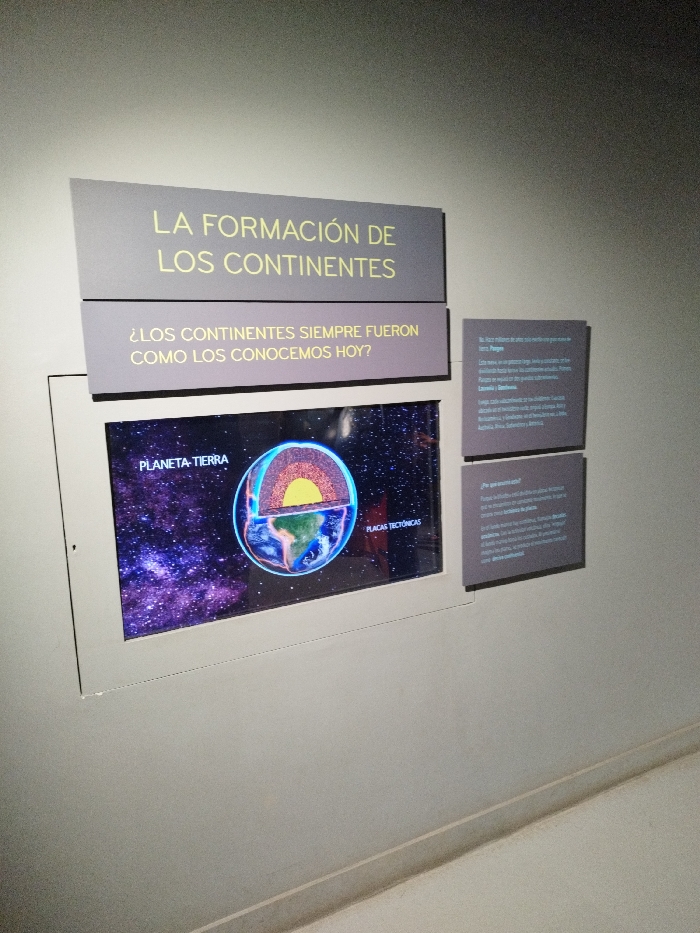
This image captures an educational exhibit, likely in a museum or science center in Santiago, Chile, focusing on Earth sciences. The scene features a wall-mounted display with several information panels and an integrated digital screen. The primary subjects are the informational elements themselves. At the top, two large rectangular panels are prominently displayed. The upper panel reads "LA FORMACIÓN DE LOS CONTINENTES" (THE FORMATION OF THE CONTINENTS). Directly below it, a second panel poses the question: "¿LOS CONTINENTES SIEMPRE FUERON COMO LOS CONOCEMOS HOY?" (WERE THE CONTINENTS ALWAYS AS WE KNOW THEM TODAY?). Below these panels, a horizontal screen shows an animation or static image related to Earth's structure and plate tectonics. On the left side of the screen, the text "PLANETA-TIERRA" (PLANET-EARTH) is visible, while on the right, "PLACAS TECTONICAS" (TECTONIC PLATES) is displayed. The screen depicts a rendered globe of Earth, with a cross-section showing its internal layers (core, mantle, crust) and the continents on the surface. To the right of the screen, two smaller, vertically stacked rectangular panels provide additional text. The top-right panel discusses the supercontinent Pangea, explaining that "250 millones de años" (250 million years ago) only one large landmass existed, which fragmented into today's continents, mentioning Laurentia, Gondwana, North America, Greenland, Eurasia, South America, Africa, Australia, and Antarctica. The bottom-right panel defines geology, stating, "¿Qué es geología?" (What is geology?), and describes it as the science that studies the Earth, its composition, structure, processes, history, and the evolution of life, from the surface to the Earth's core. The exhibit appears to be well-lit by artificial indoor lighting. No people are visible in the frame, indicating a focus on the display content. The setting suggests an informative and engaging presentation about geological processes.
No transactions found