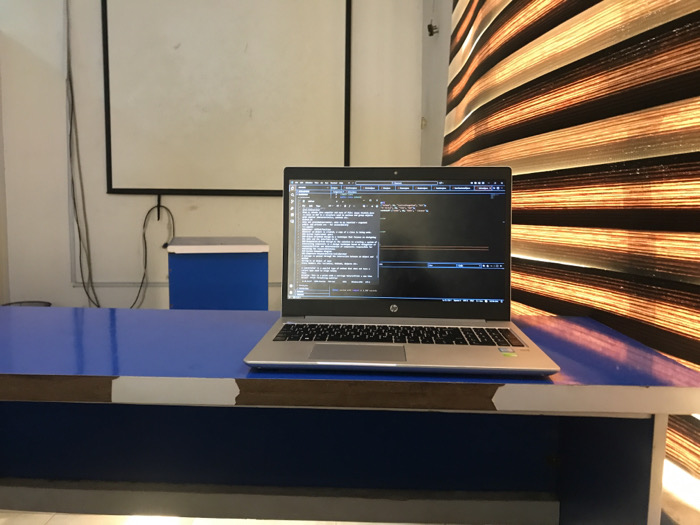
![The image displays a computer monitor positioned at an angle, primarily showing a dark-themed integrated development environment, likely Visual Studio Code. Multiple tabs for Java files are visible at the top, including `School.java`, `Man.java`, `Person.java`, `Student.java`, and `Teacher.java`. Overlaid on this interface is a smaller, white text editor window titled "OOP.txt", which contains definitions and explanations of Object-Oriented Programming (OOP) concepts in English, such as "Java-Interpreter", "Class", "Behaviour- method/function", "OOD-Object Oriented Design", "RRD-Responsive-Driven Design", "CRC-Component-Responsibility-Collaborator", "String-Is an object of Java", "Constructor", "Println- This is a print with a carriage Return/Print a new line", and "Printf- Print formatting modifier". Behind the "OOP.txt" window, segments of Java code are visible, including lines that appear to instantiate objects or call methods with parameters like `("Batman", 16, "Justiceforgotham", "SS3")`, `"Mr Victor", 40, "T201", "OOP")`, and `eachstaff ("Cedar", 60, "N301", "Cleaner")`. The bottom status bar of the main editor displays "Ln 36, Col 67", "2,066 character", "Plain text", "100%", "Windows (CRLF)", "UTF-8", and the output "[Done] exited with code=0 in 1.767 seconds". No individuals are present in the image. The immediate environment is an indoor setting; however, there are no discernible visual cues within the image to specify the location as Calabar, Nigeria, or any other particular city.](https://firebasestorage.googleapis.com/v0/b/patr-3a75e.appspot.com/o/uploads%2Fimage_picker_6e55f6cc-776f-489d-a.jpg?alt=media)

Stake attention in this memory
The image displays a computer monitor positioned at an angle, primarily showing a dark-themed integrated development environment, likely Visual Studio Code. Multiple tabs for Java files are visible at the top, including `School.java`, `Man.java`, `Person.java`, `Student.java`, and `Teacher.java`. Overlaid on this interface is a smaller, white text editor window titled "OOP.txt", which contains definitions and explanations of Object-Oriented Programming (OOP) concepts in English, such as "Java-Interpreter", "Class", "Behaviour- method/function", "OOD-Object Oriented Design", "RRD-Responsive-Driven Design", "CRC-Component-Responsibility-Collaborator", "String-Is an object of Java", "Constructor", "Println- This is a print with a carriage Return/Print a new line", and "Printf- Print formatting modifier". Behind the "OOP.txt" window, segments of Java code are visible, including lines that appear to instantiate objects or call methods with parameters like `("Batman", 16, "Justiceforgotham", "SS3")`, `"Mr Victor", 40, "T201", "OOP")`, and `eachstaff ("Cedar", 60, "N301", "Cleaner")`. The bottom status bar of the main editor displays "Ln 36, Col 67", "2,066 character", "Plain text", "100%", "Windows (CRLF)", "UTF-8", and the output "[Done] exited with code=0 in 1.767 seconds". No individuals are present in the image. The immediate environment is an indoor setting; however, there are no discernible visual cues within the image to specify the location as Calabar, Nigeria, or any other particular city.
Loading AttnAds…
No transactions found