
Stake attention in this memory
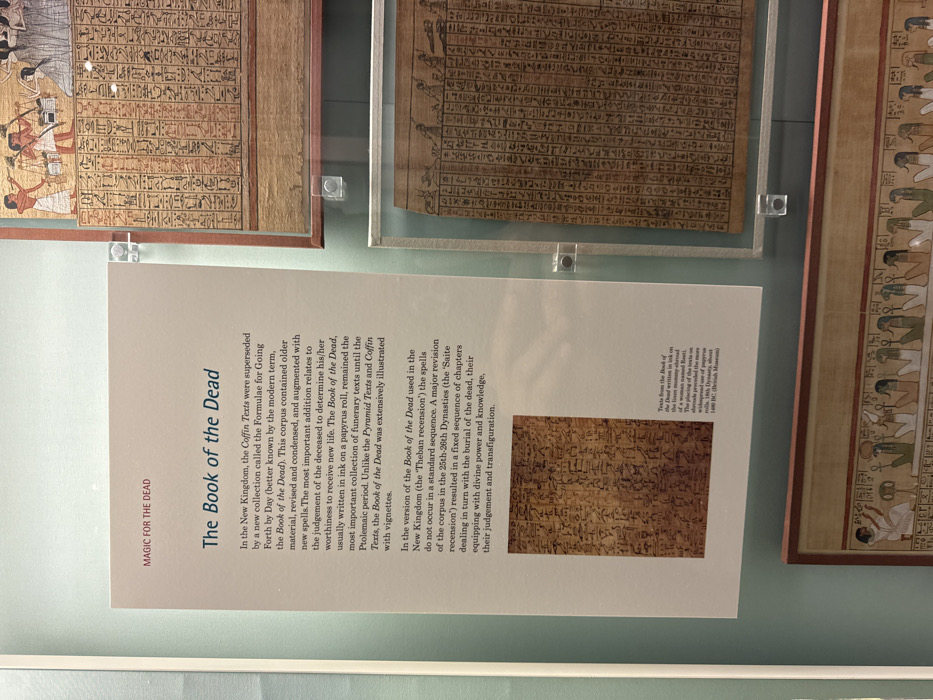
The image captures a close-up view of an ancient Egyptian exhibit within a museum, featuring multiple papyrus scrolls and an informational text panel. The overall setting appears to be indoors with controlled lighting. In the upper left, a portion of a colorful papyrus scroll is visible, framed in a dark wooden border. This scroll features intricate illustrations of figures and objects in various hues alongside columns of hieroglyphic text. To its right, centrally located in the upper half of the image, is a wider section of another papyrus scroll. This scroll is primarily covered with densely packed rows of black hieroglyphic text on a light brown background, suggesting it contains a significant amount of writing. It is encased in a clear protective barrier, possibly acrylic or glass, held by small, clear clips. On the far right, partially visible, is another colorful papyrus scroll, similar in style to the one on the left, also enclosed in a dark wooden frame. It shows more illustrations and hieroglyphic text. Dominating the lower and central part of the image is a white informational text panel, rotated ninety degrees clockwise. The text is printed in black, providing details about the artifacts on display. The heading reads "MAGIC FOR THE DEAD" and the main title is "The Book of the Dead." The text on the panel reads: "In the New Kingdom, the Coffin Texts were superseded by a new collection called the Formulae for Going Forth by Day (better known by the modern term, the Book of the Dead). This corpus contained older material, revised and condensed, and augmented with new spells. The most important addition relates to the judgement of the deceased to determine his/her worthiness to receive new life. The Book of the Dead, usually written in ink on a papyrus roll, remained the most important collection of funerary texts until the Ptolemaic period. Unlike the Pyramid Texts and Coffin Texts, the Book of the Dead was extensively illustrated with vignettes. In the version of the Book of the Dead used in the New Kingdom (the 'Theban recension') the spells do not occur in a standard sequence. A major revision of the corpus in the 25th-26th Dynasties (the 'Saite recension') resulted in a fixed sequence of chapters dealing in turn with the burial of the dead, their equipping with divine power and knowledge, their judgement and transfiguration." Below this main text, and to the right of it, is a smaller embedded image of a papyrus fragment on the panel itself. Next to this fragment, smaller text provides additional context: "Texts from the Book of the Dead written in ink on linen mummy shroud, named Resti. The placing of the mummy shrouds preceded the more extensive papyrus rolls. 18th Dynasty, British Museum 1400 BC." The artifacts are presented behind what appears to be glass or a transparent display case, indicated by the visible clips and reflections. The wall behind the text panel is a uniform light blue-green color.
Loading AttnAds…
No transactions found