Sign in
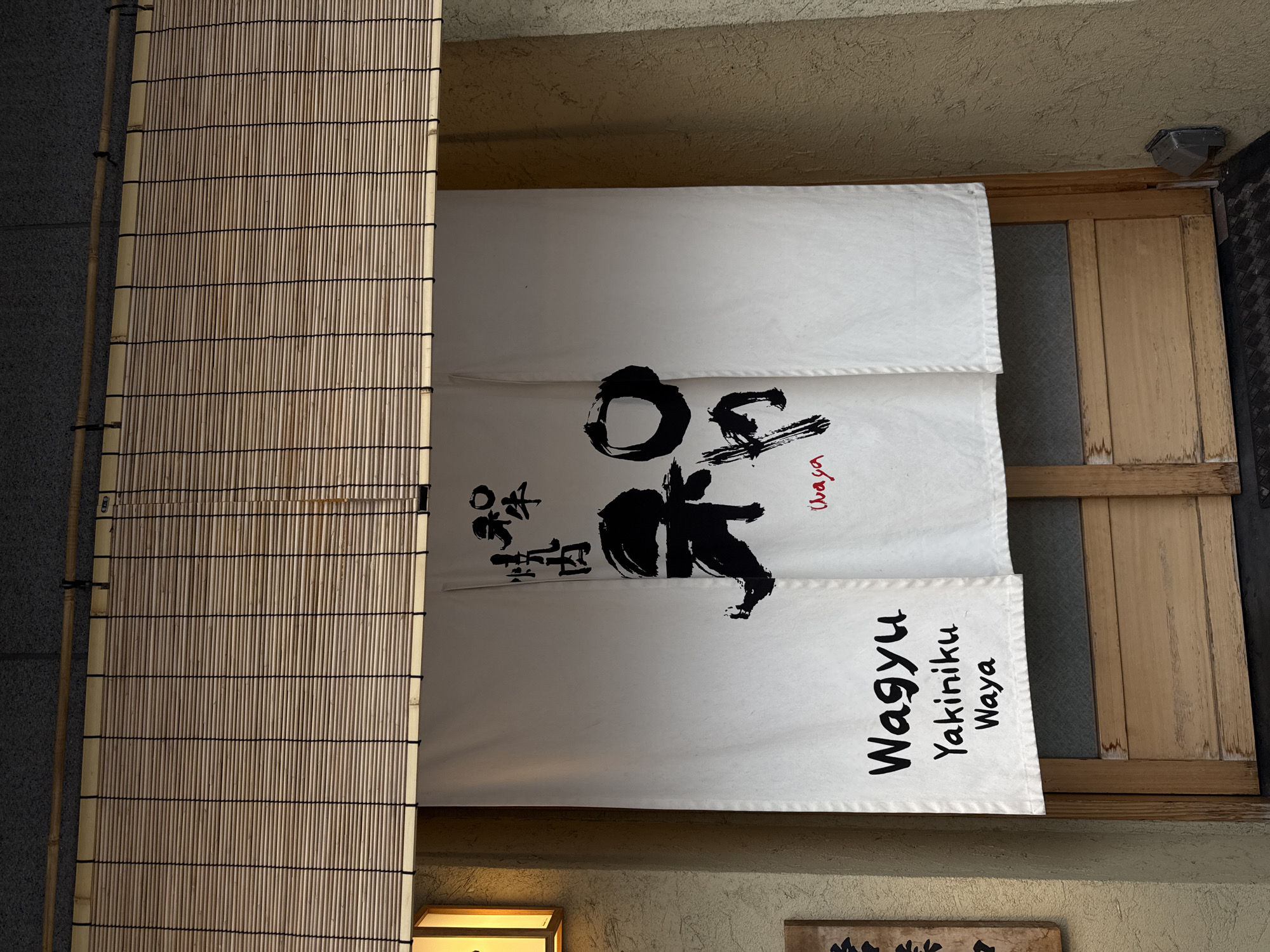
This image captures the exterior facade of a Japanese establishment, likely a restaurant, with strong cultural design elements. The focal point is a white fabric banner, known as a noren, hanging in an entryway or window. The noren features bold black calligraphy characters, most prominently "和" (Wa) and "屋" (Ya), which together form "Waya." Above the main calligraphy, there's smaller red text that appears to read "Waga." Below the Japanese script, the words "Wagyu," "Yakiniku," and "Waya" are printed vertically in black English text, clearly identifying the type of cuisine and the restaurant's name.

To the left of the noren, a traditional bamboo blind (sudare) is partially visible, made of slender bamboo strips woven together with black thread, offering privacy or shade. The wall surrounding the entrance is textured, possibly stucco, in a light beige or off-white color. On the right side, a wooden window frame or panel is visible, showing signs of age with its weathered appearance. An outdoor electrical box or light fixture is mounted in the top right corner. In the bottom left, a small, illuminated lantern or light box peeks into the frame, and a partial wooden sign with Japanese characters is visible in the bottom right.

The scene suggests a quiet moment, with no people present. The lighting is soft and even, implying either an overcast day, late afternoon, or early evening with artificial light. The traditional elements like the noren, sudare, and architecture firmly place the location in Japan, consistent with Kyoto.
mojito

Jun 3, 2026

Kyoto, Japan

Stake attention in this memory

anticipation
curiosity
culinary
inviting
authentic

This image captures the exterior facade of a Japanese establishment, likely a restaurant, with strong cultural design elements. The focal point is a white fabric banner, known as a noren, hanging in an entryway or window. The noren features bold black calligraphy characters, most prominently "和" (Wa) and "屋" (Ya), which together form "Waya." Above the main calligraphy, there's smaller red text that appears to read "Waga." Below the Japanese script, the words "Wagyu," "Yakiniku," and "Waya" are printed vertically in black English text, clearly identifying the type of cuisine and the restaurant's name. To the left of the noren, a traditional bamboo blind (sudare) is partially visible, made of slender bamboo strips woven together with black thread, offering privacy or shade. The wall surrounding the entrance is textured, possibly stucco, in a light beige or off-white color. On the right side, a wooden window frame or panel is visible, showing signs of age with its weathered appearance. An outdoor electrical box or light fixture is mounted in the top right corner. In the bottom left, a small, illuminated lantern or light box peeks into the frame, and a partial wooden sign with Japanese characters is visible in the bottom right. The scene suggests a quiet moment, with no people present. The lighting is soft and even, implying either an overcast day, late afternoon, or early evening with artificial light. The traditional elements like the noren, sudare, and architecture firmly place the location in Japan, consistent with Kyoto.

transactions
revenues
stakers
Earliest
Latest
Highest stake

No transactions found

More from this user

More from Kyoto

mojito

Jun 3, 2026

Kyoto, Japan

Licensed under Creative Commons Attribution 4.0 International License. You are free to share and adapt this content with proper attribution.