
Sign in
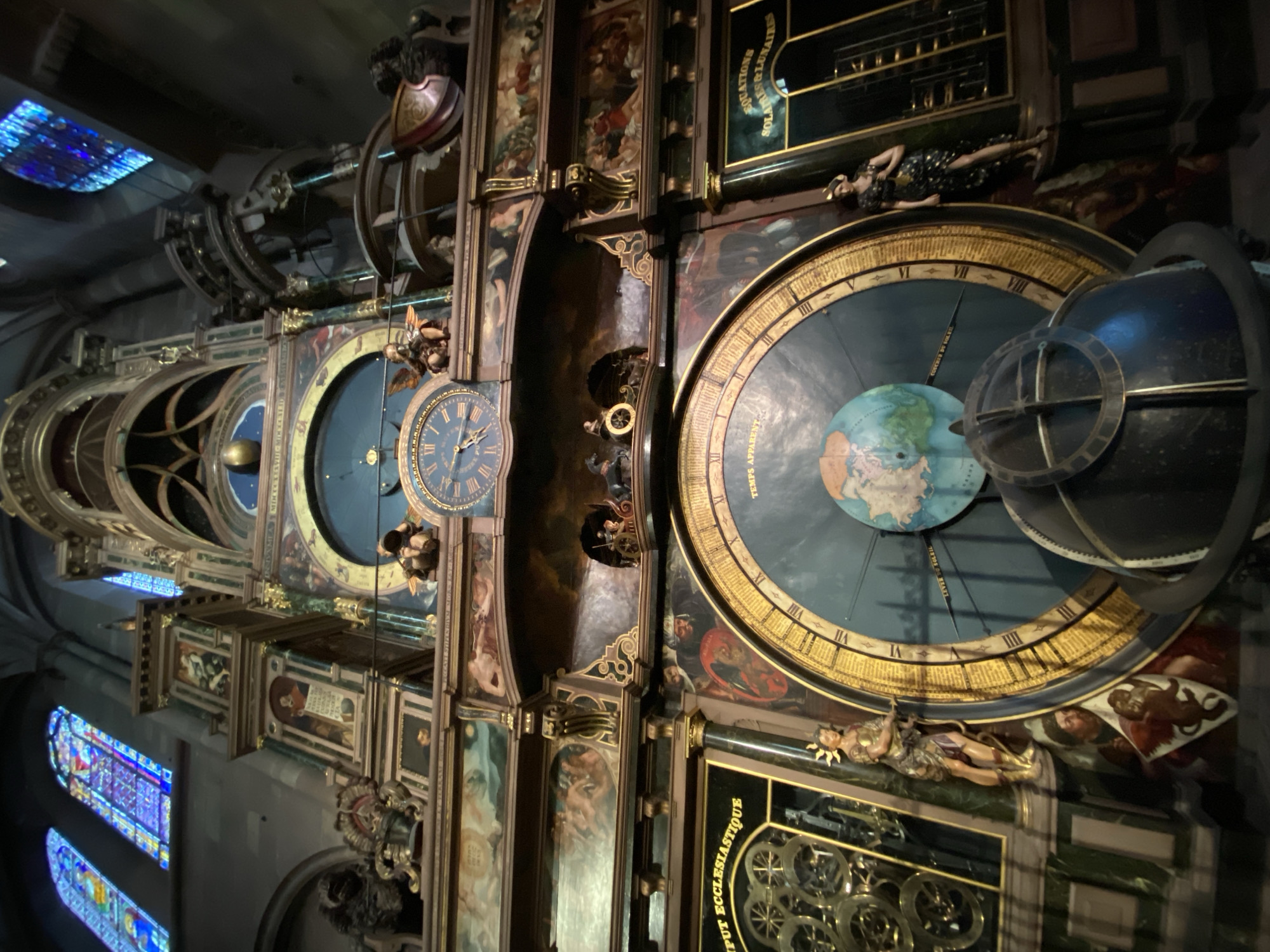
This image captures a detail of a large, ornate astronomical clock, likely located within a grand cathedral or historical building. The clock is intricately designed with multiple dials, figures, and decorative panels, all appearing to be made of wood, brass, and painted elements, with gilded accents. The overall aesthetic is rich and complex, indicative of historical craftsmanship.

The main subject is the clock itself, which features several faces. On the right, a prominent circular dial displays Roman numerals from III to XII (clockwise). This dial incorporates a terrestrial globe depicting landmasses, and another, larger celestial globe or armillary sphere. Text visible on this dial includes "TEMPS APPARENT" (Apparent Time) and partially visible "LEVER DE SOLEIL" (Sunrise). Below this main dial, a panel with golden lettering on a dark background reads "COMPUT ECCLESIASTIQUE" (Ecclesiastical Computus), referring to calculations for the church calendar. Above it, another dark panel with gold lettering includes "SOLUTIONS LUNAIRES" (Lunar Solutions/Calculations).

To the left, another smaller clock face with Roman numerals is visible. The clock structure is adorned with various figurines, including a reclining female figure with a star-patterned dress near the upper right dial, and a golden figure with sunrays around its head near the lower right. Painted panels with allegorical scenes or historical figures decorate the vertical sections between the dials. Some intricate brass gears and mechanical components are visible in the lower right, part of the clock's complex inner workings.

In the background and to the left, several vibrant stained-glass windows cast colorful light, indicating the interior setting is a grand edifice. The lighting within the space appears dim, enhancing the historical and artistic quality of the clock. No specific human activity is depicted other than the implicit function of the clock to measure and display time and astronomical phenomena. The image is rotated 90 degrees clockwise. This object is consistent with the famous astronomical clock found in Strasbourg Cathedral.
I B R O 10🥷🏿

Apr 27, 2026, 3:18 PM

Strasbourg, France

Stake attention in this memory

awe
wonder
grandeur
nostalgia
intrigue

This image captures a detail of a large, ornate astronomical clock, likely located within a grand cathedral or historical building. The clock is intricately designed with multiple dials, figures, and decorative panels, all appearing to be made of wood, brass, and painted elements, with gilded accents. The overall aesthetic is rich and complex, indicative of historical craftsmanship. The main subject is the clock itself, which features several faces. On the right, a prominent circular dial displays Roman numerals from III to XII (clockwise). This dial incorporates a terrestrial globe depicting landmasses, and another, larger celestial globe or armillary sphere. Text visible on this dial includes "TEMPS APPARENT" (Apparent Time) and partially visible "LEVER DE SOLEIL" (Sunrise). Below this main dial, a panel with golden lettering on a dark background reads "COMPUT ECCLESIASTIQUE" (Ecclesiastical Computus), referring to calculations for the church calendar. Above it, another dark panel with gold lettering includes "SOLUTIONS LUNAIRES" (Lunar Solutions/Calculations). To the left, another smaller clock face with Roman numerals is visible. The clock structure is adorned with various figurines, including a reclining female figure with a star-patterned dress near the upper right dial, and a golden figure with sunrays around its head near the lower right. Painted panels with allegorical scenes or historical figures decorate the vertical sections between the dials. Some intricate brass gears and mechanical components are visible in the lower right, part of the clock's complex inner workings. In the background and to the left, several vibrant stained-glass windows cast colorful light, indicating the interior setting is a grand edifice. The lighting within the space appears dim, enhancing the historical and artistic quality of the clock. No specific human activity is depicted other than the implicit function of the clock to measure and display time and astronomical phenomena. The image is rotated 90 degrees clockwise. This object is consistent with the famous astronomical clock found in Strasbourg Cathedral.

Loading AttnAds…

transactions
revenues
stakers
Earliest
Latest
Highest stake

No transactions found

More from this user

More from Strasbourg

I B R O 10🥷🏿

Apr 27, 2026, 3:18 PM

Strasbourg, France

Licensed under Creative Commons Attribution 4.0 International License. You are free to share and adapt this content with proper attribution.