Sign in
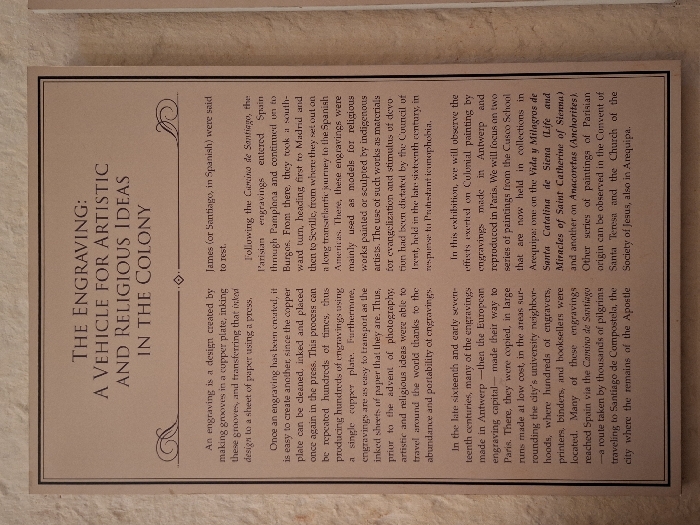
The image displays an informational panel, likely from a museum or exhibition, titled "THE ENGRAVING: A VEHICLE FOR ARTISTIC AND RELIGIOUS IDEAS IN THE COLONY." The panel features a decorative border and text organized into columns.

The text describes the process of engraving—creating designs on copper plates, inking them, and transferring them to paper using a press. It highlights the portability and reproducibility of engravings, which allowed artistic and religious ideas to spread globally before photography. The panel details the historical journey of these engravings, particularly from Antwerp (the European engraving capital) to Paris in the late sixteenth and early seventeenth centuries, then via the Camino de Santiago to Spain (Pamplona, Burgos, Madrid, Seville). From Seville, they were transported across the Atlantic to the Spanish Americas.

In the Americas, these engravings served as models for religious paintings and sculptures by indigenous artists, supporting evangelization and devotion as mandated by the Council of Trent to counter Protestant iconophobia. The panel concludes by stating that the exhibition (where this panel would be displayed) focuses on the influence of these European engravings on Colonial painting, specifically mentioning two series from the Cusco School held in Arequipa, Peru: "Vida y Milagros de Santa Catalina de Siena" and "Anacoretas." It also notes that other Parisian-origin paintings are visible in the Convent of Santa Teresa and the Church of the Society of Jesus, both in Arequipa.
L E E L O O 🇵🇪

Jan 10, 2025, 10:50 PM

Arequipa, Peru

Stake attention in this memory

The image displays an informational panel, likely from a museum or exhibition, titled "THE ENGRAVING: A VEHICLE FOR ARTISTIC AND RELIGIOUS IDEAS IN THE COLONY." The panel features a decorative border and text organized into columns. The text describes the process of engraving—creating designs on copper plates, inking them, and transferring them to paper using a press. It highlights the portability and reproducibility of engravings, which allowed artistic and religious ideas to spread globally before photography. The panel details the historical journey of these engravings, particularly from Antwerp (the European engraving capital) to Paris in the late sixteenth and early seventeenth centuries, then via the Camino de Santiago to Spain (Pamplona, Burgos, Madrid, Seville). From Seville, they were transported across the Atlantic to the Spanish Americas. In the Americas, these engravings served as models for religious paintings and sculptures by indigenous artists, supporting evangelization and devotion as mandated by the Council of Trent to counter Protestant iconophobia. The panel concludes by stating that the exhibition (where this panel would be displayed) focuses on the influence of these European engravings on Colonial painting, specifically mentioning two series from the Cusco School held in Arequipa, Peru: "Vida y Milagros de Santa Catalina de Siena" and "Anacoretas." It also notes that other Parisian-origin paintings are visible in the Convent of Santa Teresa and the Church of the Society of Jesus, both in Arequipa.

transactions
revenues
stakers
Earliest
Latest
Highest stake

No transactions found

More from this user

More from Arequipa

L E E L O O 🇵🇪

Jan 10, 2025, 10:50 PM

Arequipa, Peru

Licensed under Creative Commons Attribution 4.0 International License. You are free to share and adapt this content with proper attribution.