
Sign in
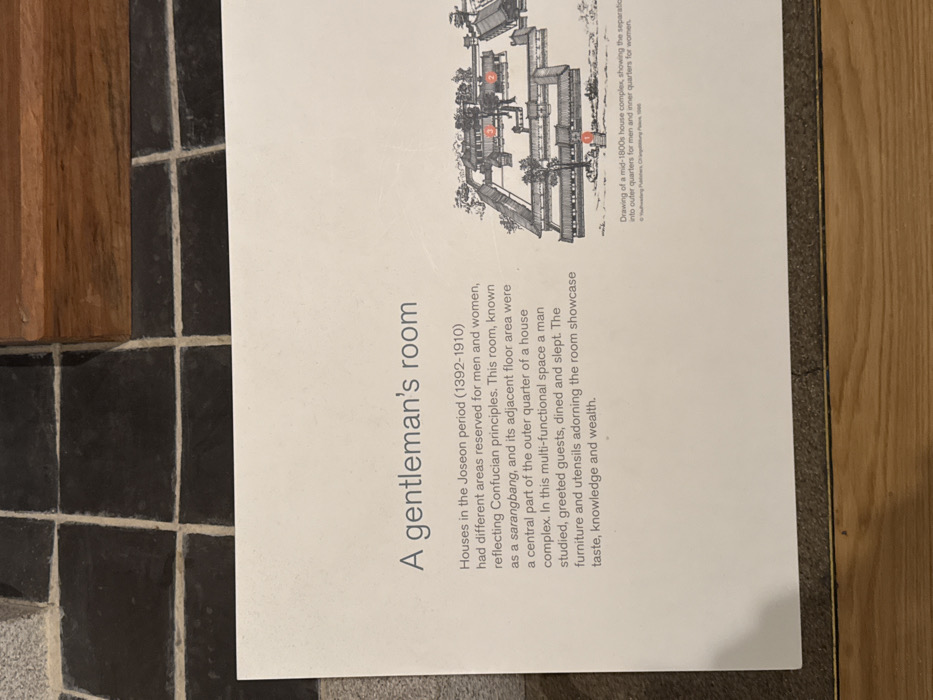
An informational sign, tilted 90 degrees clockwise, is placed on what appears to be a tiled and wooden floor or low wall, likely in a museum or exhibition in London. The sign, printed on white material, features the title "A gentleman's room" in dark, large font. Below the title, the main body of text explains that houses in the Joseon period (1392-1910) had separate areas for men and women, reflecting Confucian principles. It describes "sarangbang" as a multi-functional space within the outer quarter of a house complex where a man studied, hosted guests, dined, and slept, with its furnishings indicating taste, knowledge, and wealth.

To the right of the text, an intricate black-and-white illustration depicts a mid-1800s Korean house complex, highlighting the separation into outer quarters for men and inner quarters for women. A caption beneath the drawing reiterates this, crediting "Hastings House, Chambers's Press, 1888" as the source for the drawing. The immediate background of the sign consists of dark square tiles with lighter grout lines, and a section of light brown wooden paneling.
punit03

Dec 13, 2024, 3:40 PM

London, UK

Stake attention in this memory

An informational sign, tilted 90 degrees clockwise, is placed on what appears to be a tiled and wooden floor or low wall, likely in a museum or exhibition in London. The sign, printed on white material, features the title "A gentleman's room" in dark, large font. Below the title, the main body of text explains that houses in the Joseon period (1392-1910) had separate areas for men and women, reflecting Confucian principles. It describes "sarangbang" as a multi-functional space within the outer quarter of a house complex where a man studied, hosted guests, dined, and slept, with its furnishings indicating taste, knowledge, and wealth. To the right of the text, an intricate black-and-white illustration depicts a mid-1800s Korean house complex, highlighting the separation into outer quarters for men and inner quarters for women. A caption beneath the drawing reiterates this, crediting "Hastings House, Chambers's Press, 1888" as the source for the drawing. The immediate background of the sign consists of dark square tiles with lighter grout lines, and a section of light brown wooden paneling.

Loading AttnAds…

transactions
revenues
stakers
Earliest
Latest
Highest stake

No transactions found

More from this user

More from London

punit03

Dec 13, 2024, 3:40 PM

London, UK

Licensed under Creative Commons Attribution 4.0 International License. You are free to share and adapt this content with proper attribution.