
Stake attention in this memory
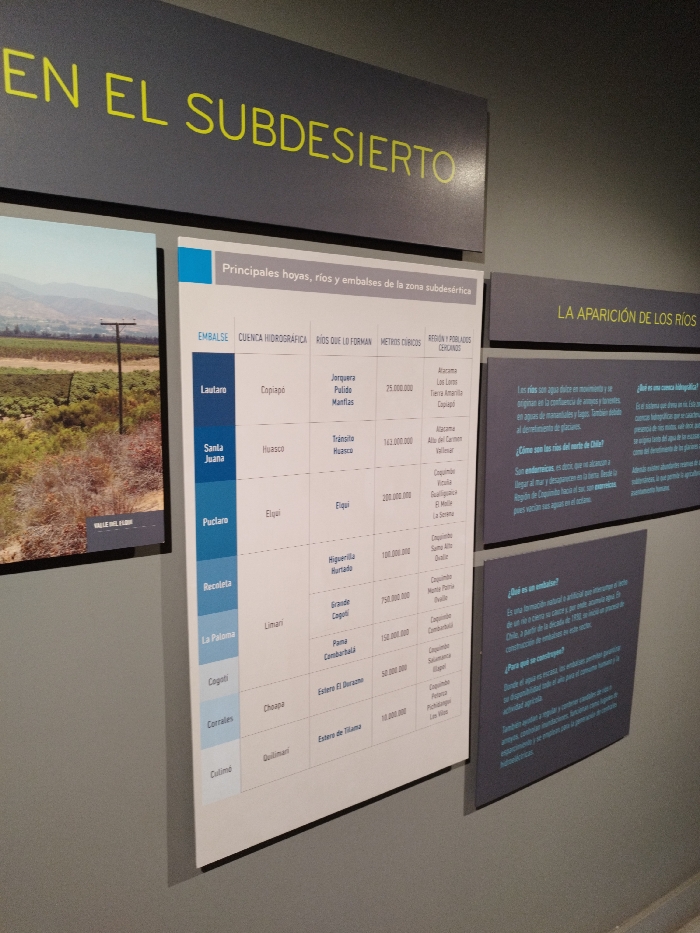
This image captures an indoor museum or educational exhibit featuring several display panels mounted on a dark grey wall. The central focus is a large white panel with blue accents, presenting a detailed table. To its left, a smaller rectangular panel displays a scenic photograph of a rural landscape, possibly a valley with cultivated fields, under a bright sky. A utility pole is visible in the foreground, and distant hills rise in the background. To the right of the main table, two smaller grey panels contain blocks of text. The exhibit's theme revolves around the hydrography of a "subdesierto" (sub-desert) region, likely in northern Chile. The top banner prominently displays "EN EL SUBDESIERTO" (IN THE SUB-DESERT). The main table is titled "Principales hoyas, ríos y embalses de la zona subdesértica" (Main basins, rivers, and reservoirs of the sub-desert zone). It lists various "EMBALSE" (Reservoir) entries such as Lautaro, Santa Juana, Púclaro, Recoleta, La Paloma, Cogotí, Corrales, and Culimáv. For each, it provides the "CUENCA HIDROGRÁFICA" (Hydrographic Basin) (e.g., Copiapó, Huasco, Elqui, Limarí, Choapa, Quilmarí), the "RÍOS QUE LO FORMAN" (Rivers that form it) (e.g., Jorquera, Pulido, Manflas; Tránsito, Huasco; Elqui; Higuerilla, Hurtado; Grande, Cogotí; Pama, Combarbalá; Estero El Durazno; Estero de Tilama), their "METROS CÚBICOS" (Cubic Meters) capacity, and "REGIÓN Y POBLADOS CERCANOS" (Region and Nearby Towns) like Atacama and Coquimbo. The landscape photograph on the left panel is labeled "VALLE DEL ELQUI." The panels on the right, under the heading "LA APARICIÓN DE LOS RÍOS" (The Appearance of Rivers), provide explanatory text. One section describes rivers as moving fresh water originating from streams, springs, lakes, and melting glaciers. It also explains that northern Chilean rivers are "endorreicos" (endorheic), meaning they do not reach the sea, while those south of Copiapó are "exorreicos" (exorheic), emptying into the ocean. Another section defines a reservoir ("embalse") as a natural or artificial formation interrupting a river's course, noting that Chile began constructing them in the 1930s. It further explains that reservoirs are built to ensure year-round water availability for human and agricultural consumption, regulate flows to prevent floods, and generate hydroelectric energy. No people are visible in the scene.
No transactions found