
Sign in
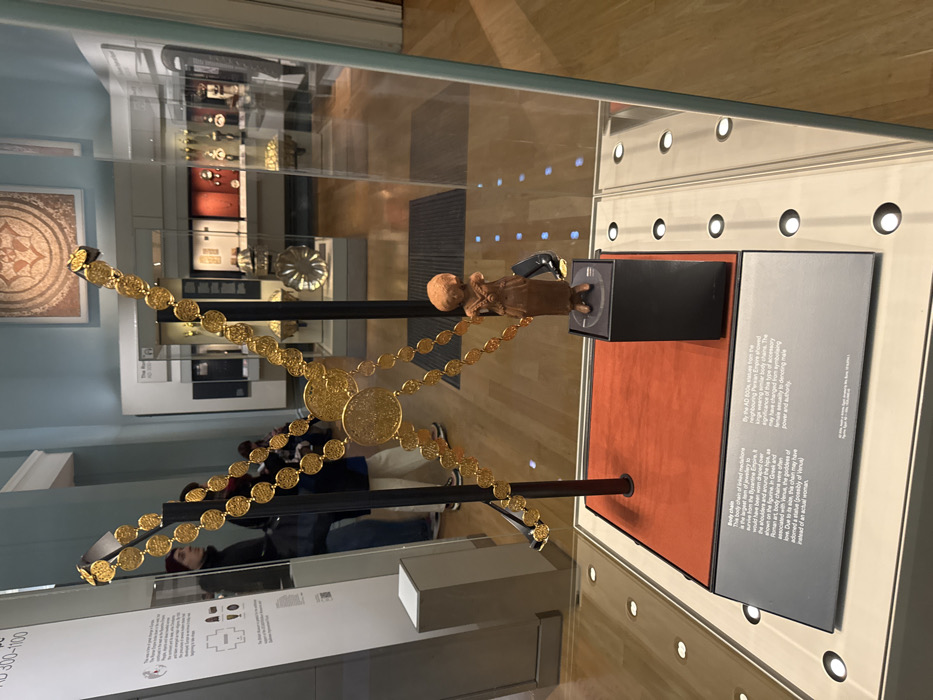
This media file captures an indoor museum display in London, United Kingdom, viewed through a glass case. The main subject is a long, ornate golden body chain, prominently draped over a small, reddish-brown humanoid figurine, which stands on a black pedestal. The chain consists of numerous circular medallions, some larger and intricately detailed, connected by smaller oval links.

An informational text panel beside the display provides details about the artifact. It mentions that by the AD 800s, chains from the Persian Empire influenced the Byzantine Empire, and that this type of accessory may have symbolized power and authority. The text further explains that body chains would have been worn draped over the shoulders and around the hips, as shown on the figurine. In Greek and Roman art, such chains were associated with Venus, the goddess of love, suggesting this particular chain might have adorned a statue, possibly of Venus, rather than an actual person. A visible date range "300-1100" likely indicates the period of the artifacts.

Reflected in the glass of the display case are several blurry figures of museum visitors, indicating people observing the exhibits. One person is partially visible in the lower-left reflection, appearing to look at the display. The reflections of the museum's interior, including other exhibits and lighting fixtures, are also visible. The setting clearly depicts a public exhibition space, likely within a museum or gallery, showcasing historical artifacts.
punit03

Dec 13, 2024, 4:38 PM

London, UK

Stake attention in this memory

This media file captures an indoor museum display in London, United Kingdom, viewed through a glass case. The main subject is a long, ornate golden body chain, prominently draped over a small, reddish-brown humanoid figurine, which stands on a black pedestal. The chain consists of numerous circular medallions, some larger and intricately detailed, connected by smaller oval links. An informational text panel beside the display provides details about the artifact. It mentions that by the AD 800s, chains from the Persian Empire influenced the Byzantine Empire, and that this type of accessory may have symbolized power and authority. The text further explains that body chains would have been worn draped over the shoulders and around the hips, as shown on the figurine. In Greek and Roman art, such chains were associated with Venus, the goddess of love, suggesting this particular chain might have adorned a statue, possibly of Venus, rather than an actual person. A visible date range "300-1100" likely indicates the period of the artifacts. Reflected in the glass of the display case are several blurry figures of museum visitors, indicating people observing the exhibits. One person is partially visible in the lower-left reflection, appearing to look at the display. The reflections of the museum's interior, including other exhibits and lighting fixtures, are also visible. The setting clearly depicts a public exhibition space, likely within a museum or gallery, showcasing historical artifacts.

Loading AttnAds…

transactions
revenues
stakers
Earliest
Latest
Highest stake

No transactions found

More from this user

More from London

punit03

Dec 13, 2024, 4:38 PM

London, UK

Licensed under Creative Commons Attribution 4.0 International License. You are free to share and adapt this content with proper attribution.