Stake attention in this memory
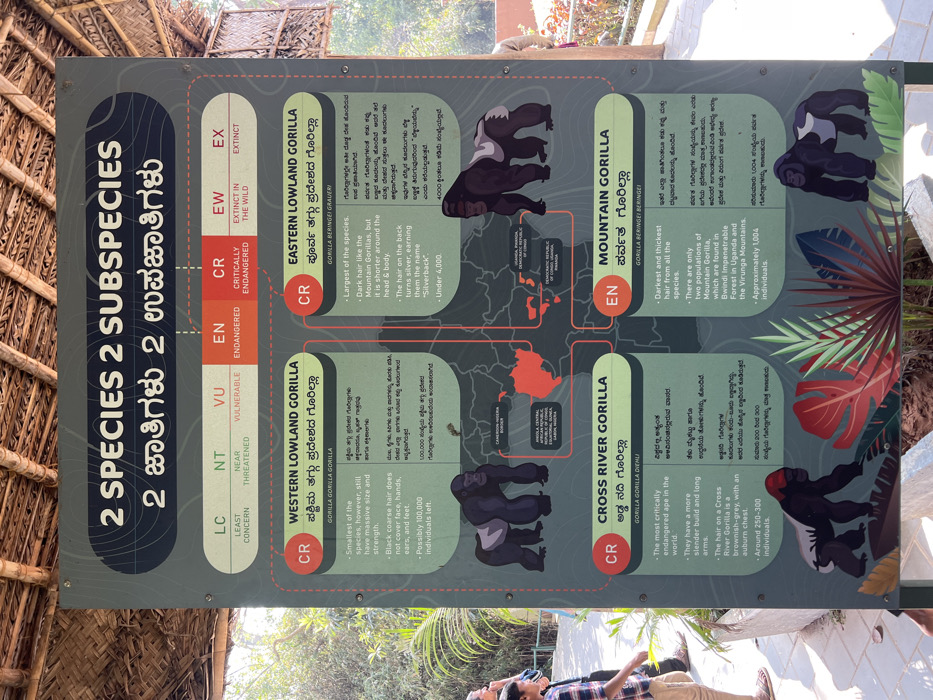
A large, vertically oriented informational display board about gorillas is prominently featured in this image, set against a backdrop of natural, woven thatch material. The board is titled "2 SPECIES 2 SUBSPECIES" in both English and Kannada, indicating its location in Karnataka, India (context provided for Mysuru). The display categorizes different gorilla subspecies based on their conservation status, using a color-coded legend including LC (Least Concern), NT (Near Threatened), VU (Vulnerable), EN (Endangered), CR (Critically Endangered), EW (Extinct in the Wild), and EX (Extinct). Four specific gorilla subspecies are detailed: 1. **Western Lowland Gorilla** (Critically Endangered - CR): Described as the smallest yet massive, with black coarse hair and an estimated population of "Possibly 100,000 individuals left." 2. **Eastern Lowland Gorilla** (Critically Endangered - CR): Noted as the "Largest of the species," with dark hair that turns silver on the back ("Silverback"), having "Under 4,000" individuals remaining. 3. **Cross River Gorilla** (Critically Endangered - CR): Highlighted as the "most critically endangered ape in the world," with a slender build, brownish-grey hair, an auburn chest, and "Around 250-300 individuals." 4. **Mountain Gorilla** (Endangered - EN): Characterized by the "Darkest and thickest hair" among all species, found in two populations in Uganda and the Virunga Mountains, with "Approximately 1,004 individuals." Each subspecies entry includes an illustration of the gorilla and a small map indicating its habitat. The board also features decorative green and red foliage artwork. At the bottom of the frame, parts of two individuals, likely visitors, are visible, suggesting an educational exhibit in a public setting such as a zoo or nature park. The bright daylight and natural surroundings with greenery further reinforce an outdoor or semi-outdoor environment.
No transactions found