
Stake attention in this memory
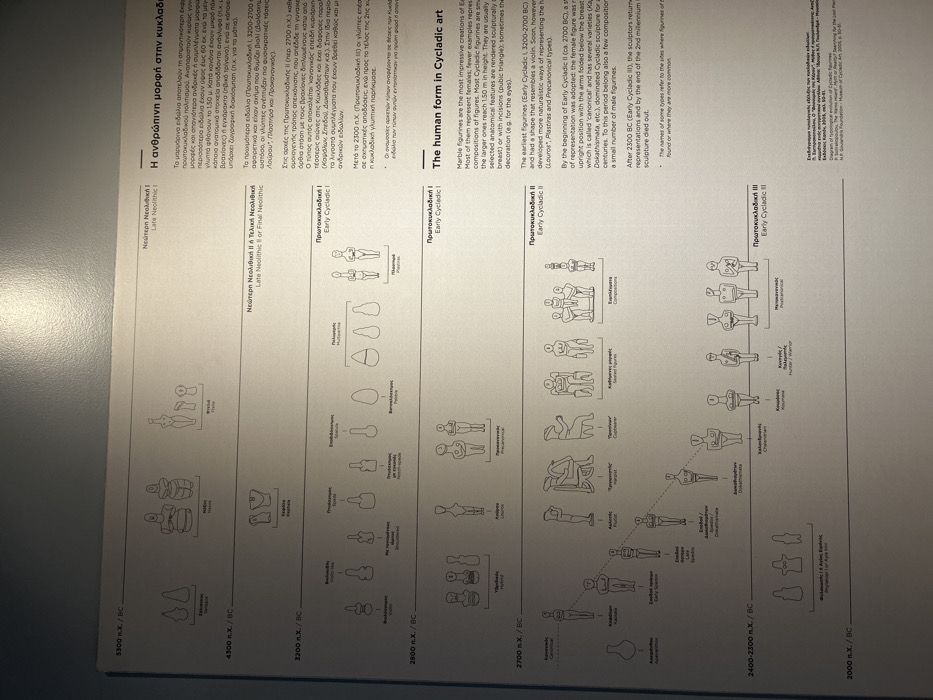
This image displays a comprehensive diagram detailing "The human form in Cycladic art" in both Greek and English, likely from a museum exhibit in Athina, Greece. The diagram illustrates the typological evolution of marble figurines from the Late Neolithic (5300 BC) to the Early Cycladic III period (2000 BC). The scene presents a chronological progression of various stylized human figures and abstract forms. The top section introduces the subject with a descriptive text in both languages, explaining that marble figurines, primarily female, are key to understanding Early Cycladic culture. It notes their size range, anatomical rendering techniques (sculptural or incised), and occasional painted decoration. The diagram itself is organized into horizontal bands representing different time periods: - **Neolithic (5300-3200 BC):** Features abstract, "violin-shaped" figures ("Βιολόσχημα / Violin-shaped") and early forms like "Πλαστηρας / Plastiras". - **Early Cycladic I (3200-2800 BC):** Shows the transition to more defined shapes, including "Προπίνων / Cupbearer" and early "Plastiras" types. - **Early Cycladic II (2800-2400 BC):** This is the most detailed section, showcasing the "canonical" type with folded arms (e.g., "Σπεδού / Spedos", "Δωκαθίσματα / Dokathismata"), as well as "Compositions" ("Συμπλέγματα"), "Seated Figures" ("Καθήμενες μορφής"), and specific male figures like the "Harpist" and "Cupbearer". - **Early Cycladic III (2400-2000 BC):** Displays later forms including "Hunter/Warrior" ("Μετοκανονικός") and figures from specific sites like "Phylakopi" and "Agia Eirini". The text elaborates on the characteristics of each period, from the early abstract forms resembling violins, to the naturalistic tendencies, and eventually the adoption of the 'canonical' type. It also mentions the decline of Cycladic sculpture by the end of the 2nd millennium BC. A note explains that many figure types are named after their discovery sites. The image is a photograph of a printed panel, with artificial light causing a slight glare on the upper left side. The overall presentation is didactic, designed to educate viewers on the artistic development of ancient Cycladic civilizations. The bottom right corner identifies the source as the "Foundation Museum of Cycladic Art."
No transactions found