
Sign in
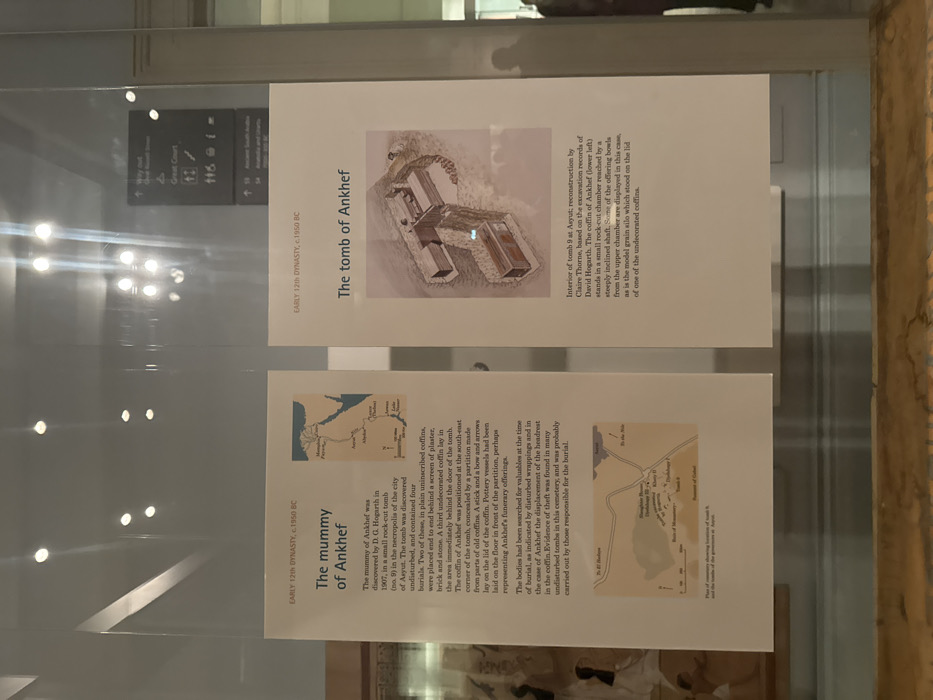
Two museum display panels, positioned vertically and slightly askew, are visible behind a reflective glass surface in what appears to be a museum or exhibition hall in London, United Kingdom. Both panels are titled "EARLY 12th DYNASTY, c.1950 BC" and pertain to an ancient Egyptian figure named Ankhef.

The left panel, titled "The mummy of Ankhef," includes a map of Egypt highlighting the Nile River and a detailed map of the necropolis of Asyut, indicating the location of tomb 9. The text describes the mummy's discovery by D. G. Hogarth in 1907 in an undisturbed rock-cut tomb containing four burials. It details the placement of coffins, including Ankhef's, and mentions grave goods such as a stick, bow, arrows, and pottery vessels. The text also notes evidence of valuables being searched for and possible theft at the time of burial, indicated by disturbed wrappings and the displacement of the headrest.

The right panel, titled "The tomb of Ankhef," features an illustrative reconstruction of the interior of tomb 9 at Asyut by Claire Thorne, based on David Hogarth's records. The illustration shows the tomb's layout with Ankhef's coffin in a rock-cut chamber accessed by a steep shaft. The accompanying text explains that offering bowls from the upper chamber and a model grain silo from one of the undecorated coffins are displayed nearby.

Numerous bright reflections of overhead lights are prominent on the glass surface covering the displays, partially obscuring some text and illustrations. Reflections of museum directional signs are also visible, indicating "Way out," "Great Court," and directions to "Ancient Middle East" and "Ancient South Asia and Oceania."
punit03

Dec 13, 2024, 3:32 PM

London, UK

Stake attention in this memory

Two museum display panels, positioned vertically and slightly askew, are visible behind a reflective glass surface in what appears to be a museum or exhibition hall in London, United Kingdom. Both panels are titled "EARLY 12th DYNASTY, c.1950 BC" and pertain to an ancient Egyptian figure named Ankhef. The left panel, titled "The mummy of Ankhef," includes a map of Egypt highlighting the Nile River and a detailed map of the necropolis of Asyut, indicating the location of tomb 9. The text describes the mummy's discovery by D. G. Hogarth in 1907 in an undisturbed rock-cut tomb containing four burials. It details the placement of coffins, including Ankhef's, and mentions grave goods such as a stick, bow, arrows, and pottery vessels. The text also notes evidence of valuables being searched for and possible theft at the time of burial, indicated by disturbed wrappings and the displacement of the headrest. The right panel, titled "The tomb of Ankhef," features an illustrative reconstruction of the interior of tomb 9 at Asyut by Claire Thorne, based on David Hogarth's records. The illustration shows the tomb's layout with Ankhef's coffin in a rock-cut chamber accessed by a steep shaft. The accompanying text explains that offering bowls from the upper chamber and a model grain silo from one of the undecorated coffins are displayed nearby. Numerous bright reflections of overhead lights are prominent on the glass surface covering the displays, partially obscuring some text and illustrations. Reflections of museum directional signs are also visible, indicating "Way out," "Great Court," and directions to "Ancient Middle East" and "Ancient South Asia and Oceania."

Loading AttnAds…

transactions
revenues
stakers
Earliest
Latest
Highest stake

No transactions found

More from this user

More from London

punit03

Dec 13, 2024, 3:32 PM

London, UK

Licensed under Creative Commons Attribution 4.0 International License. You are free to share and adapt this content with proper attribution.