
Sign in
Two framed informational panels featuring images and text about South American birds are displayed on a bright yellow wall, likely in a museum or exhibition setting in Santiago, Chile.

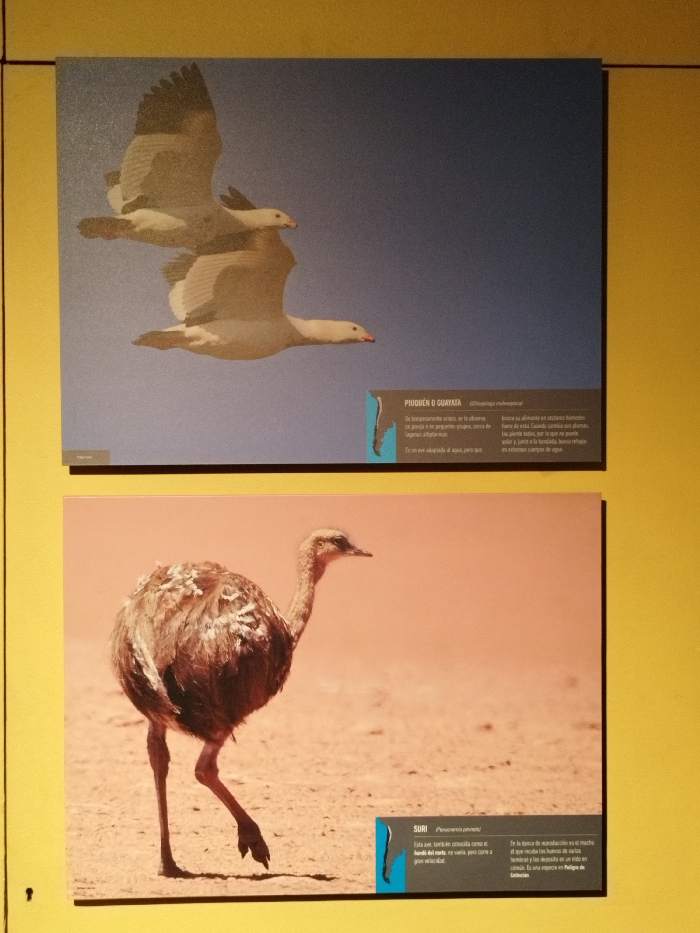
The top panel showcases an image of two white geese, identified as "PIUQUÉN O GUAYATA" (*Chloephaga melanoptera*), soaring against a clear blue sky. One goose is slightly above and behind the other, both with wings outstretched in flight. The accompanying text, partially obscured and in Spanish, describes the Andean Goose as a shy bird that nests in high-altitude lagoons. It is adapted to water, feeds in humid grasslands, and during molting, loses all its flight feathers, becoming flightless and seeking refuge in large bodies of water with its flock. A small blue outline of Chile is visible next to the text.

The bottom panel features a photograph of a "SURI" (*Pterocnemia pennata*), or Lesser Rhea, walking on sandy, reddish-brown ground, indicative of an arid environment. The bird, with its brownish-grey plumage and long neck, is shown in profile, facing right. The Spanish text explains that this bird, also known as the northern Rhea, is flightless but can run at high speed. It details that during the breeding season, the male incubates eggs from multiple females in a ground nest. The text concludes by stating that it is an Endangered species ("En Peligro de Extinción"). This panel also includes a small blue outline of Chile next to the text.
Mrv

Jan 7, 2025

Santiago, Chile

Stake attention in this memory

Two framed informational panels featuring images and text about South American birds are displayed on a bright yellow wall, likely in a museum or exhibition setting in Santiago, Chile. The top panel showcases an image of two white geese, identified as "PIUQUÉN O GUAYATA" (*Chloephaga melanoptera*), soaring against a clear blue sky. One goose is slightly above and behind the other, both with wings outstretched in flight. The accompanying text, partially obscured and in Spanish, describes the Andean Goose as a shy bird that nests in high-altitude lagoons. It is adapted to water, feeds in humid grasslands, and during molting, loses all its flight feathers, becoming flightless and seeking refuge in large bodies of water with its flock. A small blue outline of Chile is visible next to the text. The bottom panel features a photograph of a "SURI" (*Pterocnemia pennata*), or Lesser Rhea, walking on sandy, reddish-brown ground, indicative of an arid environment. The bird, with its brownish-grey plumage and long neck, is shown in profile, facing right. The Spanish text explains that this bird, also known as the northern Rhea, is flightless but can run at high speed. It details that during the breeding season, the male incubates eggs from multiple females in a ground nest. The text concludes by stating that it is an Endangered species ("En Peligro de Extinción"). This panel also includes a small blue outline of Chile next to the text.

transactions
revenues
stakers
Earliest
Latest
Highest stake

No transactions found

More from this user

More from Santiago

Mrv

Jan 7, 2025

Santiago, Chile

Licensed under Creative Commons Attribution 4.0 International License. You are free to share and adapt this content with proper attribution.