Sign in
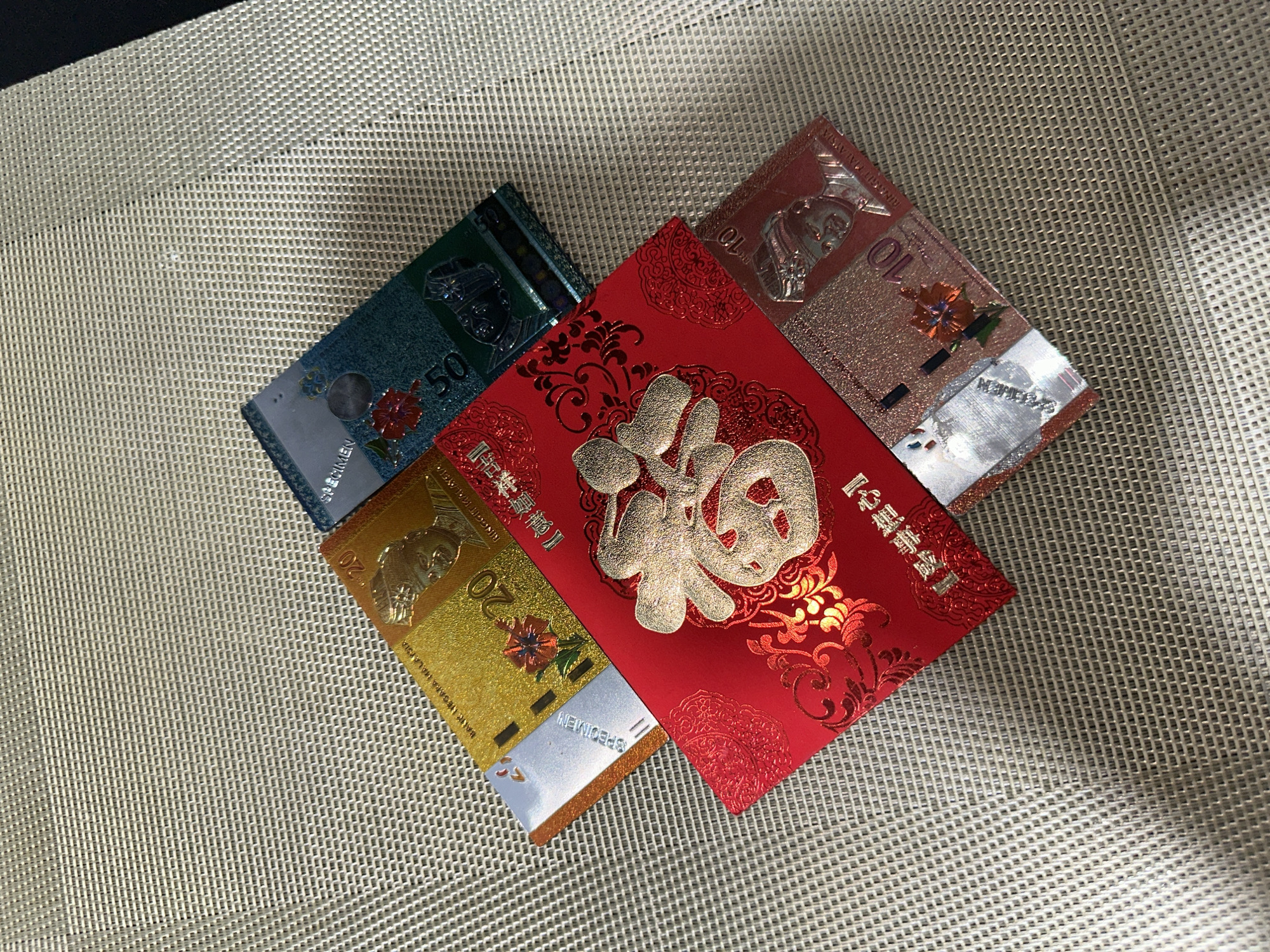
An overhead shot displays four Malaysian Ringgit specimen notes and a red envelope arranged on a light-colored, textured surface, possibly a placemat, in Davao City, Philippines. The items are spread out, with the red envelope positioned centrally.

Three of the currency notes are partially visible, fanned out behind and to the sides of the red envelope. From left to right, they appear to be a green 50 Ringgit note, a gold 20 Ringgit note, and a reddish 10 Ringgit note. Each note clearly bears the word "SPECIMEN" and "RINGGIT MALAYSIA" along with its denomination (10, 20, 50). The front of each note also features the image of what appears to be the first Yang di-Pertuan Agong, Tuanku Abdul Rahman, a common feature on Malaysian currency.

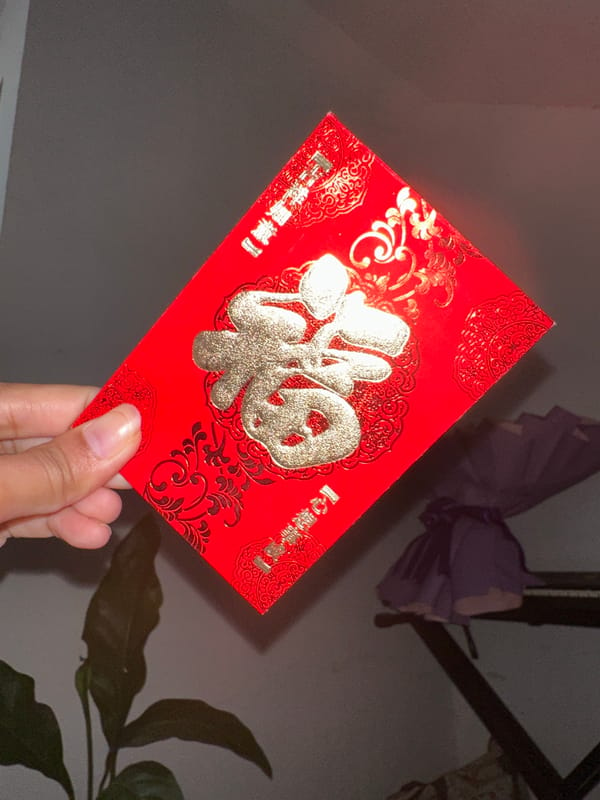
The central object is a vibrant red envelope, known as an ang pao or hongbao, typically used for gifting money during festive occasions like Lunar New Year. It is richly decorated with elaborate golden patterns and features a large, embossed gold Chinese character "福" (fú), signifying good fortune and blessings. Other Chinese characters visible on the envelope include "心想事成" (xīn xiǎng shì chéng - wishes come true) and "吉祥如意" (jí xiáng rú yì - good fortune as one wishes), further enhancing the auspicious theme. The setting appears to be indoors, under artificial lighting, casting subtle shadows.
zyanyyy

Jun 2, 2026, 12:49 PM

Davao City, Philippines

Stake attention in this memory

joyful
auspicious
celebratory
prosperous
festive

An overhead shot displays four Malaysian Ringgit specimen notes and a red envelope arranged on a light-colored, textured surface, possibly a placemat, in Davao City, Philippines. The items are spread out, with the red envelope positioned centrally. Three of the currency notes are partially visible, fanned out behind and to the sides of the red envelope. From left to right, they appear to be a green 50 Ringgit note, a gold 20 Ringgit note, and a reddish 10 Ringgit note. Each note clearly bears the word "SPECIMEN" and "RINGGIT MALAYSIA" along with its denomination (10, 20, 50). The front of each note also features the image of what appears to be the first Yang di-Pertuan Agong, Tuanku Abdul Rahman, a common feature on Malaysian currency. The central object is a vibrant red envelope, known as an ang pao or hongbao, typically used for gifting money during festive occasions like Lunar New Year. It is richly decorated with elaborate golden patterns and features a large, embossed gold Chinese character "福" (fú), signifying good fortune and blessings. Other Chinese characters visible on the envelope include "心想事成" (xīn xiǎng shì chéng - wishes come true) and "吉祥如意" (jí xiáng rú yì - good fortune as one wishes), further enhancing the auspicious theme. The setting appears to be indoors, under artificial lighting, casting subtle shadows.

Loading AttnAds…

transactions
revenues
stakers
Earliest
Latest
Highest stake

No transactions found

More from this user

More from Davao City

zyanyyy

Jun 2, 2026, 12:49 PM

Davao City, Philippines

Licensed under Creative Commons Attribution 4.0 International License. You are free to share and adapt this content with proper attribution.