
Stake attention in this memory
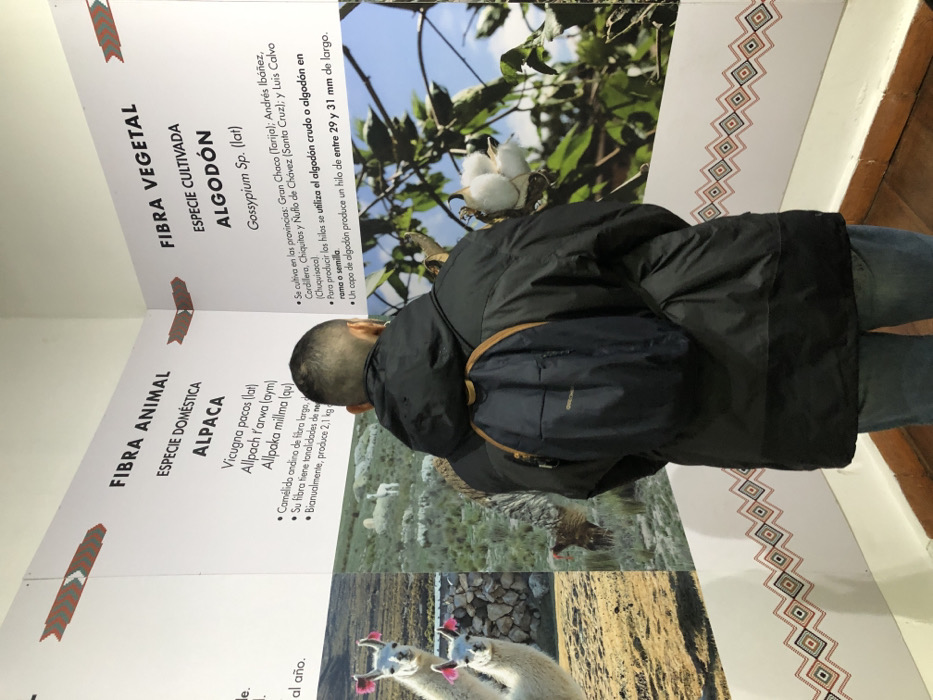
The image shows a person, likely a young male, from behind, observing an educational display in what appears to be a museum or exhibition in La Paz, Bolivia. The person is wearing a black puffer jacket, blue jeans, and a dark blue backpack, and is focused on the information presented on the wall. The display is vertically oriented and features sections on different types of fibers, bordered by red, black, and white geometric patterns. The left section, titled "FIBRA ANIMAL" (Animal Fiber), highlights the "ALPACA" (Alpaca). Visible text includes its scientific name "Vicugna pacos (lat)" and indigenous names "Allpach r'arwa (aym)" and "Allpaka millma (qu)". Descriptive bullet points mention it is an "Andean camelid of long fiber," its fiber has "tonalidades de me" (various tones), and it "produces 2.1 kg per year" biannually. Below this text are images depicting alpacas and other camelids in a field. The right section of the display is dedicated to "FIBRA VEGETAL" (Vegetable Fiber), specifically "ALGODÓN" (Cotton), with its scientific name "Gossypium Sp. (lat)". The text notes that cotton is cultivated in various Bolivian provinces, including Gran Chaco (Tarija), Andrés Ibáñez, Cordillera, Chiquitos, Nuflos de Chávez (Santa Cruz), and Luis Calvo (Chuquisaca). It explains that "raw cotton or cotton on the branch or seed" is used to produce threads, and "one cotton boll produces a thread between 29 and 31 mm long." An image of a cotton plant with open bolls of fluffy white cotton is shown.
Loading AttnAds…
No transactions found