
Sign in
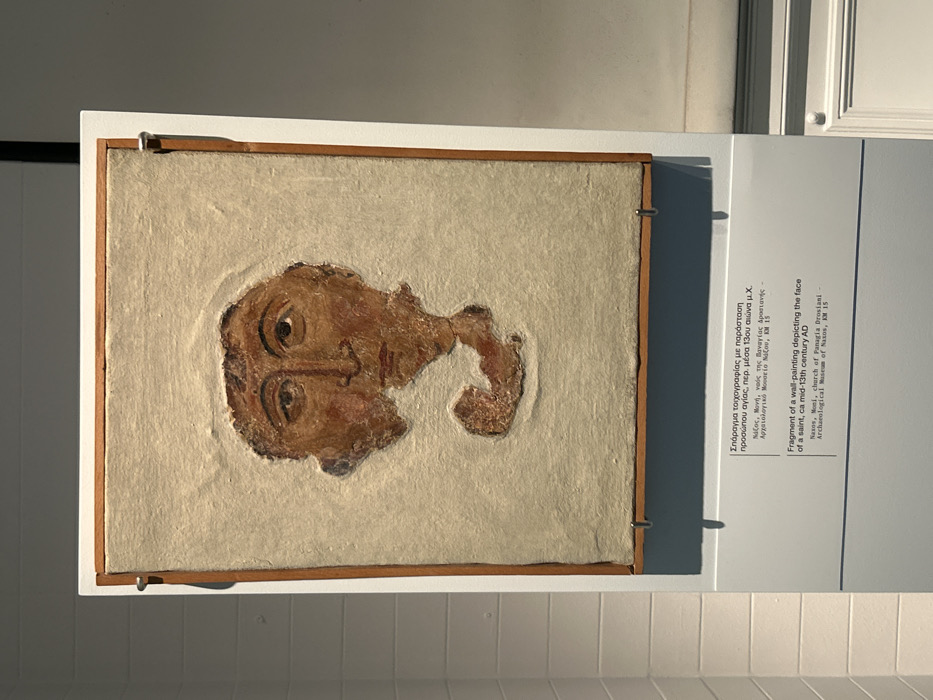
An antique wall-painting fragment, depicting the face of a saint, is displayed vertically in a museum or exhibition setting. The fragment shows a human face with brown skin tones, large, dark, almond-shaped eyes, a long, slender nose, and faint red lines suggesting lips. Part of the neck and shoulder area is also visible, with the remaining plaster surrounding the painted section in an irregular shape. The art style suggests a Byzantine influence, featuring a solemn or serene expression characteristic of religious iconography.

The fragment is mounted on a light-colored, textured background, possibly a restoration or support material, and held within a simple, narrow frame of a light brown or bronze hue. Metal clips are visible at the top and bottom of the frame, securing it to a larger white display panel. The display panel has text printed on its right side, providing information about the artifact. Natural light from the upper left illuminates the display, casting a soft shadow to the lower right.

The visible text, in both Greek and English, identifies the object as a "Fragment of a wall-painting depicting the face of a saint, ca mid-13th century AD." It further specifies its origin as "Naxos, Moni, church of Panagia Drosiani" and its current repository as the "Archaeological Museum of Naxos, IM 15." The scene depicts the presentation of an ancient religious artwork for public viewing.
FM-zLJPr2

Jan 11, 2025

Athina, Greece

Stake attention in this memory

An antique wall-painting fragment, depicting the face of a saint, is displayed vertically in a museum or exhibition setting. The fragment shows a human face with brown skin tones, large, dark, almond-shaped eyes, a long, slender nose, and faint red lines suggesting lips. Part of the neck and shoulder area is also visible, with the remaining plaster surrounding the painted section in an irregular shape. The art style suggests a Byzantine influence, featuring a solemn or serene expression characteristic of religious iconography. The fragment is mounted on a light-colored, textured background, possibly a restoration or support material, and held within a simple, narrow frame of a light brown or bronze hue. Metal clips are visible at the top and bottom of the frame, securing it to a larger white display panel. The display panel has text printed on its right side, providing information about the artifact. Natural light from the upper left illuminates the display, casting a soft shadow to the lower right. The visible text, in both Greek and English, identifies the object as a "Fragment of a wall-painting depicting the face of a saint, ca mid-13th century AD." It further specifies its origin as "Naxos, Moni, church of Panagia Drosiani" and its current repository as the "Archaeological Museum of Naxos, IM 15." The scene depicts the presentation of an ancient religious artwork for public viewing.

transactions
revenues
stakers
Earliest
Latest
Highest stake

No transactions found

More from this user

More from Athina

FM-zLJPr2

Jan 11, 2025

Athina, Greece

Licensed under Creative Commons Attribution 4.0 International License. You are free to share and adapt this content with proper attribution.