
Sign in
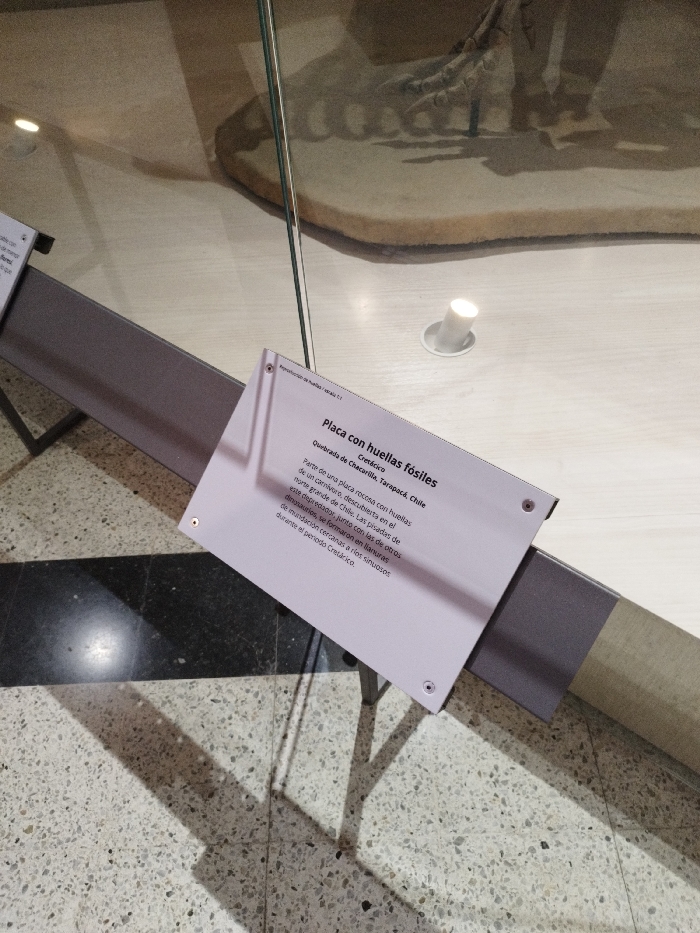
This media file captures a museum exhibit in Santiago, Chile, focused on a fossil footprint. The primary subject is a white display sign, titled "Placa con huellas fósiles" (Fossil footprint plate), which is mounted at an angle on a dark grey stand. The sign is secured by four visible bolts and displays text in Spanish.

The visible text identifies the fossil as dating from the "Cretácico" (Cretaceous period) and originating from "Quebrada de Chacarilla, Tarapacá, Chile." It further explains: "Parte de una placa rocosa con huellas de un carnívoro, descubierta en el norte grande de Chile. Las pisadas de este depredador, junto con las de otros dinosaurios, se formaron en llanuras de inundación cercanas a ríos sinuosos durante el período Cretácico." (Part of a rocky plate with footprints of a carnivore, discovered in the great north of Chile. The footprints of this predator, along with those of other dinosaurs, were formed in floodplains near winding rivers during the Cretaceous period.)

In the background, behind a glass barrier, a light-colored display area reveals what appears to be a large, three-toed fossil footprint or a detailed cast of one, consistent with dinosaur tracks described on the sign. A small, recessed spotlight on the floor illuminates the exhibit. The floor is a light-colored terrazzo with dark, irregular patterns. The scene suggests an indoor museum or exhibition hall, with no people visible. The time of day is not indicated by the indoor lighting.
Mrv

Jan 7, 2025

Santiago, Chile

Stake attention in this memory

This media file captures a museum exhibit in Santiago, Chile, focused on a fossil footprint. The primary subject is a white display sign, titled "Placa con huellas fósiles" (Fossil footprint plate), which is mounted at an angle on a dark grey stand. The sign is secured by four visible bolts and displays text in Spanish. The visible text identifies the fossil as dating from the "Cretácico" (Cretaceous period) and originating from "Quebrada de Chacarilla, Tarapacá, Chile." It further explains: "Parte de una placa rocosa con huellas de un carnívoro, descubierta en el norte grande de Chile. Las pisadas de este depredador, junto con las de otros dinosaurios, se formaron en llanuras de inundación cercanas a ríos sinuosos durante el período Cretácico." (Part of a rocky plate with footprints of a carnivore, discovered in the great north of Chile. The footprints of this predator, along with those of other dinosaurs, were formed in floodplains near winding rivers during the Cretaceous period.) In the background, behind a glass barrier, a light-colored display area reveals what appears to be a large, three-toed fossil footprint or a detailed cast of one, consistent with dinosaur tracks described on the sign. A small, recessed spotlight on the floor illuminates the exhibit. The floor is a light-colored terrazzo with dark, irregular patterns. The scene suggests an indoor museum or exhibition hall, with no people visible. The time of day is not indicated by the indoor lighting.

transactions
revenues
stakers
Earliest
Latest
Highest stake

No transactions found

More from this user

More from Santiago

Mrv

Jan 7, 2025

Santiago, Chile

Licensed under Creative Commons Attribution 4.0 International License. You are free to share and adapt this content with proper attribution.