
Stake attention in this memory
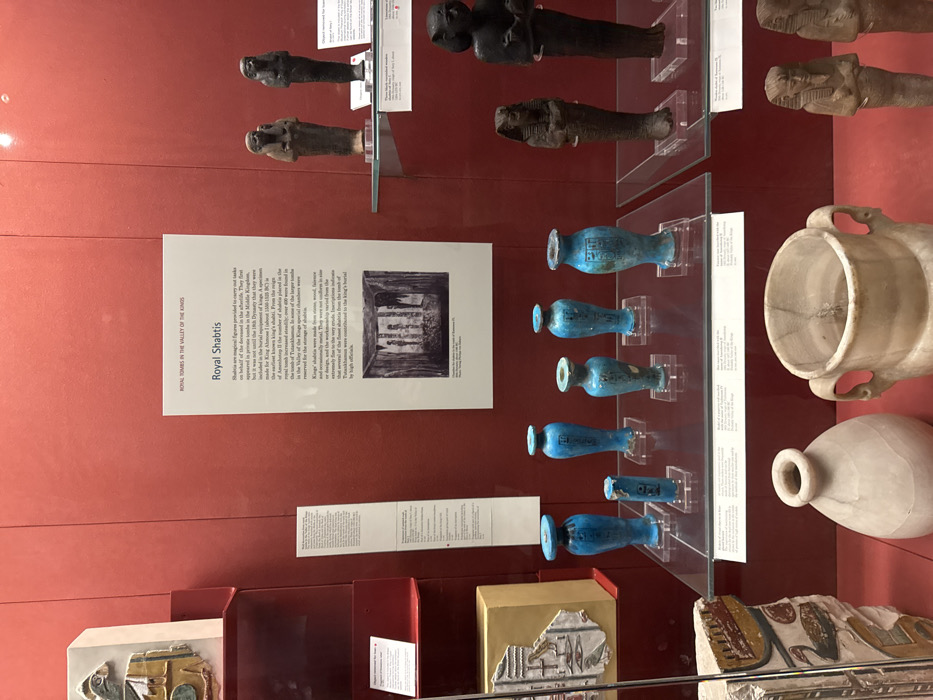
This image, taken in a museum or exhibition hall in London, United Kingdom, displays ancient Egyptian artifacts. The photograph is rotated 90 degrees counter-clockwise. The main subject is a museum display against a reddish-brown wall, featuring various artifacts behind glass. In the upper-left, several dark, mummiform figures, known as shabtis, are visible on small clear stands. These figures appear to be made of stone or wood. Below these, a prominent white informational panel titled "ROYAL TOMBS IN THE VALLEY OF THE KINGS" provides context. The subheading is "Royal Shabtis." The text on the panel explains that shabtis (also spelled shabare or ushabtis) first appeared in private tombs in the Middle Kingdom. It notes that it was not until the 18th Dynasty (around 1550-1070 BC) that they were made for royalty, with King Ahmose I (circa 1550-1525 BC) having the earliest known royal shabtis. The text mentions that from the reign of Amenhotep I, the number of shabtis in royal tombs increased, with over 400 shabtis found in the Valley of the Kings royal chambers. It further details that these shabtis, made of various materials like wood, faience, and stone, were meant to perform duties for the deceased king in the afterlife. To the right of the shabtis and text panel, a row of light blue-green glazed vessels, possibly faience ushabti boxes or offering vessels, are displayed on individual stands. Further to the right and below these, larger, light-colored pottery or alabaster vessels are also exhibited. In the bottom-left, fragmented decorative pieces, possibly relief carvings or painted fragments, are shown in another display case. The overall scene depicts a well-lit indoor museum environment showcasing archaeological finds.
Loading AttnAds…
No transactions found