Stake attention in this memory
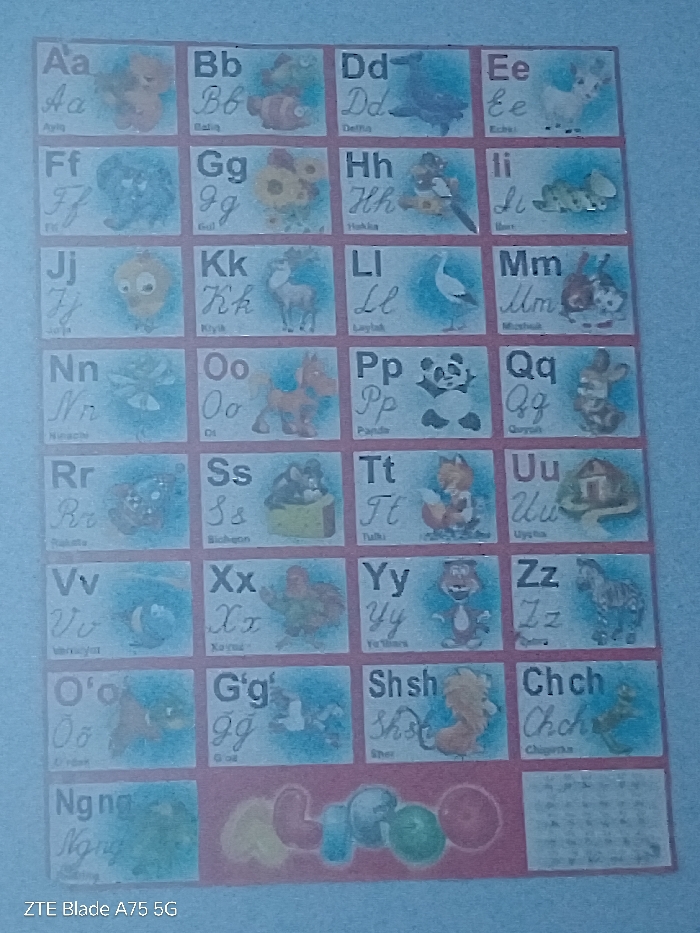
This media file captures an educational alphabet chart, likely used for teaching children in Nurota, Uzbekistan. The chart is divided into numerous rectangular cells, each dedicated to a letter or digraph of the alphabet. Each cell prominently displays the uppercase and lowercase forms of the letter, presented in both print and cursive styles. Below these letters, a colorful illustration depicts an object or animal whose name typically begins with that letter. Beneath the illustration, the corresponding word is written in Latin script. The chart covers the full standard Latin alphabet from Aa to Zz, with additional digraphs and letters specific to the Uzbek Latin alphabet, such as O'o', G'g', Shsh, Chch, and Ngng, indicating its use for the Uzbek language. Examples of letters and their associated items include: Aa for 'Ayiq' (bear), Bb for 'Baliq' (fish), Dd for 'Delfin' (dolphin), Ee for 'Echki' (goat), Gg for 'Gul' (flower), Hh for 'Hakka' (magpie), Ii for 'Ilon' (snake), Kk for 'Kiyik' (deer), Oo for 'Ot' (horse), Pp for 'Panda', Qq for 'Quyon' (rabbit), Tt for 'Tulki' (fox), Uu for 'Uy' (house), Xx for 'Xo'roz' (rooster), Zz for 'Zebra', Shsh for 'Sher' (lion), and Chch for 'Chumchuq' (sparrow). While most images clearly match the Uzbek word, some are broadly representative (e.g., a butterfly for 'Ninachi' (dragonfly), squirrels for 'Sichqon' (mouse), a donkey for 'O'q' (arrow)). At the bottom of the chart, colorful, stylized letters spell out "ALFABO", indicating "alphabet". Below this, a faint grid, possibly a calendar, is visible. The image is a static shot of the chart, suggesting an indoor setting like a classroom or child's room. No activity is taking place. The photograph itself is slightly blurry and has a "ZTE Blade A75 5G" watermark at the bottom left.
No transactions found