
Sign in
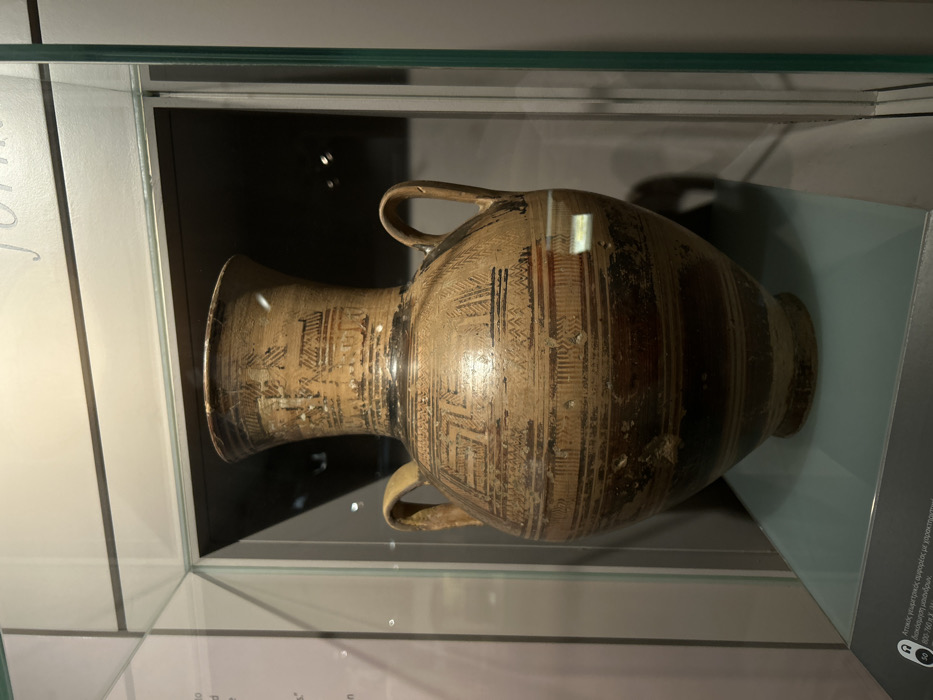
The image displays an ancient ceramic vase, or amphora, prominently featured within a glass museum display case. The vessel is made of a light, yellowish-brown clay and is richly decorated with geometric patterns in dark brown or black. These patterns include vertical stripes, zigzags, meanders, and hatched designs, covering the neck, shoulders, and main body of the vase. It features a wide, flared mouth, a relatively narrow neck, a bulbous body, and two handles, one of which is clearly visible extending from the neck to the shoulder.

The vase is presented on a light blue or grey support panel inside the case. The surrounding environment within the case appears dimly lit, with spotlights highlighting the artifact, causing various reflections on the glass panels. These reflections obscure some parts of the vase and the background.

To the left of the display case, a vertical, light-colored panel is visible, with faint, partially decipherable text that seems to include the letters "Jurn..." or similar. Below and to the right of the vase, a dark informational label is visible, containing white text in Greek. Clearly discernible fragments include "...Αττικός..." (Attic) and the dating "...750 π.Χ. / BC," suggesting the vase originates from the Attic region and dates to approximately 750 BCE.

The scene depicts a static museum exhibit, emphasizing the preservation and presentation of historical artifacts. No people are visible, nor is any specific activity taking place beyond the act of display. The location context indicates this is likely within a museum in Athina, Greece, aligning with the artifact's probable origin.
FM-zLJPr2

Jan 11, 2025

Athina, Greece

Stake attention in this memory

The image displays an ancient ceramic vase, or amphora, prominently featured within a glass museum display case. The vessel is made of a light, yellowish-brown clay and is richly decorated with geometric patterns in dark brown or black. These patterns include vertical stripes, zigzags, meanders, and hatched designs, covering the neck, shoulders, and main body of the vase. It features a wide, flared mouth, a relatively narrow neck, a bulbous body, and two handles, one of which is clearly visible extending from the neck to the shoulder. The vase is presented on a light blue or grey support panel inside the case. The surrounding environment within the case appears dimly lit, with spotlights highlighting the artifact, causing various reflections on the glass panels. These reflections obscure some parts of the vase and the background. To the left of the display case, a vertical, light-colored panel is visible, with faint, partially decipherable text that seems to include the letters "Jurn..." or similar. Below and to the right of the vase, a dark informational label is visible, containing white text in Greek. Clearly discernible fragments include "...Αττικός..." (Attic) and the dating "...750 π.Χ. / BC," suggesting the vase originates from the Attic region and dates to approximately 750 BCE. The scene depicts a static museum exhibit, emphasizing the preservation and presentation of historical artifacts. No people are visible, nor is any specific activity taking place beyond the act of display. The location context indicates this is likely within a museum in Athina, Greece, aligning with the artifact's probable origin.

transactions
revenues
stakers
Earliest
Latest
Highest stake

No transactions found

More from this user

More from Athina

FM-zLJPr2

Jan 11, 2025

Athina, Greece

Licensed under Creative Commons Attribution 4.0 International License. You are free to share and adapt this content with proper attribution.