Sign in
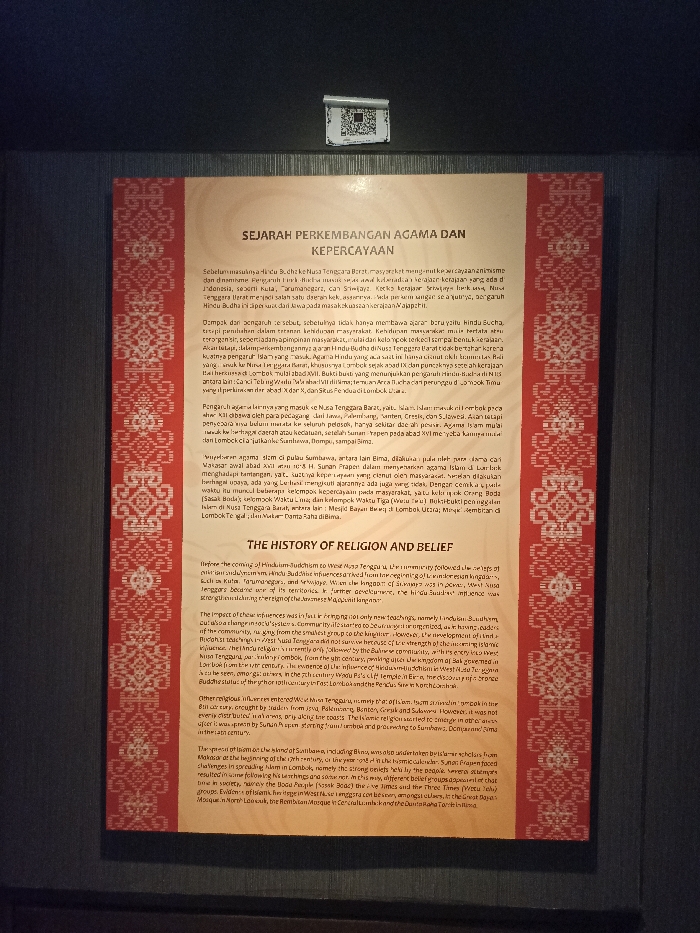
The image displays an informational exhibit panel detailing "The History of Religion and Belief" in Nusa Tenggara Barat, Indonesia. The panel is set against a dark background, suggesting an indoor museum or exhibition environment, and features a decorative red and white border. A QR code is visible at the top of the display.

The text, presented in both Indonesian and English, outlines the progression of religious influences in the region. It begins by describing the pre-Hindu-Buddhist era characterized by animism and dynamism. It then covers the arrival of Hindu-Buddhist influences from ancient kingdoms like Kuta, Tarumanegara, Srivijaya, and Majapahit, leading to societal organization. However, these traditions did not endure due to the rise of Islam, with Bali's Hindu influence on Lombok lasting from the 9th to the 17th century. Evidence mentioned includes Candi Tebing Watu Piti and bronze artifacts.

The panel explains that Islam entered Nusa Tenggara Barat via traders from Java, Palembang, Banten, Gresik, and Surabaya, initially spreading along coastal areas from the 11th century. Its wider dissemination to the interior was spearheaded by figures like Sunan Prapen from the 16th century, reaching areas such as Sumbawa, Dompu, and Bima. The text notes that Sunan Prapen faced challenges in Lombok, leading to the emergence of other belief groups like the Orang Boda (Sasak Bodas), Waktu Lima, and Waktu Tiga. Architectural evidence of Islam's spread includes the Bayan Beleq Mosque, Rombongan Mosque, and Dantoraha.
FM-DWNFF3

Feb 14, 2025, 6:28 AM

Mataram, Indonesia

Stake attention in this memory

The image displays an informational exhibit panel detailing "The History of Religion and Belief" in Nusa Tenggara Barat, Indonesia. The panel is set against a dark background, suggesting an indoor museum or exhibition environment, and features a decorative red and white border. A QR code is visible at the top of the display. The text, presented in both Indonesian and English, outlines the progression of religious influences in the region. It begins by describing the pre-Hindu-Buddhist era characterized by animism and dynamism. It then covers the arrival of Hindu-Buddhist influences from ancient kingdoms like Kuta, Tarumanegara, Srivijaya, and Majapahit, leading to societal organization. However, these traditions did not endure due to the rise of Islam, with Bali's Hindu influence on Lombok lasting from the 9th to the 17th century. Evidence mentioned includes Candi Tebing Watu Piti and bronze artifacts. The panel explains that Islam entered Nusa Tenggara Barat via traders from Java, Palembang, Banten, Gresik, and Surabaya, initially spreading along coastal areas from the 11th century. Its wider dissemination to the interior was spearheaded by figures like Sunan Prapen from the 16th century, reaching areas such as Sumbawa, Dompu, and Bima. The text notes that Sunan Prapen faced challenges in Lombok, leading to the emergence of other belief groups like the Orang Boda (Sasak Bodas), Waktu Lima, and Waktu Tiga. Architectural evidence of Islam's spread includes the Bayan Beleq Mosque, Rombongan Mosque, and Dantoraha.

transactions
revenues
stakers
Earliest
Latest
Highest stake

No transactions found

More from this user

More from Mataram

FM-DWNFF3

Feb 14, 2025, 6:28 AM

Mataram, Indonesia

Licensed under Creative Commons Attribution 4.0 International License. You are free to share and adapt this content with proper attribution.