
Stake attention in this memory
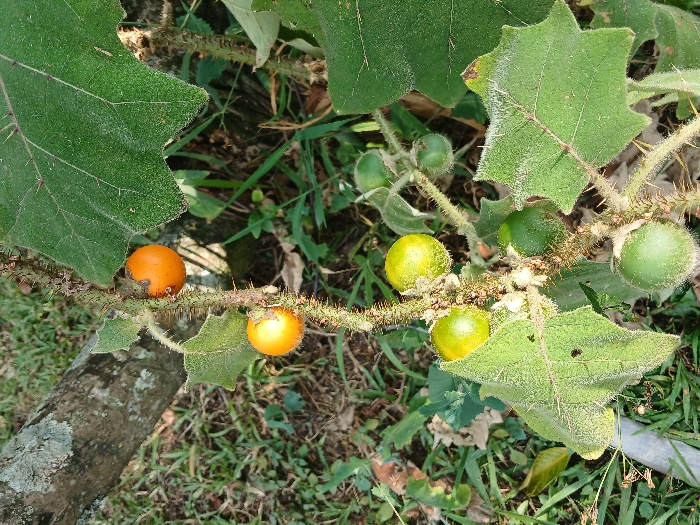
The image displays a close-up view of a *Solanum quitoense* plant, commonly known as Naranjilla or Lulo, in an outdoor natural environment. The plant occupies the central and right portions of the frame, showcasing its distinctive morphology, including its spiny stem, large leaves, and fruits in varying stages of development. The central stem is erect and robust, covered densely with sharp, elongated, green-brown spines and fine, whitish trichomes. Several large, dark green leaves with prominent veins originate from the stem; their surfaces appear textured and fuzzy due to a covering of fine hairs, and spines are visible on their veins and margins. Some leaves exhibit small, irregular perforations consistent with minor insect damage. Multiple spherical fruits are attached to the stem. Two fruits, positioned in the upper-left and upper-center, are fully ripened to a vibrant orange-yellow, each measuring approximately 5-7 cm in diameter. The upper-left orange fruit shows a small, dark blemish. Below these, several unripe fruits are visible, transitioning from bright green to yellowish-green, and ranging in size from approximately 2 cm to 5 cm in diameter; these unripe fruits also appear covered in fine hairs. Remnants of white or cream-colored floral structures are present near some developing fruits. The immediate ground environment includes a mixture of green grass, exposed dark soil, and scattered dry leaf debris. In the upper-left background, a segment of a gray-brown tree trunk with textured bark is visible. Additional blurred green vegetation forms the distant background, indicating a natural or cultivated outdoor setting. The scene is illuminated by natural daylight. No people or animals are present. While *Solanum quitoense* is commonly found and cultivated in the region of Cali, Colombia, the exact location within the city is not discernible from the visual information provided.
No transactions found