
Sign in
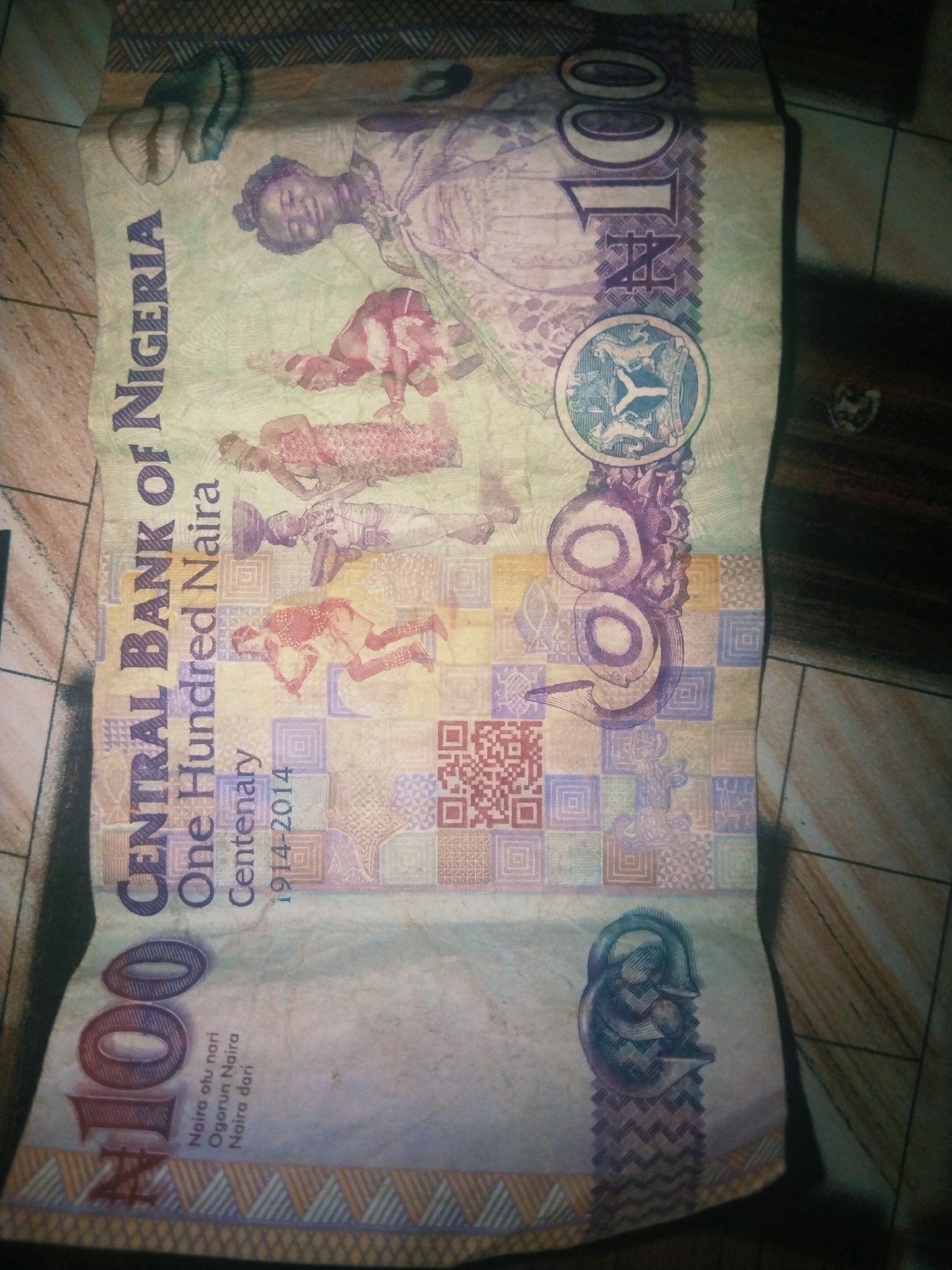
A Nigerian One Hundred Naira (₦100) Centenary banknote, issued between 1914-2014, is depicted in a vertical orientation. The banknote appears moderately wrinkled and exhibits signs of wear.

The obverse side of the banknote is visible. Key features include:
-   **Text:** "CENTRAL BANK OF NIGERIA" is printed vertically along the left edge. "One Hundred Naira" is positioned horizontally to its right. Below this, "Centenary 1914-2014" commemorates the banknote's special edition. The denomination "100" appears in large numerals at the top right and bottom left corners, accompanied by the Naira symbol (₦) at the top right. At the bottom left, the value "Naira otu nani," "Ogorun Naira," and "Naira dari" are printed in three different Nigerian languages.
-   **Imagery:** A woman in traditional attire is depicted at the upper-center portion. Below her, three additional human figures in various traditional poses and costumes are arranged, signifying cultural representations. To the far left, near the top, a stylized cowrie shell is visible. In the top-right quadrant, below the "100" and Naira symbol, a circular emblem containing the Nigerian Coat of Arms (two horses supporting a shield) is present. Intricate geometric patterns and designs are spread across the banknote, including a red-and-white QR code in the bottom-right quadrant. A stylized, elaborate, coiled design is situated at the bottom right.
-   **Border:** The top and bottom edges feature decorative borders with repeated triangular and zigzag patterns.

The banknote rests on a tiled surface, characterized by light-colored, possibly beige or cream-toned, square or rectangular tiles with a marbled or subtle pattern. Grout lines are faintly visible. A dark shadow is cast along the right side of the banknote, indicating a directional light source from the left or above the scene.

The image does not provide any visual information or indicators to identify a specific location within the city of Uyo, Nigeria, or any other geographical point.
Visijo 😎✌️

Jun 5, 2026

Uyo, Nigeria

Short Term

Stake attention in this memory

Naira
Currency
Nigeria
Banknote
Value

A Nigerian One Hundred Naira (₦100) Centenary banknote, issued between 1914-2014, is depicted in a vertical orientation. The banknote appears moderately wrinkled and exhibits signs of wear. The obverse side of the banknote is visible. Key features include: - **Text:** "CENTRAL BANK OF NIGERIA" is printed vertically along the left edge. "One Hundred Naira" is positioned horizontally to its right. Below this, "Centenary 1914-2014" commemorates the banknote's special edition. The denomination "100" appears in large numerals at the top right and bottom left corners, accompanied by the Naira symbol (₦) at the top right. At the bottom left, the value "Naira otu nani," "Ogorun Naira," and "Naira dari" are printed in three different Nigerian languages. - **Imagery:** A woman in traditional attire is depicted at the upper-center portion. Below her, three additional human figures in various traditional poses and costumes are arranged, signifying cultural representations. To the far left, near the top, a stylized cowrie shell is visible. In the top-right quadrant, below the "100" and Naira symbol, a circular emblem containing the Nigerian Coat of Arms (two horses supporting a shield) is present. Intricate geometric patterns and designs are spread across the banknote, including a red-and-white QR code in the bottom-right quadrant. A stylized, elaborate, coiled design is situated at the bottom right. - **Border:** The top and bottom edges feature decorative borders with repeated triangular and zigzag patterns. The banknote rests on a tiled surface, characterized by light-colored, possibly beige or cream-toned, square or rectangular tiles with a marbled or subtle pattern. Grout lines are faintly visible. A dark shadow is cast along the right side of the banknote, indicating a directional light source from the left or above the scene. The image does not provide any visual information or indicators to identify a specific location within the city of Uyo, Nigeria, or any other geographical point.

Symbol

7CDA2

Volume

9,827

Creator

+$0.35

Revenue

+$0.45

TVL

$25.21

1D
1W
1M
All
transactions
revenues
stakers
Earliest
Latest
Highest stake

1

Olaoluwaloseyi

Staked 14d ago
Redeemed 9d ago

$3.04 USD

+$0.14 USD

Fee: $0.01 (0.25%)

+5%

2

perekirill

Staked 14d ago

$25.01 USD

+$0.20 USD

+0.8%

3

Rev Bot 🤖💰

Injected revenue 14d ago

Revenue bonus for the last 2 stakes.

+$0.70 USD

More from this user

More from Uyo

Visijo 😎✌️

Jun 5, 2026

Uyo, Nigeria

Licensed under Creative Commons Attribution 4.0 International License. You are free to share and adapt this content with proper attribution.

A Nigerian One Hundred Naira (₦100) Centenary banknote, issued between 1914-2014, is depicted in a vertical orientation. The banknote appears moderately wrinkled and exhibits signs of wear. The obverse side of the banknote is visible. Key features include: - **Text:** "CENTRAL BANK OF NIGERIA" is printed vertically along the left edge. "One Hundred Naira" is positioned horizontally to its right. Below this, "Centenary 1914-2014" commemorates the banknote's special edition. The denomination "100" appears in large numerals at the top right and bottom left corners, accompanied by the Naira symbol (₦) at the top right. At the bottom left, the value "Naira otu nani," "Ogorun Naira," and "Naira dari" are printed in three different Nigerian languages. - **Imagery:** A woman in traditional attire is depicted at the upper-center portion. Below her, three additional human figures in various traditional poses and costumes are arranged, signifying cultural representations. To the far left, near the top, a stylized cowrie shell is visible. In the top-right quadrant, below the "100" and Naira symbol, a circular emblem containing the Nigerian Coat of Arms (two horses supporting a shield) is present. Intricate geometric patterns and designs are spread across the banknote, including a red-and-white QR code in the bottom-right quadrant. A stylized, elaborate, coiled design is situated at the bottom right. - **Border:** The top and bottom edges feature decorative borders with repeated triangular and zigzag patterns. The banknote rests on a tiled surface, characterized by light-colored, possibly beige or cream-toned, square or rectangular tiles with a marbled or subtle pattern. Grout lines are faintly visible. A dark shadow is cast along the right side of the banknote, indicating a directional light source from the left or above the scene. The image does not provide any visual information or indicators to identify a specific location within the city of Uyo, Nigeria, or any other geographical point. in Uyo, Nigeria | Collective Memory