
Sign in
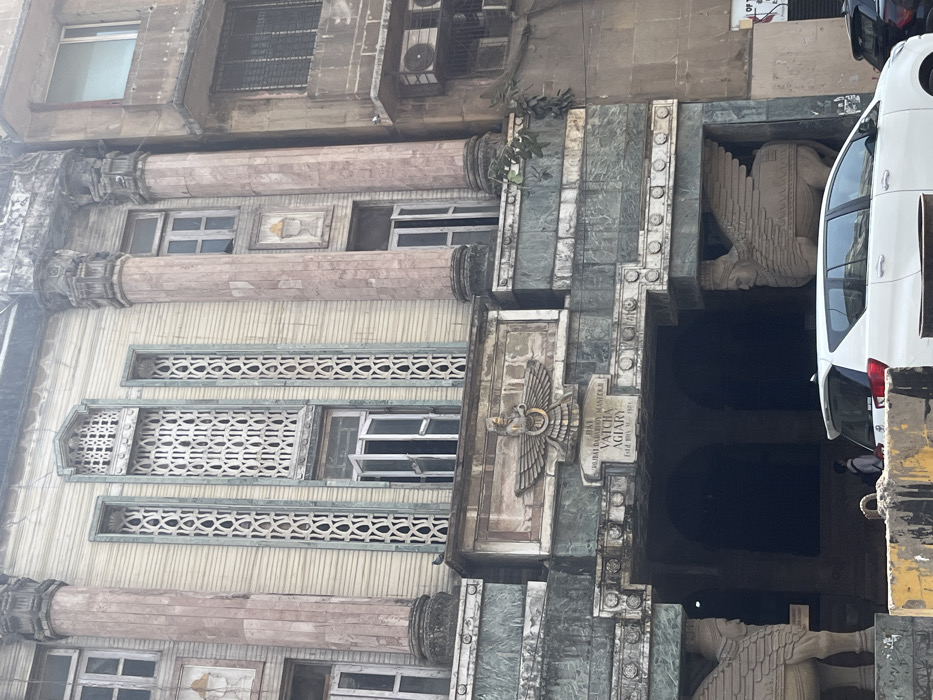
The image, rotated 90 degrees clockwise, captures the ornate facade of a multi-story building in Mumbai, identified as a Parsi Agiary (Zoroastrian fire temple). The structure exhibits a rich architectural style, blending classical and ancient Persian influences.

The lower section of the building features dark green-hued stone or tiling, adorned with intricate geometric patterns. Flanking the main entrance archway are large, light-colored sculptures of winged, mythical creatures, possibly resembling griffins or winged bulls, often found in ancient Persian art.

Above the entrance, a prominent relief of a Fravahar, a key symbol in Zoroastrianism, is displayed. A plaque beneath it contains visible text: "BAI DURABAI BAHADURJI MANTORE VATCHA AGIARY ESTD. 1921 NO. 1. 1921". This inscription identifies the building as a fire temple named after Bai Durabai Bahadurji Mantore, established in 1921.

The upper floors are characterized by cream-colored walls and several large, fluted columns topped with elaborate, carved capitals. Various windows punctuate the facade; some feature decorative jali (latticework) patterns, while others are simpler glass panes, with some appearing open. Air conditioning units are visible on an upper level, hinting at modern amenities within the historic structure.

A white car, possibly a van or SUV, is partially visible on the right side of the image, parked or driving past the building. The scene is illuminated by natural daylight, indicating clear weather conditions. The overall impression is one of a culturally significant and meticulously decorated edifice.
FM-OhtiC3

Feb 3, 2025, 6:49 AM

Mumbai, India

Stake attention in this memory

The image, rotated 90 degrees clockwise, captures the ornate facade of a multi-story building in Mumbai, identified as a Parsi Agiary (Zoroastrian fire temple). The structure exhibits a rich architectural style, blending classical and ancient Persian influences. The lower section of the building features dark green-hued stone or tiling, adorned with intricate geometric patterns. Flanking the main entrance archway are large, light-colored sculptures of winged, mythical creatures, possibly resembling griffins or winged bulls, often found in ancient Persian art. Above the entrance, a prominent relief of a Fravahar, a key symbol in Zoroastrianism, is displayed. A plaque beneath it contains visible text: "BAI DURABAI BAHADURJI MANTORE VATCHA AGIARY ESTD. 1921 NO. 1. 1921". This inscription identifies the building as a fire temple named after Bai Durabai Bahadurji Mantore, established in 1921. The upper floors are characterized by cream-colored walls and several large, fluted columns topped with elaborate, carved capitals. Various windows punctuate the facade; some feature decorative jali (latticework) patterns, while others are simpler glass panes, with some appearing open. Air conditioning units are visible on an upper level, hinting at modern amenities within the historic structure. A white car, possibly a van or SUV, is partially visible on the right side of the image, parked or driving past the building. The scene is illuminated by natural daylight, indicating clear weather conditions. The overall impression is one of a culturally significant and meticulously decorated edifice.

transactions
revenues
stakers
Earliest
Latest
Highest stake

No transactions found

More from this user

More from Mumbai

FM-OhtiC3

Feb 3, 2025, 6:49 AM

Mumbai, India

Licensed under Creative Commons Attribution 4.0 International License. You are free to share and adapt this content with proper attribution.