
Sign in
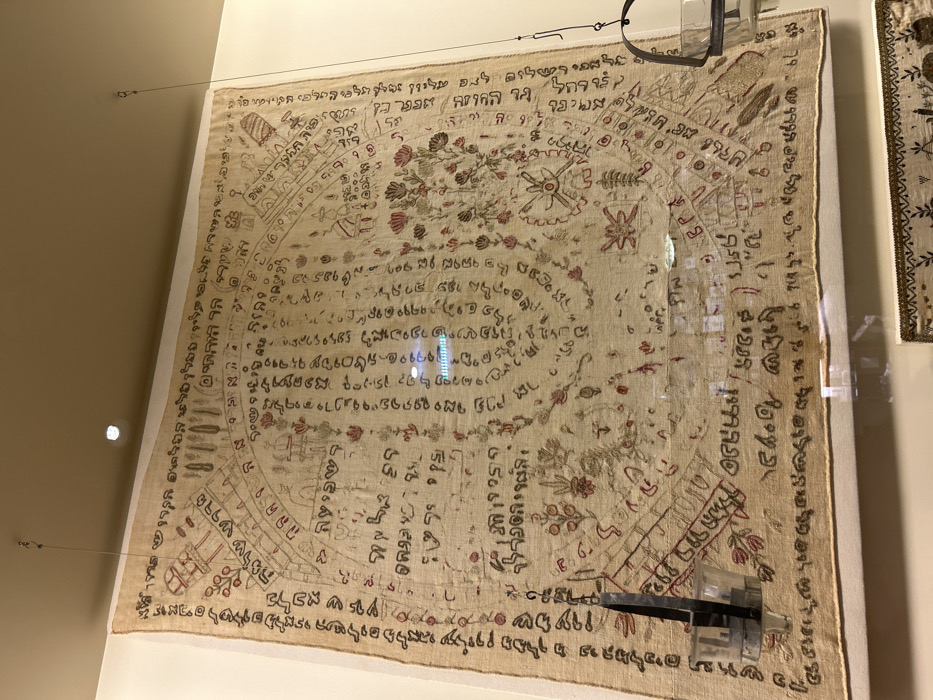
This media file displays an intricately embroidered textile, likely an ancient document or talisman, exhibited behind a protective glass panel in what appears to be a museum or gallery setting. The textile, made of a light, cream-colored fabric, is rectangular and positioned at an angle, held in place by thin wires.

The primary subject is the textile itself, covered with extensive writing and decorative motifs. The design features a central circular or spiral arrangement of text, surrounded by concentric rings and linear sections of script. Interspersed with the writing are small, stylized floral patterns, geometric shapes, and abstract symbols, rendered in shades of red, brown, and black embroidery thread.

The writing on the textile is a notable detail, appearing in at least two distinct scripts. One script is clearly Hebrew, with decipherable words and phrases such as "הר הזיתים" (Mount of Olives), "שלמה ראש" (Solomon's head/chief), "פפרים" (books), "מלכים" (kings), and "שלום" (peace) visible among others. Another prominent script consists of numerous curved characters, resembling a Brahmic script possibly from South India (e.g., Telugu or Kannada) or Southeast Asia (e.g., Thai or Lao). Numbers like "100" and "996" are also visible.

The overall scene is static, showcasing the artifact for observation. Reflections on the glass surface, including a vertical streak of light near the center, slightly obscure some parts of the textile. A small portion of another embroidered textile, featuring different patterns, is visible on the right edge of the frame. The exhibit setup suggests careful preservation of a historical or cultural artifact. The indoor setting implies artificial lighting.
FM-zLJPr2

Jan 12, 2025

Athina, Greece

Stake attention in this memory

This media file displays an intricately embroidered textile, likely an ancient document or talisman, exhibited behind a protective glass panel in what appears to be a museum or gallery setting. The textile, made of a light, cream-colored fabric, is rectangular and positioned at an angle, held in place by thin wires. The primary subject is the textile itself, covered with extensive writing and decorative motifs. The design features a central circular or spiral arrangement of text, surrounded by concentric rings and linear sections of script. Interspersed with the writing are small, stylized floral patterns, geometric shapes, and abstract symbols, rendered in shades of red, brown, and black embroidery thread. The writing on the textile is a notable detail, appearing in at least two distinct scripts. One script is clearly Hebrew, with decipherable words and phrases such as "הר הזיתים" (Mount of Olives), "שלמה ראש" (Solomon's head/chief), "פפרים" (books), "מלכים" (kings), and "שלום" (peace) visible among others. Another prominent script consists of numerous curved characters, resembling a Brahmic script possibly from South India (e.g., Telugu or Kannada) or Southeast Asia (e.g., Thai or Lao). Numbers like "100" and "996" are also visible. The overall scene is static, showcasing the artifact for observation. Reflections on the glass surface, including a vertical streak of light near the center, slightly obscure some parts of the textile. A small portion of another embroidered textile, featuring different patterns, is visible on the right edge of the frame. The exhibit setup suggests careful preservation of a historical or cultural artifact. The indoor setting implies artificial lighting.

transactions
revenues
stakers
Earliest
Latest
Highest stake

No transactions found

More from this user

More from Athina

FM-zLJPr2

Jan 12, 2025

Athina, Greece

Licensed under Creative Commons Attribution 4.0 International License. You are free to share and adapt this content with proper attribution.