
Sign in
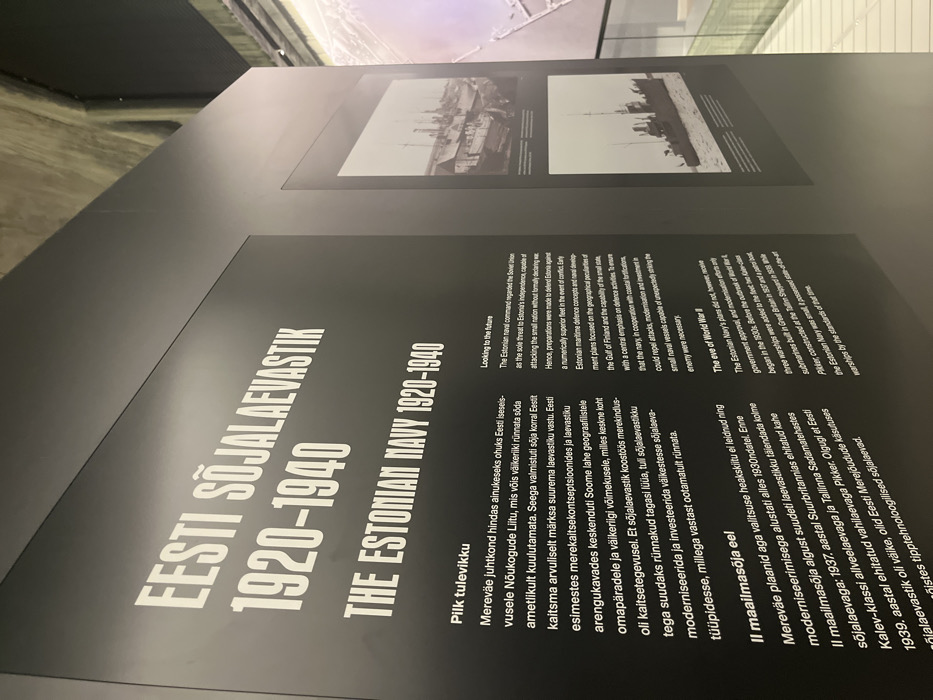
This media file displays a dark gray museum exhibit panel, positioned at an angle, likely showcasing historical information. The primary subjects are two black and white photographs of naval vessels and extensive bilingual text.

The visible text is titled "EESTI SÕJALAEVASTIK 1920-1940" and "THE ESTONIAN NAVY 1920-1940," indicating the exhibit focuses on the Estonian Navy during this period. Two main sections are present: "Pilk tulevikku" / "Looking to the future" and "II maailmasõja eel" / "The eve of World War II."

The English text explains that the Estonian naval command considered the Soviet Union the sole threat to Estonia's independence, capable of attacking without formally declaring war. Preparations were made to defend Estonia against a numerically superior fleet, focusing on the geographical peculiarities of the Gulf of Finland and emphasizing defence activities in cooperation with coastal fortifications. The plan was to modernize the navy with small naval vessels capable of surprising the enemy. The text further notes that the Navy's plans didn't receive government approval until the 1930s, when modernization began. By the eve of World War II, three warships were added: two Kalev-class submarines built in Great Britain in 1937, and the patrol ship Pikker, constructed at the Tallinn Shipyard in 1939. It concludes that while the Estonian Navy was small, its warships were state-of-the-art for the time.

The two photographs depict what appear to be naval vessels in harbor or at sea, consistent with the exhibit's theme. The setting is an indoor museum or exhibition hall in Tallinn, Estonia, suggested by the prompt and the nature of the display. The overall tone of the exhibit is historical and informative.
FM-kkr2I2

Jan 18, 2025

Tallinn, Estonia

Stake attention in this memory

This media file displays a dark gray museum exhibit panel, positioned at an angle, likely showcasing historical information. The primary subjects are two black and white photographs of naval vessels and extensive bilingual text. The visible text is titled "EESTI SÕJALAEVASTIK 1920-1940" and "THE ESTONIAN NAVY 1920-1940," indicating the exhibit focuses on the Estonian Navy during this period. Two main sections are present: "Pilk tulevikku" / "Looking to the future" and "II maailmasõja eel" / "The eve of World War II." The English text explains that the Estonian naval command considered the Soviet Union the sole threat to Estonia's independence, capable of attacking without formally declaring war. Preparations were made to defend Estonia against a numerically superior fleet, focusing on the geographical peculiarities of the Gulf of Finland and emphasizing defence activities in cooperation with coastal fortifications. The plan was to modernize the navy with small naval vessels capable of surprising the enemy. The text further notes that the Navy's plans didn't receive government approval until the 1930s, when modernization began. By the eve of World War II, three warships were added: two Kalev-class submarines built in Great Britain in 1937, and the patrol ship Pikker, constructed at the Tallinn Shipyard in 1939. It concludes that while the Estonian Navy was small, its warships were state-of-the-art for the time. The two photographs depict what appear to be naval vessels in harbor or at sea, consistent with the exhibit's theme. The setting is an indoor museum or exhibition hall in Tallinn, Estonia, suggested by the prompt and the nature of the display. The overall tone of the exhibit is historical and informative.

transactions
revenues
stakers
Earliest
Latest
Highest stake

No transactions found

More from this user

More from Tallinn

FM-kkr2I2

Jan 18, 2025

Tallinn, Estonia

Licensed under Creative Commons Attribution 4.0 International License. You are free to share and adapt this content with proper attribution.