Sign in
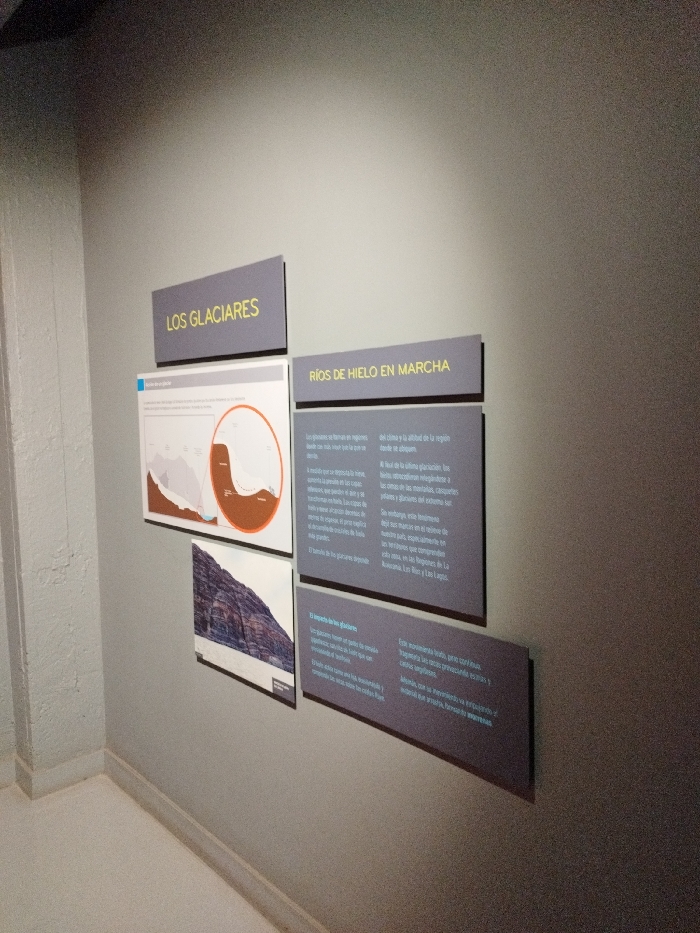
The image captures an indoor exhibition space, likely a museum or educational center, featuring a wall display about glaciers. The setting is a corner with light gray walls and a lighter-colored baseboard and floor. No people are visible.

The display consists of multiple rectangular panels mounted on the wall. A large grey title panel at the top left reads "LOS GLACIARES" (The Glaciers). To its right, another grey title panel, slightly smaller, states "RÍOS DE HIELO EN MARCHA" (Rivers of Ice in Motion).

Below "LOS GLACIARES" is a graphic panel featuring abstract diagrams, possibly illustrating glacier formation or structure, with prominent white and brown circular and curved shapes. Below this graphic, a photographic panel shows a rugged, rocky mountain face, possibly depicting a glacier-carved landscape.

Underneath "RÍOS DE HIELO EN MARCHA" are two large text panels. The upper text panel, divided into two columns, discusses how glaciers form where more snow falls than melts, the transformation of snow into ice under pressure (firn/névé), and how glacier size depends on climate and altitude. It also mentions the impact of the last glaciation on the Andes, forming moraines, ice caps, and plains, and its profound mark on the relief, particularly in the Ventisqueros region of La Araucanía, Los Ríos, and Los Lagos. The lower text panel, also in two columns, is titled "El impacto de los glaciares" (The impact of glaciers). It describes how glaciers profoundly impact the landscape by creating U-shaped valleys, fjords, and lakes, eroding and polishing rocks like sandpaper, and how their slow movement fragments rocks, creating striations, cracks, and dragging material to form moraines.

The text is in Spanish, consistent with the given location context of Santiago, Chile. The overall presentation is informative and educational, utilizing both text and visual aids to explain geological concepts.
Mrv

Jan 7, 2025

Santiago, Chile

Stake attention in this memory

The image captures an indoor exhibition space, likely a museum or educational center, featuring a wall display about glaciers. The setting is a corner with light gray walls and a lighter-colored baseboard and floor. No people are visible. The display consists of multiple rectangular panels mounted on the wall. A large grey title panel at the top left reads "LOS GLACIARES" (The Glaciers). To its right, another grey title panel, slightly smaller, states "RÍOS DE HIELO EN MARCHA" (Rivers of Ice in Motion). Below "LOS GLACIARES" is a graphic panel featuring abstract diagrams, possibly illustrating glacier formation or structure, with prominent white and brown circular and curved shapes. Below this graphic, a photographic panel shows a rugged, rocky mountain face, possibly depicting a glacier-carved landscape. Underneath "RÍOS DE HIELO EN MARCHA" are two large text panels. The upper text panel, divided into two columns, discusses how glaciers form where more snow falls than melts, the transformation of snow into ice under pressure (firn/névé), and how glacier size depends on climate and altitude. It also mentions the impact of the last glaciation on the Andes, forming moraines, ice caps, and plains, and its profound mark on the relief, particularly in the Ventisqueros region of La Araucanía, Los Ríos, and Los Lagos. The lower text panel, also in two columns, is titled "El impacto de los glaciares" (The impact of glaciers). It describes how glaciers profoundly impact the landscape by creating U-shaped valleys, fjords, and lakes, eroding and polishing rocks like sandpaper, and how their slow movement fragments rocks, creating striations, cracks, and dragging material to form moraines. The text is in Spanish, consistent with the given location context of Santiago, Chile. The overall presentation is informative and educational, utilizing both text and visual aids to explain geological concepts.

transactions
revenues
stakers
Earliest
Latest
Highest stake

No transactions found

More from this user

More from Santiago

Mrv

Jan 7, 2025

Santiago, Chile

Licensed under Creative Commons Attribution 4.0 International License. You are free to share and adapt this content with proper attribution.