
Sign in
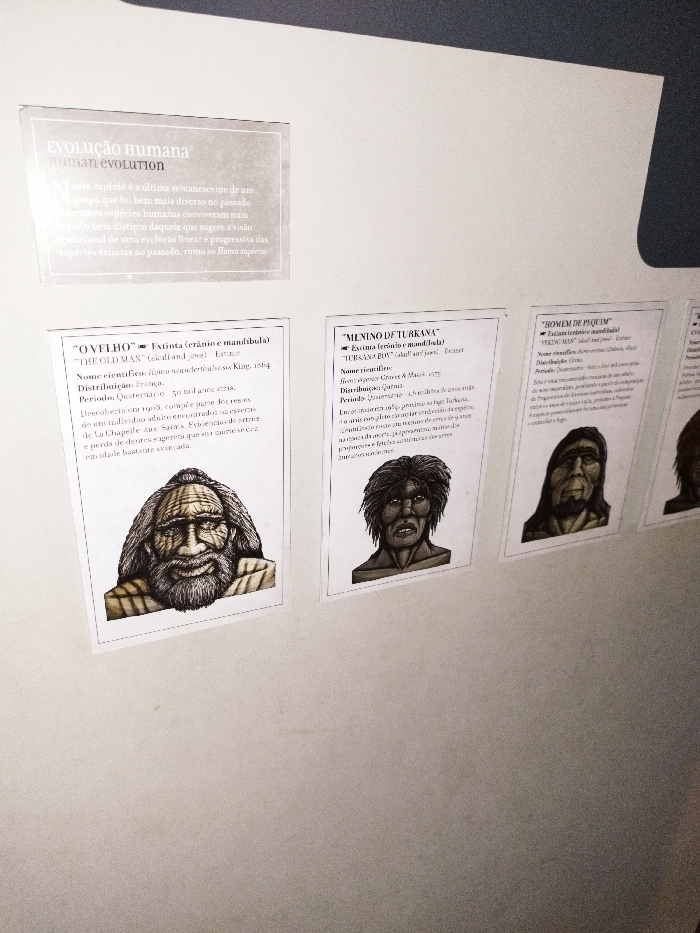
Four framed informational panels about human evolution are mounted on a white wall. Each panel includes an illustration of a different early human species, accompanied by text in Portuguese. 

The panel on the far left features a black and white illustration of an elderly man with a long beard, labeled "O Velho" ("The Old Man"). It describes him as extinct with a cranium and mandible, discovered in 1908, and details his scientific name, period, and distribution. The panel next to it features a black and white illustration of a young woman with a thick braid, labeled "Menino de Turkana" ("Turkana Boy"), describing her as extinct with a cranium, mandible, and pelvis, discovered in 1984, and details her scientific name, period, and distribution. The next panel, to the right, features a black and white illustration of a woman with a thick braid, labeled "Homem de Pequim" ("Peking Man"), describing her as extinct with a cranium and mandible, discovered in 1929, and details her scientific name, period, and distribution. The last panel on the far right is cut off and only partially visible, appearing to depict a skull.

The wall appears to be a museum display, and the location is the Museu do Ipiranga, located in the Ipiranga neighborhood of São Paulo, Brazil, at the coordinates provided (latitude: -23.588, longitude: -46.61).
Mrv

May 13, 2025, 5:36 PM

São Paulo, Brazil

Stake attention in this memory

historical
ancient
informative
educational
evolution

Four framed informational panels about human evolution are mounted on a white wall. Each panel includes an illustration of a different early human species, accompanied by text in Portuguese. The panel on the far left features a black and white illustration of an elderly man with a long beard, labeled "O Velho" ("The Old Man"). It describes him as extinct with a cranium and mandible, discovered in 1908, and details his scientific name, period, and distribution. The panel next to it features a black and white illustration of a young woman with a thick braid, labeled "Menino de Turkana" ("Turkana Boy"), describing her as extinct with a cranium, mandible, and pelvis, discovered in 1984, and details her scientific name, period, and distribution. The next panel, to the right, features a black and white illustration of a woman with a thick braid, labeled "Homem de Pequim" ("Peking Man"), describing her as extinct with a cranium and mandible, discovered in 1929, and details her scientific name, period, and distribution. The last panel on the far right is cut off and only partially visible, appearing to depict a skull. The wall appears to be a museum display, and the location is the Museu do Ipiranga, located in the Ipiranga neighborhood of São Paulo, Brazil, at the coordinates provided (latitude: -23.588, longitude: -46.61).

Loading AttnAds…

transactions
revenues
stakers
Earliest
Latest
Highest stake

No transactions found

More from this user

More from São Paulo

Mrv

May 13, 2025, 5:36 PM

São Paulo, Brazil

Licensed under Creative Commons Attribution 4.0 International License. You are free to share and adapt this content with proper attribution.