Stake attention in this memory
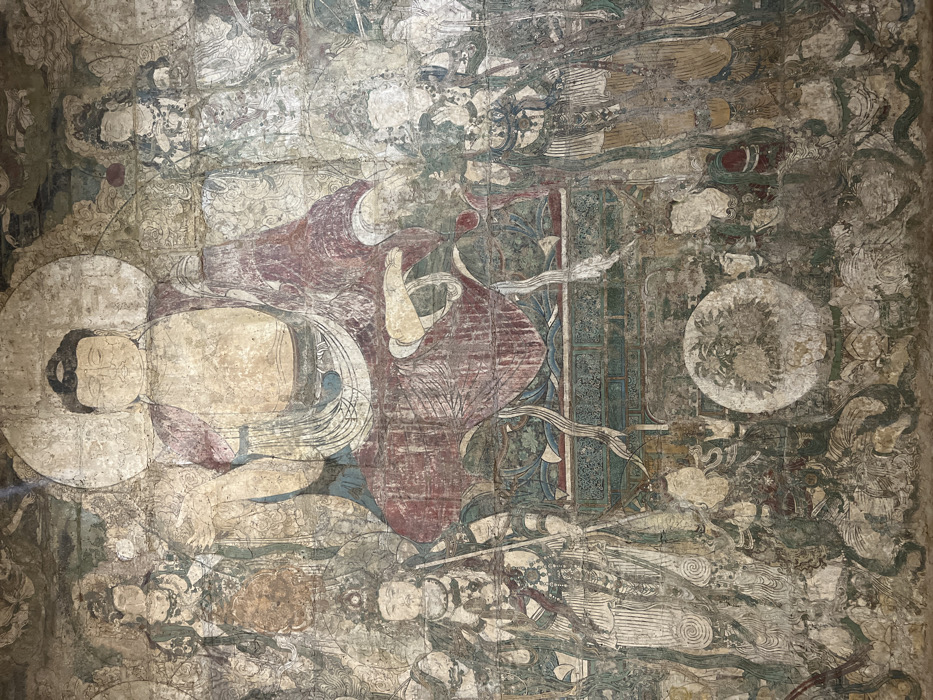
This is a large, ancient Buddhist mural, specifically a replica of the Paradise of Amitābha from the Mogao Grottoes (Cave 3), located within The Metropolitan Museum of Art in New York City, New York, United States. The mural depicts a central, monumental Buddha figure seated frontally on an elaborate tiered throne. The Buddha wears monastic robes in faded reds, blues, and creams, with a prominent circular halo (mandorla) behind its head. Its right hand is raised in a gesture of reassurance, while the left rests on its lap. Flanking the central Buddha are two large standing Bodhisattvas, depicted in ornate attire with elongated bodies and holding long staves or scepters. Further smaller figures, including Bodhisattvas and celestial beings, are arranged symmetrically around the central deity, some in the upper corners and others kneeling or seated on the lower ground plane. At the bottom center, a circular motif with internal foliage patterns is visible. The entire mural exhibits significant signs of age and deterioration, with the painted surface showing extensive fading, cracks, flaking, and discoloration. The colors, primarily muted earth tones, reds, blues, and greens, are preserved unevenly. The composition is hierarchical, depicting a divine assembly.
Loading AttnAds…
No transactions found