Stake attention in this memory
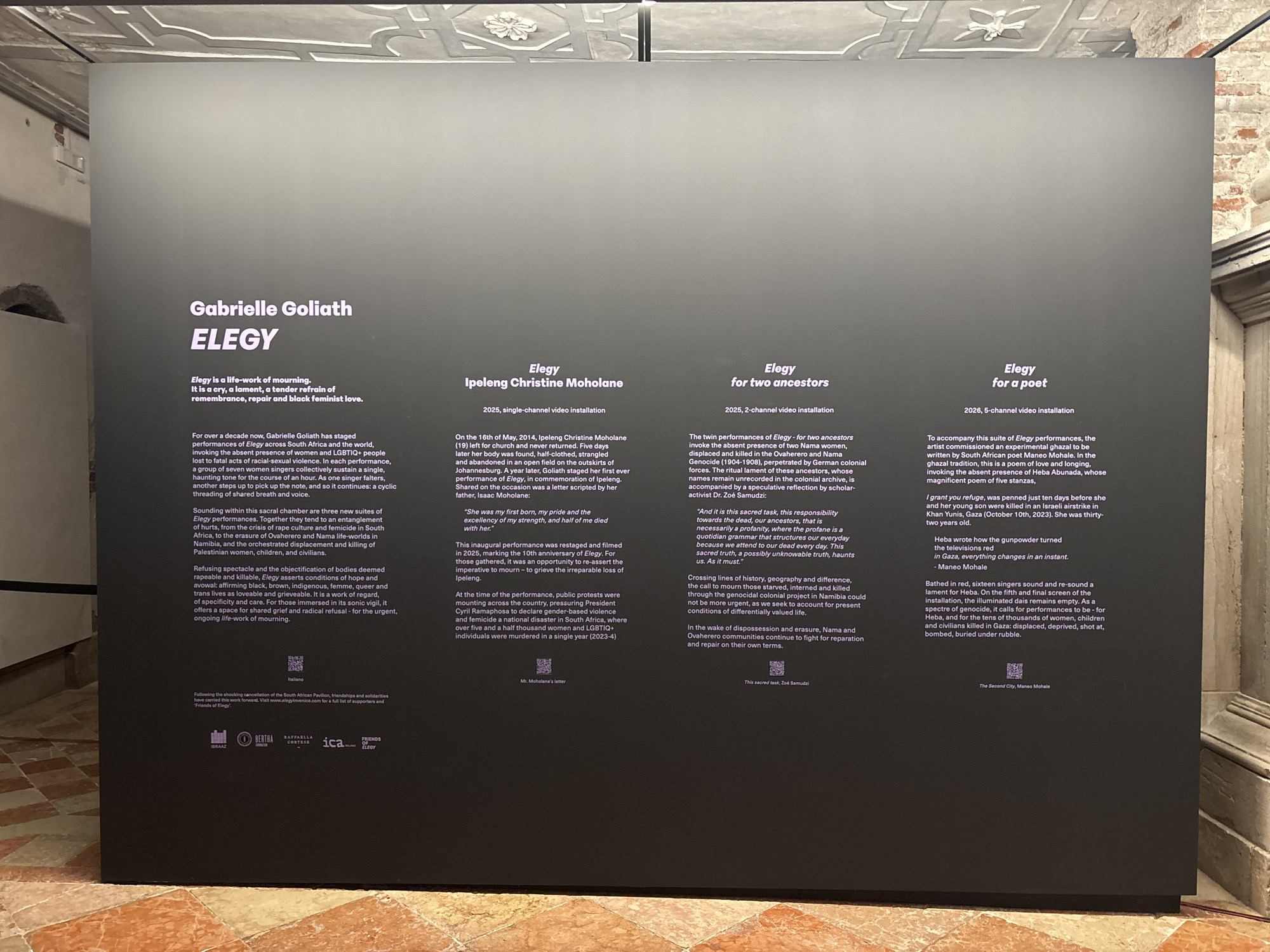
An exhibition information panel, dark grey in color with white text, is centrally positioned against a light grey wall in what appears to be an interior architectural setting. The panel displays text in multiple columns detailing an art exhibition titled "Gabrielle Goliath ELEGY," described as a "life-work of mourning" focusing on racial-sexual violence and black feminist love. The panel features four main sections of text, each with a primary title and accompanying descriptive paragraphs. 1. The leftmost section provides a general overview of Gabrielle Goliath's *Elegy* performances, which have been staged for over a decade, addressing the "absent presence of women and LGBTIQ+ people lost to fatal acts of racial-sexual violence." It describes a performance involving seven women singers sustaining a single note and mentions three new suites of performances addressing issues from South Africa's rape culture and femicide to the "erasure of Ovaherero and Nama life-worlds in Namibia" and the "displacement and killing of Palestinian women, children, and civilians." This section also includes a statement about the "shocking cancellation of the South African Pavilion" and a URL (www.elegyinvenice.com), indicating the exhibition's location in Venice, Italy. Below this text, a QR code labeled "Italiano" and five sponsor logos are visible: Africalia, BERTHA, RAFFAELLA CORTELLESE, ICA Milano, and Friends of Elegy. 2. The second section, titled "Elegy Ipeleng Christine Moholane," details a 2025 single-channel video installation. It recounts the story of Ipeleng Christine Moholane, a 19-year-old who disappeared in 2014 and was later found murdered. Goliath's first *Elegy* performance commemorated Ipeleng, and a restaged, filmed version is set for 2025. This section includes a quote attributed to Ipeleng's father, Isaac Moholane, and mentions public protests in South Africa against gender-based violence and femicide. A QR code labeled "Mr. Moholane's letter" is positioned below this text. 3. The third section, "Elegy for two ancestors," describes a 2025 two-channel video installation. It refers to the "absent presence of two Nama women, displaced and killed in the Ovaherero and Nama Genocide (1904-1908)" by German colonial forces. The text includes a speculative reflection by scholar-activist Dr. Zoë Samudzi and discusses the urgency of mourning those erased and banished by colonial projects in Namibia. A QR code labeled "This sacred task, Zoë Samudzi" is at the bottom of this column. 4. The rightmost section, "Elegy for a poet," details a 2026 five-channel video installation. It describes an experimental ghazal commissioned from South African poet Maneo Mohale,
No transactions found