
Sign in
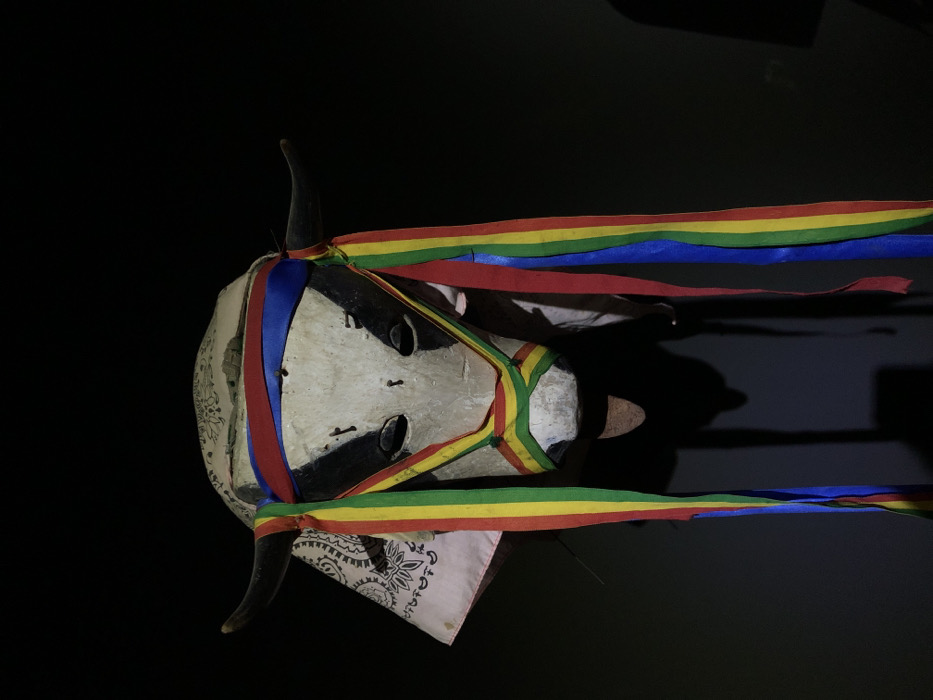
The media file displays a traditional mask, likely a bull or cow head, against a solid dark background. The mask is primarily off-white or light grey, with black accents outlining features such as the eyes and nose. It has two prominent, curved horns, one visible on the left and another partially visible on the right. Two large eyeholes and two smaller holes (possibly for the nose or breathing) are visible.

The mask is elaborately decorated with multiple colorful satin ribbons. These ribbons are red, blue, yellow, and green, and are tied around various parts of the mask, flowing outwards in different directions. Some ribbons run horizontally across the top of the mask, while others wrap around its snout and sides. A piece of white cloth with a black bandana-like paisley pattern is visible underneath the lower part of the mask, extending towards the bottom right.

The mask is oriented vertically in the frame, with its top pointing towards the left. The dark, featureless background creates a dramatic contrast, highlighting the mask and its vibrant ribbons. The setting appears to be indoors or at night, with focused lighting on the subject. There is no visible text. The mask's design, especially with the ribbons and horns, is characteristic of traditional dance masks found in Andean cultures, particularly in Bolivia, where such masks are used in festivals and parades like the Carnaval de Oruro or dances such as the Morenada or Diablada. No specific activity or event is taking place in the image, which solely focuses on the mask itself as an artifact.
MNela

Jan 9, 2025, 8:30 PM

La Paz, Bolivia

Stake attention in this memory

The media file displays a traditional mask, likely a bull or cow head, against a solid dark background. The mask is primarily off-white or light grey, with black accents outlining features such as the eyes and nose. It has two prominent, curved horns, one visible on the left and another partially visible on the right. Two large eyeholes and two smaller holes (possibly for the nose or breathing) are visible. The mask is elaborately decorated with multiple colorful satin ribbons. These ribbons are red, blue, yellow, and green, and are tied around various parts of the mask, flowing outwards in different directions. Some ribbons run horizontally across the top of the mask, while others wrap around its snout and sides. A piece of white cloth with a black bandana-like paisley pattern is visible underneath the lower part of the mask, extending towards the bottom right. The mask is oriented vertically in the frame, with its top pointing towards the left. The dark, featureless background creates a dramatic contrast, highlighting the mask and its vibrant ribbons. The setting appears to be indoors or at night, with focused lighting on the subject. There is no visible text. The mask's design, especially with the ribbons and horns, is characteristic of traditional dance masks found in Andean cultures, particularly in Bolivia, where such masks are used in festivals and parades like the Carnaval de Oruro or dances such as the Morenada or Diablada. No specific activity or event is taking place in the image, which solely focuses on the mask itself as an artifact.

Loading AttnAds…

transactions
revenues
stakers
Earliest
Latest
Highest stake

No transactions found

More from this user

More from La Paz

MNela

Jan 9, 2025, 8:30 PM

La Paz, Bolivia

Licensed under Creative Commons Attribution 4.0 International License. You are free to share and adapt this content with proper attribution.