
Stake attention in this memory
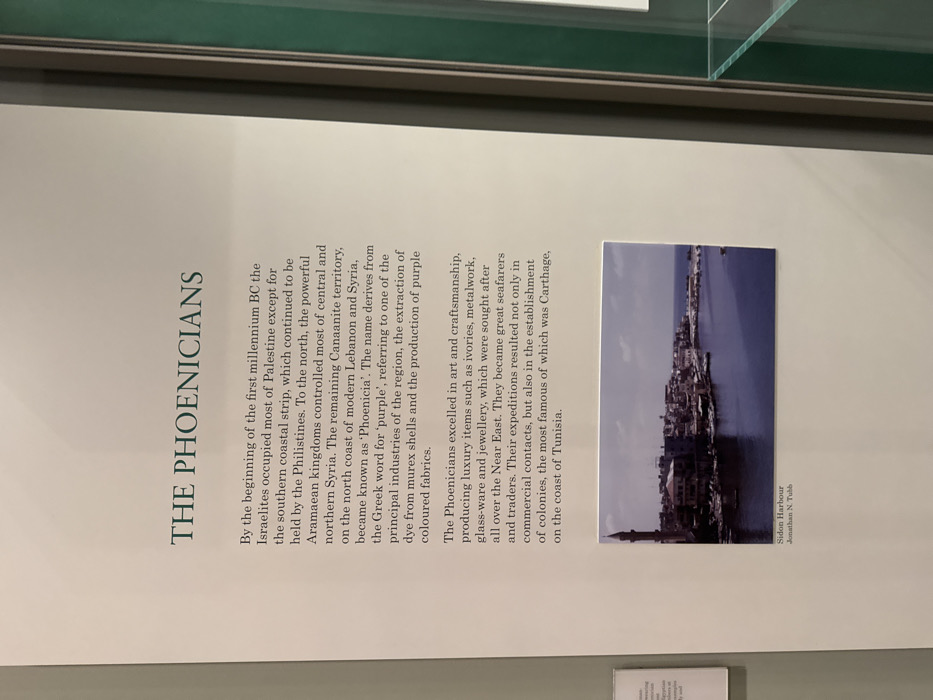
The image displays a museum exhibit panel, oriented vertically and rotated 90 degrees clockwise, against a plain light-colored wall. Above it, a glass display case is visible. The panel's main title, prominently displayed, reads "THE PHOENICIANS". The accompanying text provides historical information about the Phoenicians. It states that by the first millennium BC, the Israelites occupied most of Palestine, with the southern coastal strip held by the Philistines. To the north, Aramaean kingdoms controlled central and northern Syria. The remaining Canaanite territory, along the north coast of modern Lebanon and Syria, became known as 'Phoenicia'. The name is derived from the Greek word for 'purple', referencing their key industry of extracting dye from murex shells and producing purple fabrics. The text further highlights the Phoenicians' excellence in art and craftsmanship, producing luxury items such as ivories, metalwork, glass-ware, and jewellery, which were highly sought after across the Near East. They were renowned as great seafarers and traders, whose expeditions led to commercial contacts and the establishment of colonies, notably Carthage on the coast of Tunisia. To the right of the text, also vertically oriented, is a color photograph depicting a densely built coastal city with buildings lining a harbor, where several boats are visible in the blue water. Below this image, a caption reads "Sidon Harbour Jonathan N. Tubb". The setting is a museum in London, United Kingdom, presenting ancient history.
Loading AttnAds…
No transactions found