
Stake attention in this memory
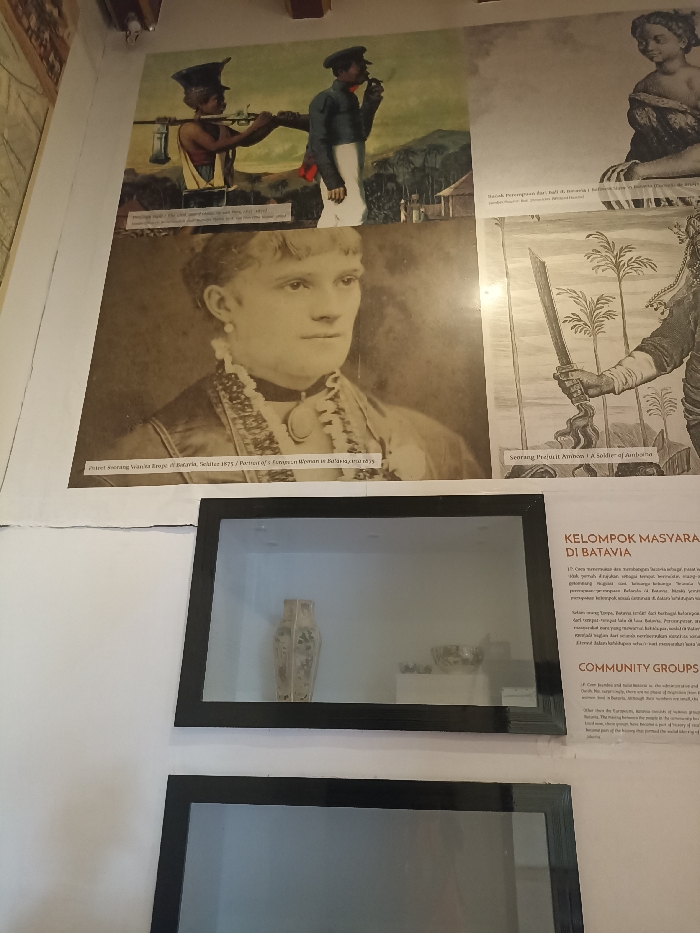
A wall in a building in West Jakarta, Indonesia (-6.135, 106.813), is adorned with framed pictures and display cases. On the top left, a picture shows a man in a colonial uniform walking with another man in a straw hat, both facing right. To its right, a picture depicts a woman standing with crossed arms, facing left, with a smaller image of a seated woman in a white dress underneath. The middle left features a portrait of a woman with pulled-back hair in a dark dress, looking directly at the viewer. Below this is a caption, translated from Indonesian, reading: "Portrait of a Woman in Batavia, 1873 / Portrait of an Eurasian Woman in Batavia, 1873." Below this picture are two display cases: the top holds a ceramic vase with white and blue markings, and the bottom contains a small, white, ceramic bowl. To the right of these cases is a picture of a soldier holding a sword, standing over palm trees, looking right, with a caption translated from Indonesian: "A Soldier of Ambon." Adjacent to the display cases is an information panel headed (translated from Indonesian) "Groups of people in Batavia." This panel includes both Indonesian and English text. The Indonesian text describes 17th-century Batavia as a diverse melting pot, attracting various ethnic groups from across Indonesia (Sunda, Malay, Javanese, Bugis, Makasar, Batak, Balinese) and beyond (Malacca, Bengal, Indian subcontinent, China, Arabian Peninsula, Europe). It emphasizes intermarriage, cultural diversity, and distinct community traditions. The English text, titled "COMMUNITY GROUPS," further details Batavia's social and cultural diversity from immigrant populations, noting their contributions to its history and heritage, and the role of women brought by European settlers in forming the social fabric.
Loading AttnAds…
No transactions found