
Stake attention in this memory
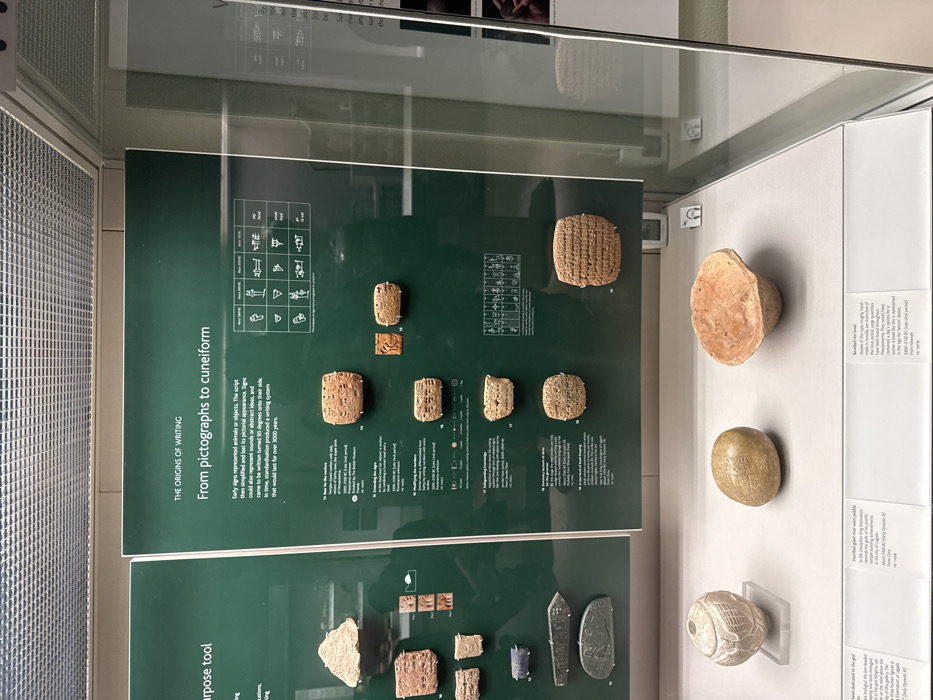
This media file captures a museum display focusing on "THE ORIGINS OF WRITING From pictographs to cuneiform." The scene is an indoor museum or exhibition hall, indicated by the display cases, informative panels, and artificial lighting. The primary subject is a large green display board illustrating the evolution of writing. Visible text on this board explains that "Early signs represented animals or objects. The script then simplified and lost its pictorial appearance. Signs could also represent sounds or abstract ideas, and came to be written turned 90 degrees onto their side. In time, standardisation produced a writing system that would last for over 3000 years." Diagrams on the panel show pictographs from c. 3000 BC evolving into early cuneiform (c. 2700 BC) and Assyrian cuneiform (c. 700 BC), using examples like a head and an ox. Below this explanatory text, numerous ancient clay tablets with cuneiform script are displayed. These tablets, varying in size and shape, are labeled with descriptions such as "Counting the Signs," "Modifying the Function," "Calibrating Knowledge," "The writing of a will," and "A list of food for the temple," along with approximate dates like 2300-2000 BC and 1900-1600 BC. Also on display next to a separate green panel, is a "purpose tool" and other dark, flat tablets or tools. To the right, in a white-lined display case, are several other artifacts. These include a terracotta-colored, half-sphere-shaped object described as a "Bread loaf-shaped object," likely a Sumerian offering from the Early Dynastic II-III period. Below it, an oval, dark stone seal or bead from the Mesopotamian Early Bronze Age. Further down, a white, spherical limestone object is identified as being "Dedicated to the god Nanna" from the Early Dynastic III period. The overall scene highlights the historical development of written language through ancient artifacts and educational explanations.
Loading AttnAds…
No transactions found