
Sign in
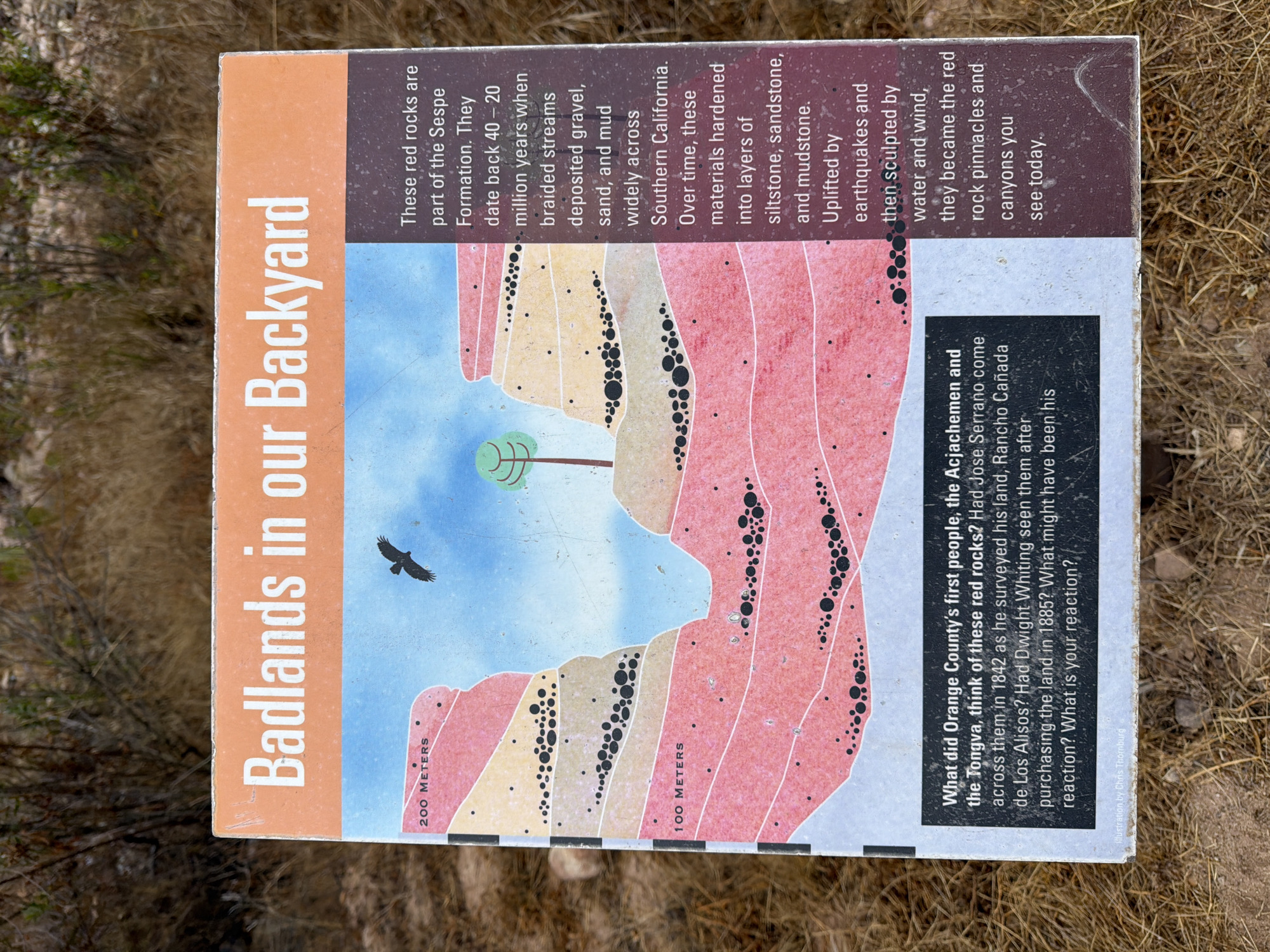
This media file features a close-up, slightly angled shot of an informational sign about the "Badlands in our Backyard." The sign is placed outdoors, with dry, grassy vegetation and dirt visible in the foreground and background, suggesting a natural, arid environment. The sign itself is colorful, depicting a cross-section of geological layers and a stylized landscape with a tree and a bird in flight.

The sign is divided into two main sections of text. The larger section, on the left, is an orange panel with white, bold lettering that reads "Badlands in our Backyard." To the right of this is a brown panel containing explanatory text about the red rocks. This text details their origin from the Sespe Formation, dating back 40-20 million years, formed from braided streams depositing gravel, sand, and mud. It explains how these materials hardened into siltstone, sandstone, and mudstone, and were later uplifted by earthquakes and sculpted by water and wind into pinnacles and canyons.

Below the geological illustration, a black panel presents a series of questions related to the history of the land and its people. It asks what the Acjachemen and Tongva people thought of the rocks, and if historical figures like Jose Serrano or Dwight Whiting observed them. The questions conclude by asking the viewer for their own reaction.

Visible text includes "200 METERS" and "100 METERS" near the bottom of the illustrated geological layers. A credit at the bottom right of the sign reads "Illustration by Chris Thornburg." The image appears to be taken during the daytime, with natural lighting illuminating the sign and its surroundings. The setting strongly suggests an outdoor location in a natural park or geological area.
DRD60

Jul 1, 2026

Lake Forest, USA

Stake attention in this memory

informative
contemplative
nostalgic
curious
peaceful

This media file features a close-up, slightly angled shot of an informational sign about the "Badlands in our Backyard." The sign is placed outdoors, with dry, grassy vegetation and dirt visible in the foreground and background, suggesting a natural, arid environment. The sign itself is colorful, depicting a cross-section of geological layers and a stylized landscape with a tree and a bird in flight. The sign is divided into two main sections of text. The larger section, on the left, is an orange panel with white, bold lettering that reads "Badlands in our Backyard." To the right of this is a brown panel containing explanatory text about the red rocks. This text details their origin from the Sespe Formation, dating back 40-20 million years, formed from braided streams depositing gravel, sand, and mud. It explains how these materials hardened into siltstone, sandstone, and mudstone, and were later uplifted by earthquakes and sculpted by water and wind into pinnacles and canyons. Below the geological illustration, a black panel presents a series of questions related to the history of the land and its people. It asks what the Acjachemen and Tongva people thought of the rocks, and if historical figures like Jose Serrano or Dwight Whiting observed them. The questions conclude by asking the viewer for their own reaction. Visible text includes "200 METERS" and "100 METERS" near the bottom of the illustrated geological layers. A credit at the bottom right of the sign reads "Illustration by Chris Thornburg." The image appears to be taken during the daytime, with natural lighting illuminating the sign and its surroundings. The setting strongly suggests an outdoor location in a natural park or geological area.

transactions
revenues
stakers
Earliest
Latest
Highest stake

No transactions found

More from this user

More from Lake Forest

DRD60

Jul 1, 2026

Lake Forest, USA

Licensed under Creative Commons Attribution 4.0 International License. You are free to share and adapt this content with proper attribution.