
Stake attention in this memory
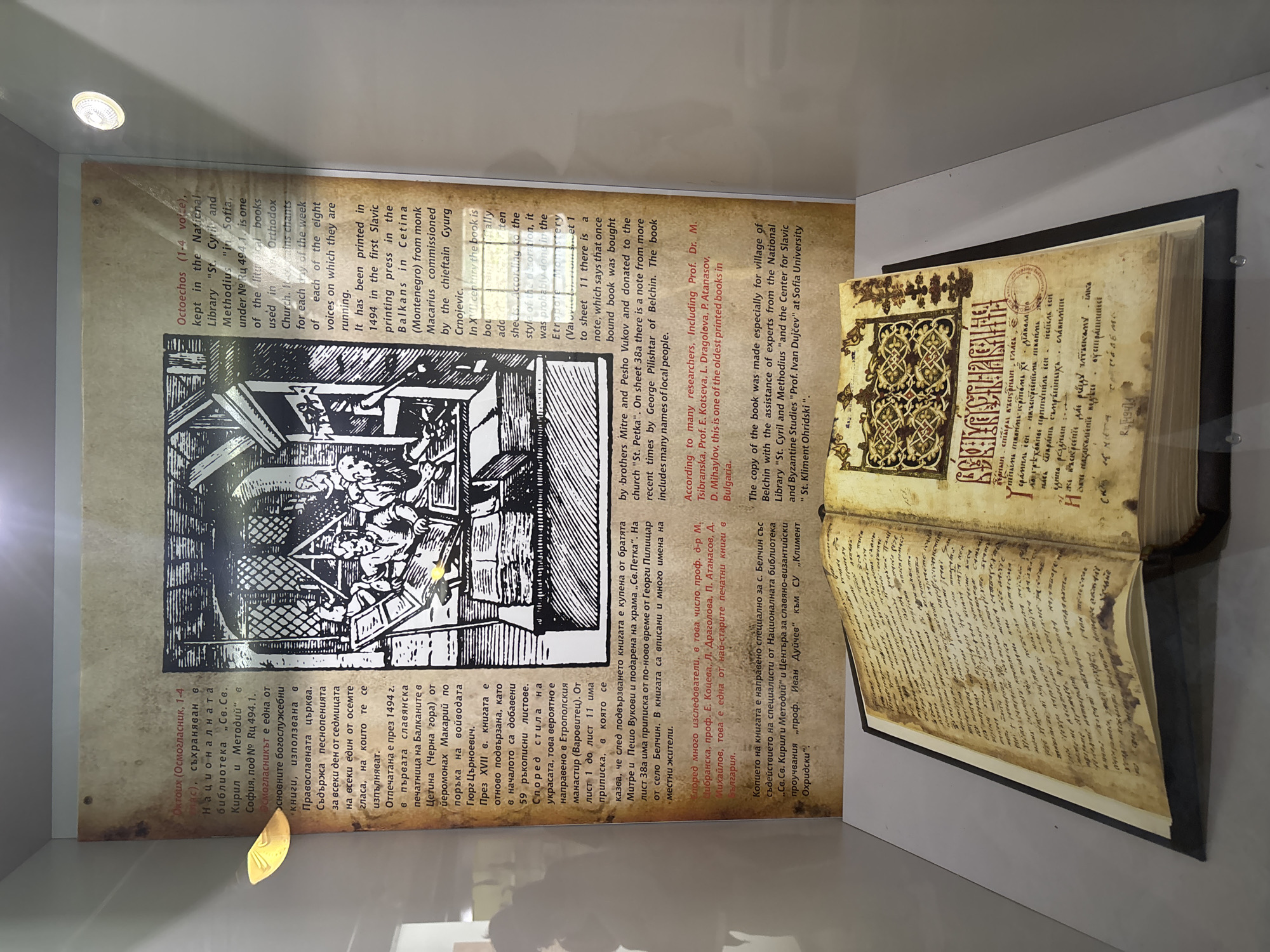
An indoor, eye-level shot captures a museum display featuring an open, antique book and an informational panel. The panel, in the upper portion of the frame, displays a black and white illustration of an early printing press with several individuals engaged in operating it. Below and to the sides of the illustration, text in both Bulgarian and English describes the exhibit. The English text, partially obscured by reflections and a small yellow decorative element, identifies the displayed item as an "Octoechos (1-4 voice)," kept in the National Library "St. Cyril and Methodius" in Sofia. It is described as a liturgical book for the Orthodox Church, containing chants for each day of the week based on eight voices. The book was printed in 1494 in Cetina, Montenegro, by hieromonk Macarius, commissioned by chieftain Gyurg Crnojevic, making it one of the first Slavic printed books in the Balkans. The text further notes that in the 17th century, 59 handwritten sheets were added, and its decoration style suggests it was done in the Etropole Monastery. A note on sheet 11 indicates the book was bought by brothers Mitre and Pesho Vukov and donated to the "St. Petka" church, while a note on sheet 38a mentions George Pilishtar of **Belchin**, suggesting a historical connection to the village in Bulgaria. The book includes names of local people. According to researchers, it is one of the oldest printed books in Bulgaria. The specific copy on display was made for the village of **Belchin** with the assistance of the National Library "St. Cyril and Methodius" and the Center for Slavic-Byzantine Studies "Prof. Ivan Dujčev" at Sofia University "St. Kliment Ohridski." Below the panel, an open, aged book rests on a light-colored surface within a glass display case. The left page is filled with dense, handwritten script in black ink, appearing very old with some scattered dark stains. The right page features elaborate, illuminated text and decorative borders in red, black, and gold, characteristic of early printed or manuscript works. A circular red stamp with illegible text is visible on the right page. The book's binding is dark, likely leather, visible along the spine and edges. Overhead spotlights illuminate the display, casting a warm glow on the ancient pages and creating reflections on the glass case. The background is a plain white wall.
Symbol
85DE8
Volume
0
Creator
+$0.03
Revenue
+$0.00
TVL
$0.00
Loading AttnAds…

2

Rev Bot 🤖💰
Injected revenue 2mo ago
“Revenue bonus for the last stake.”
+$0.04 USD