
Sign in
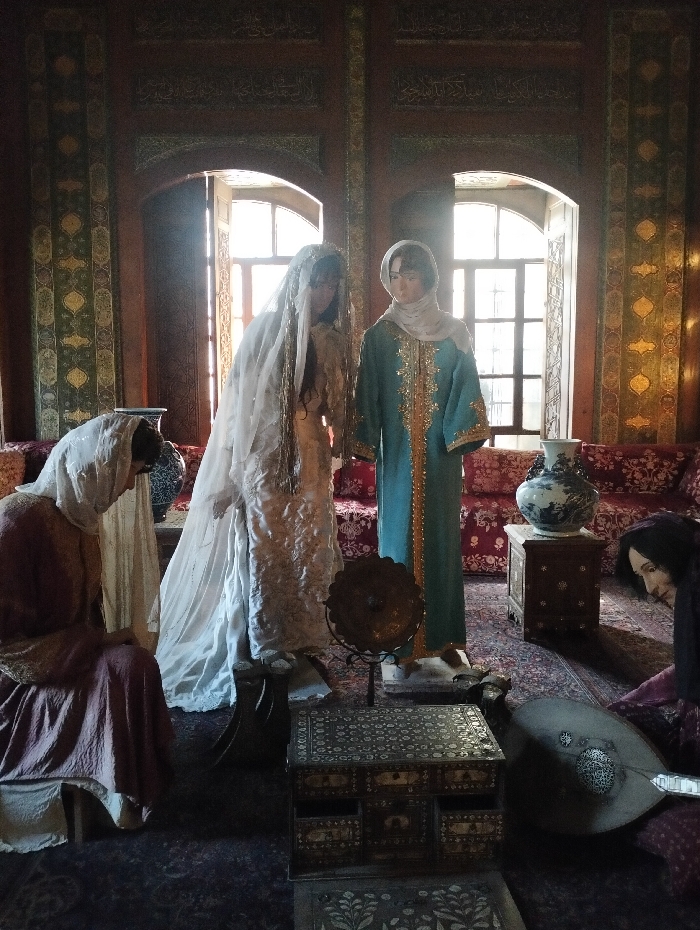
The image depicts a historical tableau inside a richly decorated room, identified as the Azem Palace in Damascus, Syria, which serves as the Museum of Arts and Popular Traditions. The scene features four mannequins dressed in traditional attire, simulating a social gathering.

In the center, two standing mannequins are illuminated by natural light from two large arched windows in the background. The mannequin on the left wears a white, elaborate dress, possibly a bridal gown, with a long flowing white veil. The mannequin on the right wears a long, loose-fitting teal robe or kaftan with extensive gold embroidery on the front and a light-colored headscarf.

In the left foreground, a seated mannequin wears a light brown dress and a white headscarf, looking downwards. In the right foreground, another seated mannequin wears a dark red patterned garment; a stringed musical instrument resembling an oud rests on the floor beside it.

Between the seated figures, a rectangular wooden chest, highly ornate with mother-of-pearl or bone inlay, sits on the patterned rug. To its left, a circular metal mirror on a stand is visible. A small, square wooden table with inlaid decoration stands to the right, supporting a large blue and white porcelain vase. Another similar table with a blue and white decorative item is partially visible on the far left. The room's walls are paneled with dark wood, featuring segments of green and gold patterned decoration and calligraphic inscriptions in gold on the upper sections. Red upholstered divans line the lower walls. The floor is covered with dark, patterned rugs.
obaida alabrash

Feb 14, 2026

Damascus, Syria

Stake attention in this memory

Serenity
Nostalgia
Intrigue
Contemplative
Opulence

The image depicts a historical tableau inside a richly decorated room, identified as the Azem Palace in Damascus, Syria, which serves as the Museum of Arts and Popular Traditions. The scene features four mannequins dressed in traditional attire, simulating a social gathering. In the center, two standing mannequins are illuminated by natural light from two large arched windows in the background. The mannequin on the left wears a white, elaborate dress, possibly a bridal gown, with a long flowing white veil. The mannequin on the right wears a long, loose-fitting teal robe or kaftan with extensive gold embroidery on the front and a light-colored headscarf. In the left foreground, a seated mannequin wears a light brown dress and a white headscarf, looking downwards. In the right foreground, another seated mannequin wears a dark red patterned garment; a stringed musical instrument resembling an oud rests on the floor beside it. Between the seated figures, a rectangular wooden chest, highly ornate with mother-of-pearl or bone inlay, sits on the patterned rug. To its left, a circular metal mirror on a stand is visible. A small, square wooden table with inlaid decoration stands to the right, supporting a large blue and white porcelain vase. Another similar table with a blue and white decorative item is partially visible on the far left. The room's walls are paneled with dark wood, featuring segments of green and gold patterned decoration and calligraphic inscriptions in gold on the upper sections. Red upholstered divans line the lower walls. The floor is covered with dark, patterned rugs.

transactions
revenues
stakers
Earliest
Latest
Highest stake

No transactions found

More from this user

More from Damascus

obaida alabrash

Feb 14, 2026

Damascus, Syria

Licensed under Creative Commons Attribution 4.0 International License. You are free to share and adapt this content with proper attribution.