Sign in
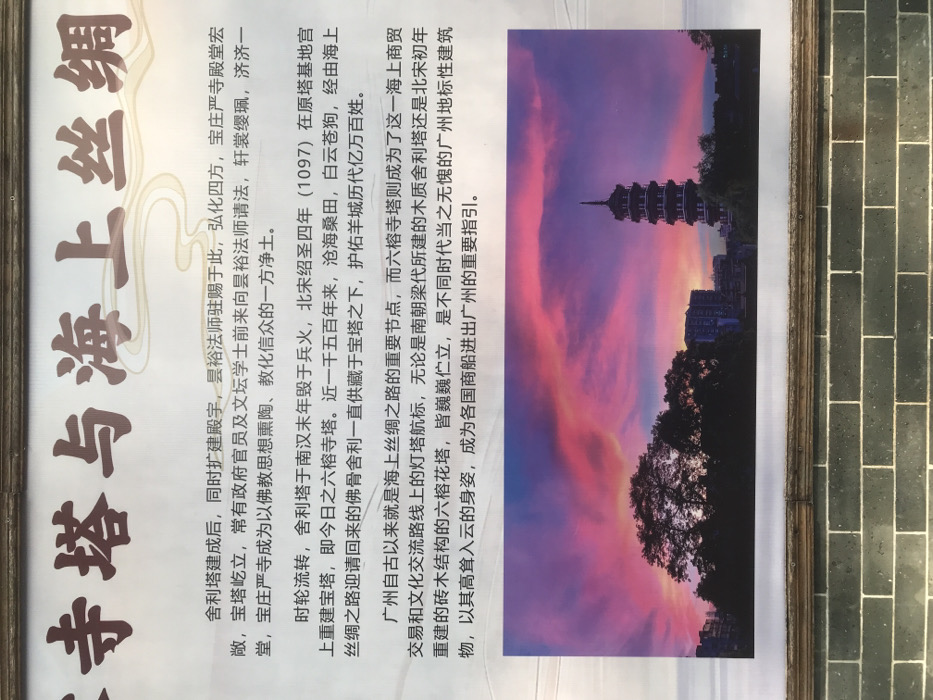
The image displays a large, vertically oriented sign featuring Chinese text and a photograph. The photograph, positioned on the right side of the sign, captures a pagoda silhouetted against a vibrant sunset sky. The sky is filled with sweeping clouds in shades of deep orange, pink, and purple, indicating the late hours of the day. In the foreground of the photograph, dark silhouettes of trees and foliage are visible. Behind the pagoda, the indistinct outlines of city buildings can be seen against the colorful horizon.

The text on the left side of the sign provides historical and cultural information, with a large title reading "寺塔与海上丝绸" (Pagoda and Maritime Silk Road). The body text describes the historical significance of the pagoda, identified as the Six Banyan Pagoda (六榕寺塔) in Guangzhou, China. It details the pagoda's origins, mentioning the establishment of Baoneng Temple and the role of Master Tanyun in spreading Buddhism. The text further explains that the pagoda was rebuilt in 1097 during the Northern Song dynasty after an earlier structure was destroyed. For over 1500 years, Buddhist relics (sarira) brought via the Maritime Silk Road have been preserved beneath the pagoda, offering protection to the people of Guangzhou.

The sign emphasizes Guangzhou's historical importance as a key hub on the Maritime Silk Road and highlights the Six Banyan Pagoda's role as a "lighthouse beacon" for trade and cultural exchange. It refers to both an earlier wooden sarira pagoda and the current brick-and-wood Six Banyan Flower Pagoda, asserting their status as prominent landmarks that guided international merchant ships entering and leaving Guangzhou with their towering presence. The sign is framed by a wooden border on the right, next to a wall constructed from dark grey bricks.
F
FM-qn0Jb2

Dec 11, 2024

Guangzhou, China

Stake attention in this memory

The image displays a large, vertically oriented sign featuring Chinese text and a photograph. The photograph, positioned on the right side of the sign, captures a pagoda silhouetted against a vibrant sunset sky. The sky is filled with sweeping clouds in shades of deep orange, pink, and purple, indicating the late hours of the day. In the foreground of the photograph, dark silhouettes of trees and foliage are visible. Behind the pagoda, the indistinct outlines of city buildings can be seen against the colorful horizon. The text on the left side of the sign provides historical and cultural information, with a large title reading "寺塔与海上丝绸" (Pagoda and Maritime Silk Road). The body text describes the historical significance of the pagoda, identified as the Six Banyan Pagoda (六榕寺塔) in Guangzhou, China. It details the pagoda's origins, mentioning the establishment of Baoneng Temple and the role of Master Tanyun in spreading Buddhism. The text further explains that the pagoda was rebuilt in 1097 during the Northern Song dynasty after an earlier structure was destroyed. For over 1500 years, Buddhist relics (sarira) brought via the Maritime Silk Road have been preserved beneath the pagoda, offering protection to the people of Guangzhou. The sign emphasizes Guangzhou's historical importance as a key hub on the Maritime Silk Road and highlights the Six Banyan Pagoda's role as a "lighthouse beacon" for trade and cultural exchange. It refers to both an earlier wooden sarira pagoda and the current brick-and-wood Six Banyan Flower Pagoda, asserting their status as prominent landmarks that guided international merchant ships entering and leaving Guangzhou with their towering presence. The sign is framed by a wooden border on the right, next to a wall constructed from dark grey bricks.

transactions
revenues
stakers
Earliest
Latest
Highest stake

No transactions found

More from this user

More from Guangzhou

FFM-qn0Jb2

Dec 11, 2024

Guangzhou, China

Licensed under Creative Commons Attribution 4.0 International License. You are free to share and adapt this content with proper attribution.