Sign in
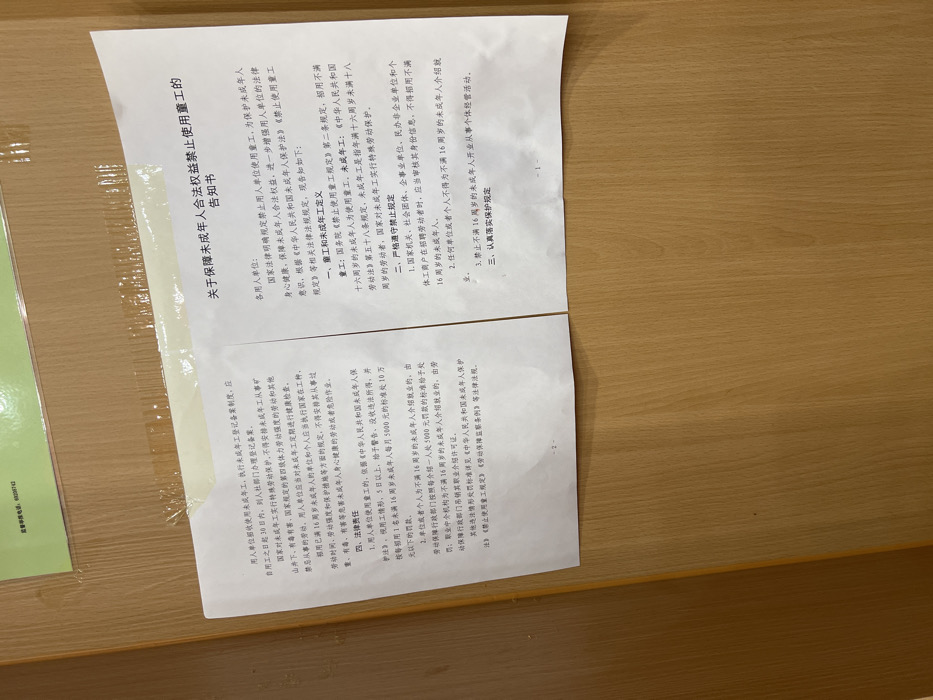
The image displays two documents, printed in Chinese, lying on a wooden desk or table. The documents appear to be official notices or regulations, likely posted in a workplace or public area, given their formal nature.

The document on the right, titled "关于保障未成年人合法权益禁止使用童工的告知书" (Notice Regarding the Protection of Minors' Legal Rights and Prohibition of Child Labor), outlines definitions, prohibitions, and protective measures concerning minor workers. It defines "童工" (child labor) as individuals under 16 years old and "未成年工" (minor workers) as those aged between 16 and 18. It strictly forbids hiring individuals under 16, and prohibits any unit or individual from introducing or assisting minors under 16 into employment or individual business activities. It emphasizes the need to implement protective regulations.

The document on the left details responsibilities and legal liabilities. It mandates employers to register minor workers within 30 days of employment and outlines special labor protections for minors, including prohibitions from working in mines, toxic/hazardous environments, or jobs with intense physical labor (Level 4 and above), as well as requiring regular health check-ups. For minor workers aged 16 and above, specific regulations regarding job types, working hours, intensity, and protective measures must be followed. The document also specifies legal penalties for using child labor, including warnings, confiscation of illegal gains, fines (up to 100,000 RMB, with a baseline of 5,000 RMB per month per child labor under 16), and penalties for individuals or agencies introducing child labor (5,000 RMB per person, and revocation of operating licenses for agencies). It references laws like the "中华人民共和国未成年人保护法" (Law of the People's Republic of China on the Protection of Minors) and "禁止使用童工规定" (Regulations on Prohibiting the Use of Child Labor).

The setting is an indoor environment, likely an office or public space where such notices would be displayed. The documents are slightly crumpled, suggesting they have been handled or are fixed to a surface. No people are visible.
F
FM-kxd2z1

Jan 24, 2025, 9:40 AM

Beijing, China

Stake attention in this memory

The image displays two documents, printed in Chinese, lying on a wooden desk or table. The documents appear to be official notices or regulations, likely posted in a workplace or public area, given their formal nature. The document on the right, titled "关于保障未成年人合法权益禁止使用童工的告知书" (Notice Regarding the Protection of Minors' Legal Rights and Prohibition of Child Labor), outlines definitions, prohibitions, and protective measures concerning minor workers. It defines "童工" (child labor) as individuals under 16 years old and "未成年工" (minor workers) as those aged between 16 and 18. It strictly forbids hiring individuals under 16, and prohibits any unit or individual from introducing or assisting minors under 16 into employment or individual business activities. It emphasizes the need to implement protective regulations. The document on the left details responsibilities and legal liabilities. It mandates employers to register minor workers within 30 days of employment and outlines special labor protections for minors, including prohibitions from working in mines, toxic/hazardous environments, or jobs with intense physical labor (Level 4 and above), as well as requiring regular health check-ups. For minor workers aged 16 and above, specific regulations regarding job types, working hours, intensity, and protective measures must be followed. The document also specifies legal penalties for using child labor, including warnings, confiscation of illegal gains, fines (up to 100,000 RMB, with a baseline of 5,000 RMB per month per child labor under 16), and penalties for individuals or agencies introducing child labor (5,000 RMB per person, and revocation of operating licenses for agencies). It references laws like the "中华人民共和国未成年人保护法" (Law of the People's Republic of China on the Protection of Minors) and "禁止使用童工规定" (Regulations on Prohibiting the Use of Child Labor). The setting is an indoor environment, likely an office or public space where such notices would be displayed. The documents are slightly crumpled, suggesting they have been handled or are fixed to a surface. No people are visible.

Loading AttnAds…

transactions
revenues
stakers
Earliest
Latest
Highest stake

No transactions found

More from this user

More from Beijing

FFM-kxd2z1

Jan 24, 2025, 9:40 AM

Beijing, China

Licensed under Creative Commons Attribution 4.0 International License. You are free to share and adapt this content with proper attribution.