Sign in
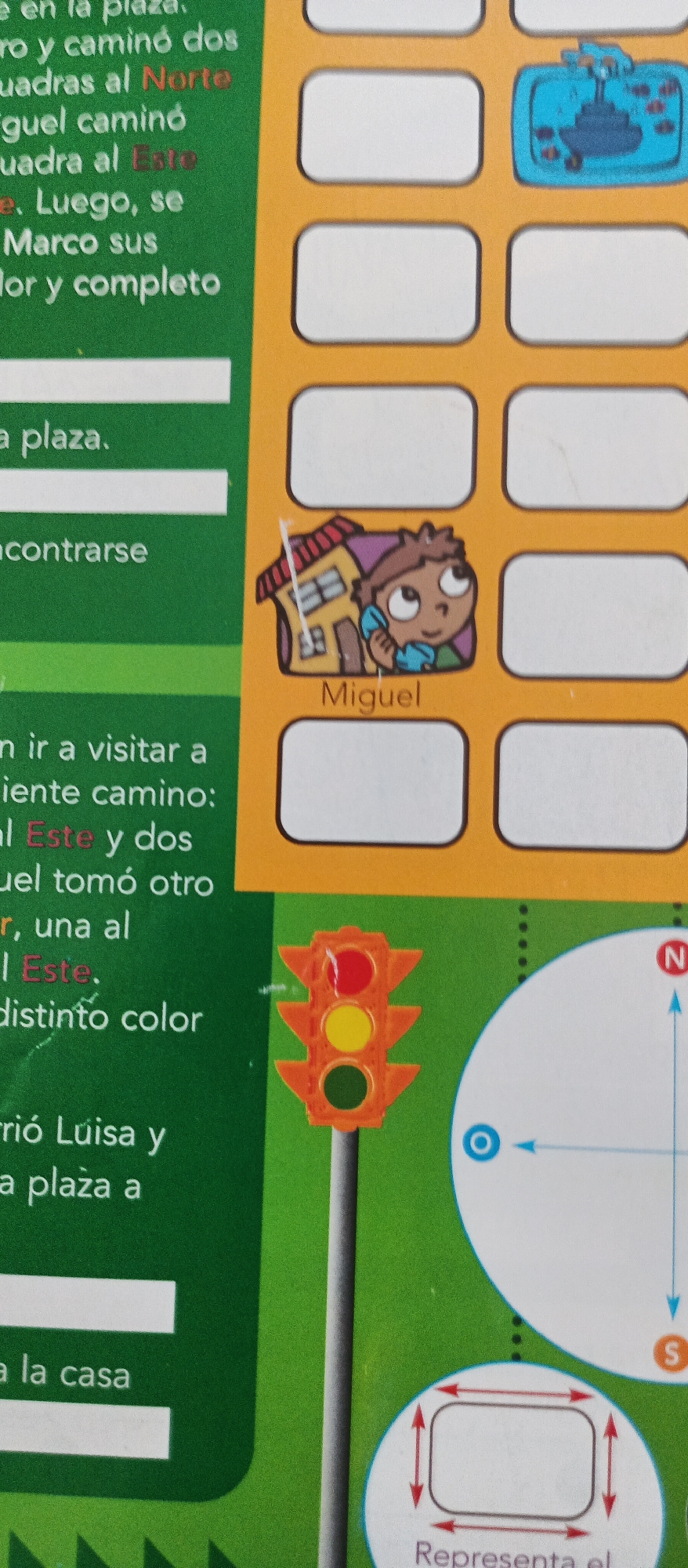
This media file is a close-up photograph of a page from what appears to be a children's educational activity book, likely related to directions and navigation. The page is divided into sections with text and illustrations.

On the left side, there is green-colored text. Some phrases are visible, such as "e en la plaza," "camino dos cuadras al Norte," "Miguel camino," "al Este," "l Este," "distinto color," "Luisa y a plaza a," and "a la casa." This text seems to describe a series of movements and locations.

The right side of the page features a light orange background with rectangular boxes, some of which are empty and others contain illustrations. One illustration shows a cartoon boy named Miguel holding a phone to his ear, standing in front of a house. Another illustration depicts a blue boat on water within a box. Below these boxes, there is a traffic light, and further down, a circular diagram with directional arrows pointing North (N), East (implied by the blue circle with an arrow), South (S), and West (implied by the blue circle with an arrow). A rectangular outline with arrows indicating length and width is also present, with accompanying text that appears to read "Representa el."

The overall scene is bright and colorful, suggesting a daytime setting. The illustrations are simple and child-friendly. The combination of text and visual aids indicates that the page is designed to teach children about spatial awareness, directions (North, East, South, West), and possibly how to follow instructions or read maps. The specific location context of "La Tagua, Venezuela" suggests the material might be related to local geography or a Venezuelan curriculum.

No specific time of day or weather conditions are depicted. The emotions conveyed by the illustrations are neutral to positive, with Miguel appearing engaged in his activity.

The visible text provides clues about the activities and concepts being taught. The names "Miguel" and "Luisa" suggest characters involved in the narrative exercises. The traffic light and directional diagram are common elements in teaching about movement and orientation.
Ramón

Jun 23, 2026, 1:21 PM

La Tagua, Venezuela

Stake attention in this memory

educational
curious
engaged
organized
playful

This media file is a close-up photograph of a page from what appears to be a children's educational activity book, likely related to directions and navigation. The page is divided into sections with text and illustrations. On the left side, there is green-colored text. Some phrases are visible, such as "e en la plaza," "camino dos cuadras al Norte," "Miguel camino," "al Este," "l Este," "distinto color," "Luisa y a plaza a," and "a la casa." This text seems to describe a series of movements and locations. The right side of the page features a light orange background with rectangular boxes, some of which are empty and others contain illustrations. One illustration shows a cartoon boy named Miguel holding a phone to his ear, standing in front of a house. Another illustration depicts a blue boat on water within a box. Below these boxes, there is a traffic light, and further down, a circular diagram with directional arrows pointing North (N), East (implied by the blue circle with an arrow), South (S), and West (implied by the blue circle with an arrow). A rectangular outline with arrows indicating length and width is also present, with accompanying text that appears to read "Representa el." The overall scene is bright and colorful, suggesting a daytime setting. The illustrations are simple and child-friendly. The combination of text and visual aids indicates that the page is designed to teach children about spatial awareness, directions (North, East, South, West), and possibly how to follow instructions or read maps. The specific location context of "La Tagua, Venezuela" suggests the material might be related to local geography or a Venezuelan curriculum. No specific time of day or weather conditions are depicted. The emotions conveyed by the illustrations are neutral to positive, with Miguel appearing engaged in his activity. The visible text provides clues about the activities and concepts being taught. The names "Miguel" and "Luisa" suggest characters involved in the narrative exercises. The traffic light and directional diagram are common elements in teaching about movement and orientation.

Loading AttnAds…

transactions
revenues
stakers
Earliest
Latest
Highest stake

No transactions found

More from this user

More from La Tagua

Ramón

Jun 23, 2026, 1:21 PM

La Tagua, Venezuela

Licensed under Creative Commons Attribution 4.0 International License. You are free to share and adapt this content with proper attribution.