
Sign in
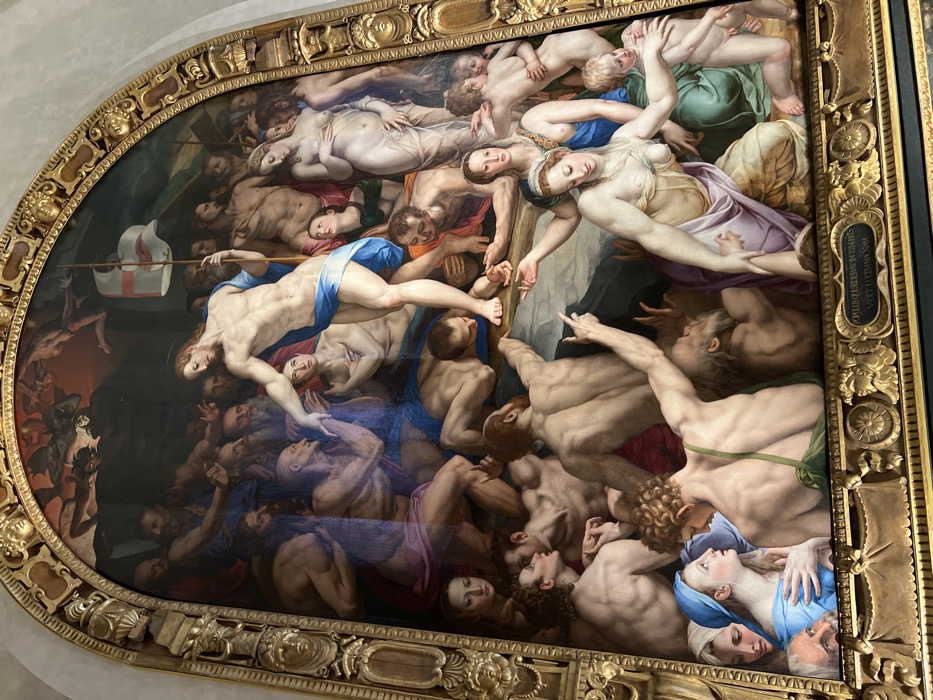
This media file captures a large, dynamic painting titled "The Last Judgment" by Giorgio Vasari, displayed within an ornate, gilded frame. The artwork is likely housed in a museum or gallery in Florence, Italy, as indicated by the location context.

The painting is a crowded, multi-figure composition depicting the resurrection of the dead and their judgment. Numerous nude and partially draped human figures, both male and female, are shown in various states of ascent and descent. In the upper-central left, a prominent, muscular figure, presumably Christ, descends, holding a long staff topped with a white banner bearing a red cross. He appears to be leading or commanding the scene.

Figures in the upper and central sections are depicted rising towards salvation, many with expressions of hope, awe, or reverence. In contrast, the lower-left portion of the painting descends into dark, chaotic depths, where distressed figures struggle amidst demonic entities, illustrating damnation. The emotional range is vast, from despair and agony to serenity and joy.

The artistic style reflects the High Renaissance and Mannerist periods, characterized by classical musculature, dramatic poses, and a rich, though somewhat muted, color palette. The elaborate gold frame features intricate carvings. A Latin inscription is visible on the right side of the frame: "G. VASARIUS ARETINUS INV. ET D. MDCIIX". This translates to "G. Vasari from Arezzo, invented and designed, 1608," referring either to the frame itself, a specific copy, or a later restoration, as Vasari completed the original painting in 1572.
FM-nv0sw2

Feb 5, 2025, 1:11 PM

Firenze, Italy

Stake attention in this memory

This media file captures a large, dynamic painting titled "The Last Judgment" by Giorgio Vasari, displayed within an ornate, gilded frame. The artwork is likely housed in a museum or gallery in Florence, Italy, as indicated by the location context. The painting is a crowded, multi-figure composition depicting the resurrection of the dead and their judgment. Numerous nude and partially draped human figures, both male and female, are shown in various states of ascent and descent. In the upper-central left, a prominent, muscular figure, presumably Christ, descends, holding a long staff topped with a white banner bearing a red cross. He appears to be leading or commanding the scene. Figures in the upper and central sections are depicted rising towards salvation, many with expressions of hope, awe, or reverence. In contrast, the lower-left portion of the painting descends into dark, chaotic depths, where distressed figures struggle amidst demonic entities, illustrating damnation. The emotional range is vast, from despair and agony to serenity and joy. The artistic style reflects the High Renaissance and Mannerist periods, characterized by classical musculature, dramatic poses, and a rich, though somewhat muted, color palette. The elaborate gold frame features intricate carvings. A Latin inscription is visible on the right side of the frame: "G. VASARIUS ARETINUS INV. ET D. MDCIIX". This translates to "G. Vasari from Arezzo, invented and designed, 1608," referring either to the frame itself, a specific copy, or a later restoration, as Vasari completed the original painting in 1572.

transactions
revenues
stakers
Earliest
Latest
Highest stake

No transactions found

More from this user

More from Firenze

FM-nv0sw2

Feb 5, 2025, 1:11 PM

Firenze, Italy

Licensed under Creative Commons Attribution 4.0 International License. You are free to share and adapt this content with proper attribution.