
Sign in
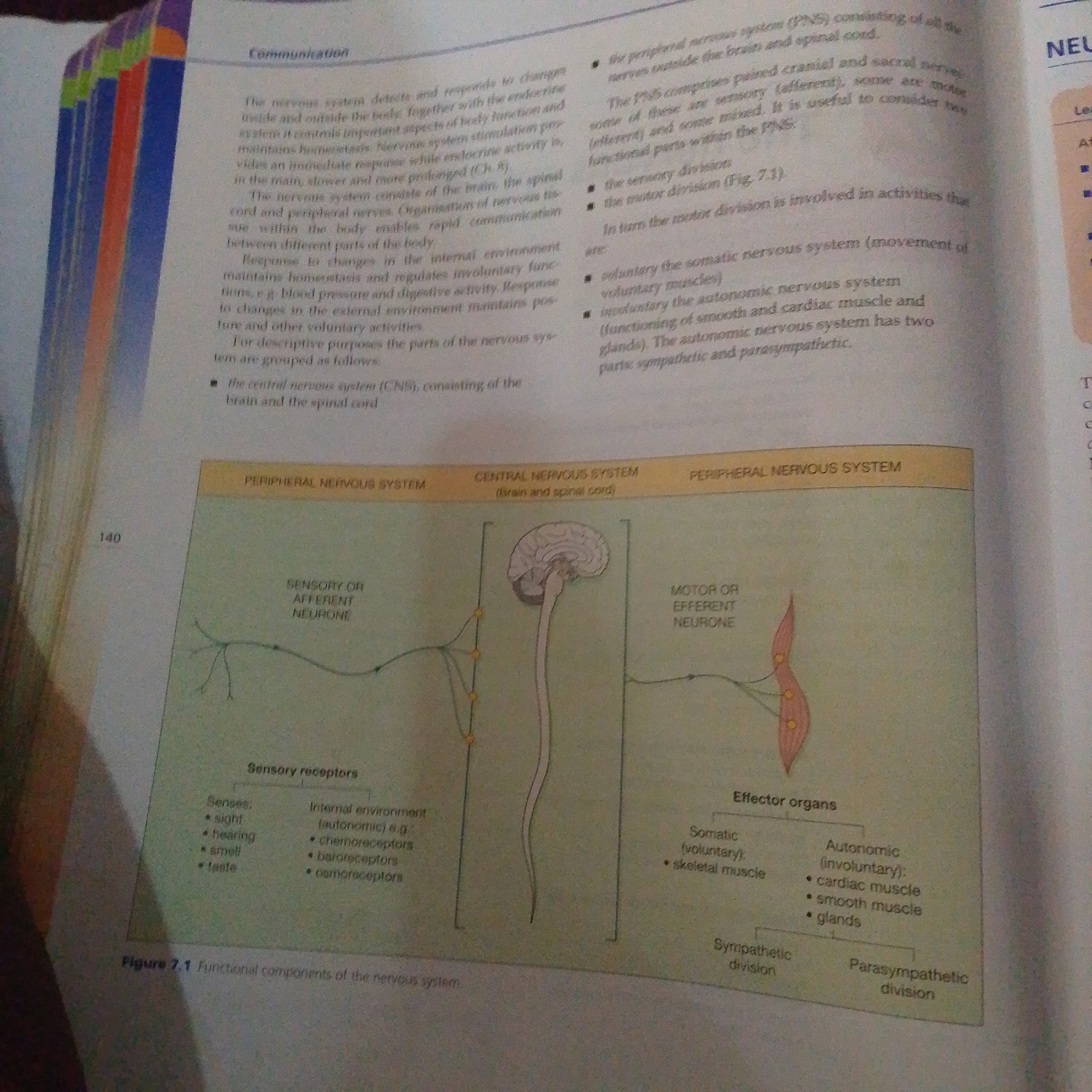
The image shows a page from a textbook, likely an anatomy or biology textbook given the diagrams and text. The central subject is the human nervous system, with a large diagram illustrating its functional components, divided into the Central Nervous System (brain and spinal cord) and the Peripheral Nervous System. The diagram labels and differentiates sensory or afferent neurons from motor or efferent neurons. It also categorizes effector organs into somatic (voluntary) and autonomic (involuntary) systems, with the autonomic system further divided into sympathetic and parasympathetic divisions. Another section details sensory receptors, listing senses like sight, hearing, smell, and taste, and internal environment receptors like chemoreceptors, baroreceptors, and osmoreceptors.

Accompanying the diagrams are blocks of text explaining the nervous system's role in communication, its structure (CNS and PNS), and the functions of its different divisions. Specific text includes headings such as "Communication," "Central Nervous System (Brain and spinal cord)," "Peripheral Nervous System," "Sensory receptors," and "Effector organs." A figure caption reads "Figure 7.1 Functional components of the nervous system." The page number "140" is visible on the left side. The setting is clearly an educational context, with the content designed to inform and explain complex biological concepts. There are no people or any indication of a specific time of day, weather conditions, or location cues beyond it being a printed educational resource. The overall tone is informative and academic.
FM-66btC3

Jun 30, 2026, 1:15 PM

Jalingo, Nigeria

Stake attention in this memory

studious
analytical
intellectual
focused
curious

The image shows a page from a textbook, likely an anatomy or biology textbook given the diagrams and text. The central subject is the human nervous system, with a large diagram illustrating its functional components, divided into the Central Nervous System (brain and spinal cord) and the Peripheral Nervous System. The diagram labels and differentiates sensory or afferent neurons from motor or efferent neurons. It also categorizes effector organs into somatic (voluntary) and autonomic (involuntary) systems, with the autonomic system further divided into sympathetic and parasympathetic divisions. Another section details sensory receptors, listing senses like sight, hearing, smell, and taste, and internal environment receptors like chemoreceptors, baroreceptors, and osmoreceptors. Accompanying the diagrams are blocks of text explaining the nervous system's role in communication, its structure (CNS and PNS), and the functions of its different divisions. Specific text includes headings such as "Communication," "Central Nervous System (Brain and spinal cord)," "Peripheral Nervous System," "Sensory receptors," and "Effector organs." A figure caption reads "Figure 7.1 Functional components of the nervous system." The page number "140" is visible on the left side. The setting is clearly an educational context, with the content designed to inform and explain complex biological concepts. There are no people or any indication of a specific time of day, weather conditions, or location cues beyond it being a printed educational resource. The overall tone is informative and academic.

transactions
revenues
stakers
Earliest
Latest
Highest stake

No transactions found

More from this user

More from Jalingo

FM-66btC3

Jun 30, 2026, 1:15 PM

Jalingo, Nigeria

Licensed under Creative Commons Attribution 4.0 International License. You are free to share and adapt this content with proper attribution.