
Sign in
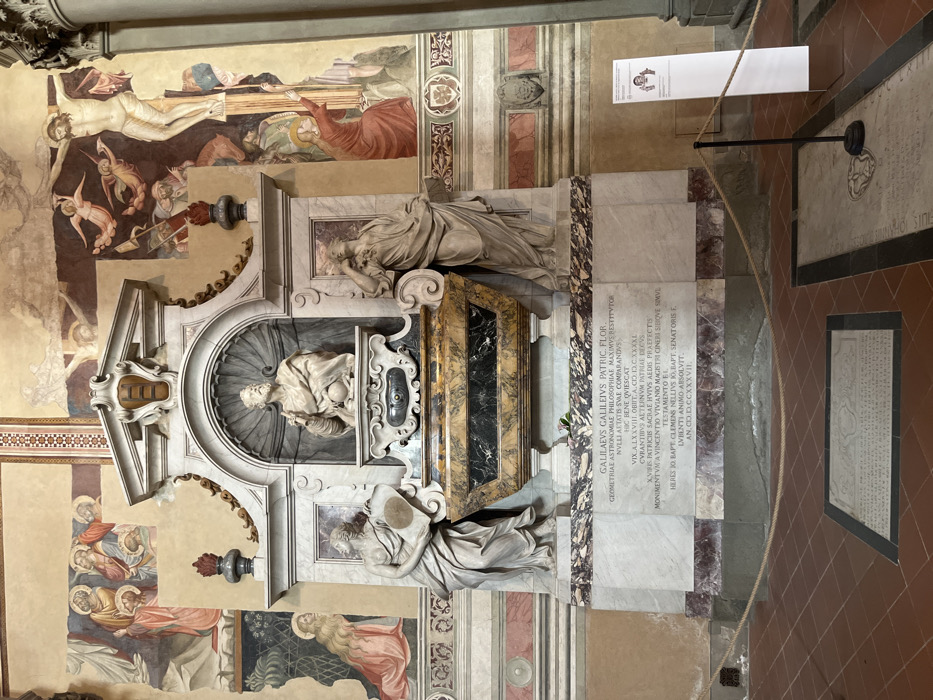
This image captures a grand funerary monument dedicated to Galileo Galilei, situated within a historical building in Firenze, Italy. The setting is an interior, likely a chapel or aisle of a church or cathedral, distinguished by its elaborate artwork.

The central subject is a multi-tiered marble monument adorned with sculptures. At the top, an allegorical female figure, possibly representing Astronomy or Science, is depicted in a melancholic pose, resting her head on one hand. Below, within a semicircular niche, a seated male figure, presumably Galileo Galilei, looks to the left while holding a celestial sphere or globe. At the bottom, another allegorical male figure, likely Geometry or Philosophy, holds a compass and a tablet. A dark, veined marble sarcophagus or pedestal forms the base of the central sculptures. The monument is richly decorated with architectural moldings, volutes, a coat of arms above the niche, and a flaming urn below.

The walls flanking the monument are adorned with frescoes. Above, a detailed crucifixion scene shows Christ on the cross, with Mary Magdalene at the foot and other figures below. Below the monument, additional frescoes depict robed figures, possibly saints or apostles, in various poses. The floor is laid with terracotta tiles in a diagonal pattern, interspersed with marble slabs, one of which bears an inscription. A rope barrier and a white informational sign are visible on the right.

No active event is taking place; the image presents a static historical and artistic display. The atmosphere is solemn and contemplative.

The primary visible text is a large Latin inscription on the monument, dedicating it to "GALILAEVS GALILEIVS PATRIC. FLOR." (Galileo Galilei, Florentine Patrician). It describes him as the "MAXIMVS RESTITVTOR" (greatest restorer) of Geometry, Astronomy, and Philosophy, stating he died at 78 in 1642. The inscription also notes the monument was erected by fifteen patricians and Vincenzo Viviani, and completed in 1737. Another partially visible inscription is on a floor slab.
FM-oNt2k1

Feb 9, 2025

Firenze, Italy

Stake attention in this memory

This image captures a grand funerary monument dedicated to Galileo Galilei, situated within a historical building in Firenze, Italy. The setting is an interior, likely a chapel or aisle of a church or cathedral, distinguished by its elaborate artwork. The central subject is a multi-tiered marble monument adorned with sculptures. At the top, an allegorical female figure, possibly representing Astronomy or Science, is depicted in a melancholic pose, resting her head on one hand. Below, within a semicircular niche, a seated male figure, presumably Galileo Galilei, looks to the left while holding a celestial sphere or globe. At the bottom, another allegorical male figure, likely Geometry or Philosophy, holds a compass and a tablet. A dark, veined marble sarcophagus or pedestal forms the base of the central sculptures. The monument is richly decorated with architectural moldings, volutes, a coat of arms above the niche, and a flaming urn below. The walls flanking the monument are adorned with frescoes. Above, a detailed crucifixion scene shows Christ on the cross, with Mary Magdalene at the foot and other figures below. Below the monument, additional frescoes depict robed figures, possibly saints or apostles, in various poses. The floor is laid with terracotta tiles in a diagonal pattern, interspersed with marble slabs, one of which bears an inscription. A rope barrier and a white informational sign are visible on the right. No active event is taking place; the image presents a static historical and artistic display. The atmosphere is solemn and contemplative. The primary visible text is a large Latin inscription on the monument, dedicating it to "GALILAEVS GALILEIVS PATRIC. FLOR." (Galileo Galilei, Florentine Patrician). It describes him as the "MAXIMVS RESTITVTOR" (greatest restorer) of Geometry, Astronomy, and Philosophy, stating he died at 78 in 1642. The inscription also notes the monument was erected by fifteen patricians and Vincenzo Viviani, and completed in 1737. Another partially visible inscription is on a floor slab.

transactions
revenues
stakers
Earliest
Latest
Highest stake

No transactions found

More from this user

More from Firenze

FM-oNt2k1

Feb 9, 2025

Firenze, Italy

Licensed under Creative Commons Attribution 4.0 International License. You are free to share and adapt this content with proper attribution.