
Sign in
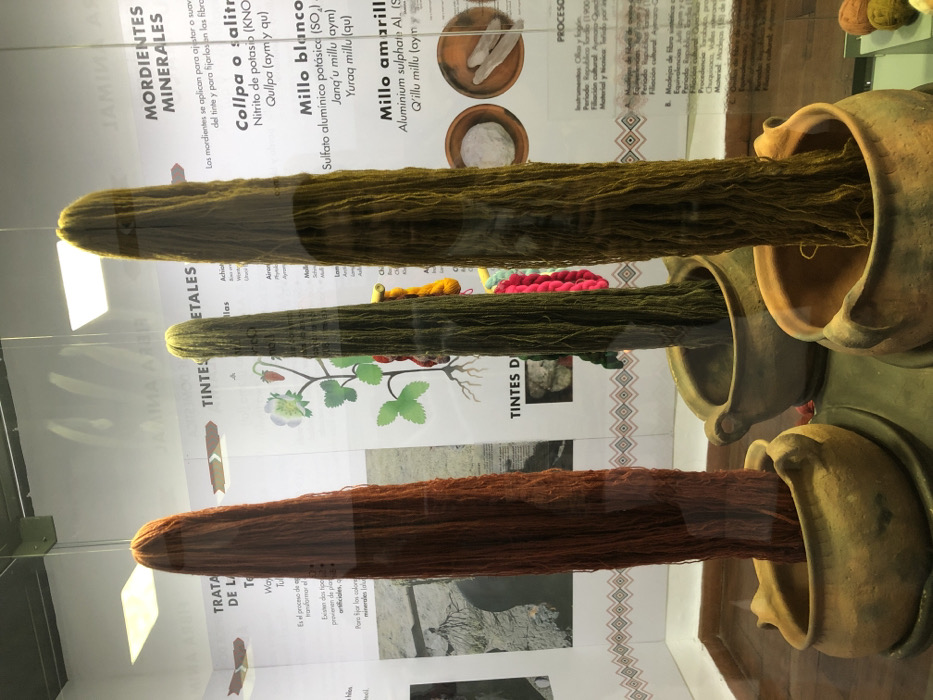
This image captures a museum display, rotated 90 degrees counter-clockwise, showcasing traditional textile dyeing materials and processes. The scene features three distinct bundles of dyed fibers, likely yarn or wool, standing upright within terracotta-colored ceramic pots.

From left to right (as if the image were correctly rotated), the bundles display different shades: a rich reddish-brown, a deep moss-green, and a lighter olive-green. The fibers appear natural, possibly wool, and are arranged in a dense, cylindrical form. The ceramic pots are simple, unglazed vessels, typical of traditional pottery, holding the dyed material.

In the background, behind a reflective glass panel, are several informational plaques written primarily in Spanish, with some indigenous Aymara and Quechua terms. These plaques detail aspects of textile production. Visible text headers include "MORDIEINTES MINERALES" (Mineral Mordants) and "TINTES VEGETALES" (Vegetable Dyes). Specific mordants like "Collpa o salitre" (Saltpeter, Potassium Nitrite), "Millo blanco" (White Alum/Potassium Aluminum Sulfate), and "Millo amarillo" (Yellow Alum/Aluminum Sulphate) are listed with their Aymara/Quechua names. The "TINTES VEGETALES" section mentions plant names like Achiote, Airampo, and Molle. Another section covers the "PROCESO" (Process), referencing "Instrumentos: Ollas y fogón" (Instruments: Pots and stove) and "Filiación cultural Aymara Quech" (Aymara Quechua cultural affiliation).

The display is illuminated by overhead fluorescent lights, whose reflections are visible on the glass, along with slight distortions. The overall impression is an educational exhibit designed to illustrate the historical and cultural significance of natural dyeing techniques, likely in the La Paz, Bolivia region given the context.
MNela

Jan 9, 2025, 7:50 PM

La Paz, Bolivia

Stake attention in this memory

This image captures a museum display, rotated 90 degrees counter-clockwise, showcasing traditional textile dyeing materials and processes. The scene features three distinct bundles of dyed fibers, likely yarn or wool, standing upright within terracotta-colored ceramic pots. From left to right (as if the image were correctly rotated), the bundles display different shades: a rich reddish-brown, a deep moss-green, and a lighter olive-green. The fibers appear natural, possibly wool, and are arranged in a dense, cylindrical form. The ceramic pots are simple, unglazed vessels, typical of traditional pottery, holding the dyed material. In the background, behind a reflective glass panel, are several informational plaques written primarily in Spanish, with some indigenous Aymara and Quechua terms. These plaques detail aspects of textile production. Visible text headers include "MORDIEINTES MINERALES" (Mineral Mordants) and "TINTES VEGETALES" (Vegetable Dyes). Specific mordants like "Collpa o salitre" (Saltpeter, Potassium Nitrite), "Millo blanco" (White Alum/Potassium Aluminum Sulfate), and "Millo amarillo" (Yellow Alum/Aluminum Sulphate) are listed with their Aymara/Quechua names. The "TINTES VEGETALES" section mentions plant names like Achiote, Airampo, and Molle. Another section covers the "PROCESO" (Process), referencing "Instrumentos: Ollas y fogón" (Instruments: Pots and stove) and "Filiación cultural Aymara Quech" (Aymara Quechua cultural affiliation). The display is illuminated by overhead fluorescent lights, whose reflections are visible on the glass, along with slight distortions. The overall impression is an educational exhibit designed to illustrate the historical and cultural significance of natural dyeing techniques, likely in the La Paz, Bolivia region given the context.

Loading AttnAds…

transactions
revenues
stakers
Earliest
Latest
Highest stake

No transactions found

More from this user

More from La Paz

MNela

Jan 9, 2025, 7:50 PM

La Paz, Bolivia

Licensed under Creative Commons Attribution 4.0 International License. You are free to share and adapt this content with proper attribution.