
Sign in
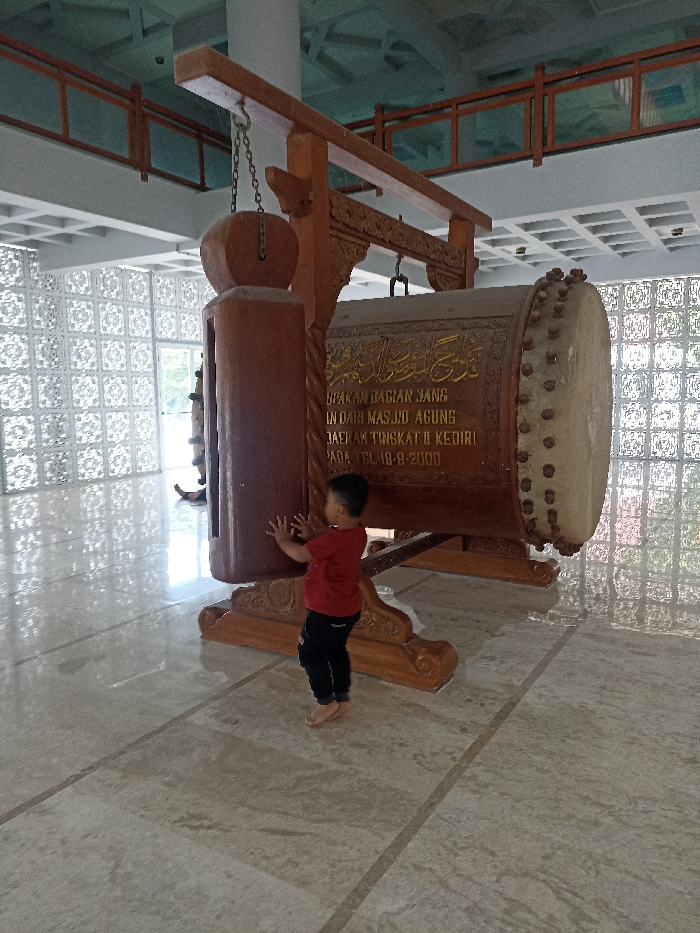
A young child, appearing to be a toddler, stands barefoot in front of a large, traditional Indonesian drum (bedug) inside a spacious building. The child, wearing a red t-shirt and black pants, reaches out with both hands to touch a large wooden mallet hanging by chains next to the drum.

The bedug is a prominent feature, crafted from dark wood with intricate carvings and Arabic script visible on its side. Its drumhead is a light, opaque material secured by numerous decorative studs. The drum rests on a sturdy, carved wooden stand. An inscription is carved into the drum's side, which reads: "UPAKAN BAGIAN YANG IN DARI MASJID AGUNG JAERAN TINGKAT II KEDIRI PADA TEL-18-9-2000," indicating its origin or dedication to the Grand Mosque of Kediri on September 18, 2000.

The setting appears to be an indoor area, likely a mosque or a public building associated with Islamic culture, consistent with the location context of Kecamatan Pare, Indonesia. The floor is made of large, light-colored tiles with visible grout lines, reflecting the bright natural light filtering in. The walls feature white, geometric patterned screens, and the ceiling is high with visible structural elements and a patterned design. A wooden-railed balcony or upper level is visible in the background. The natural lighting suggests it is daytime. The scene captures a moment of childhood curiosity within a culturally significant environment.
FM-DWNFF3

Jan 5, 2025, 4:44 AM

Kecamatan Pare, Indonesia

Stake attention in this memory

A young child, appearing to be a toddler, stands barefoot in front of a large, traditional Indonesian drum (bedug) inside a spacious building. The child, wearing a red t-shirt and black pants, reaches out with both hands to touch a large wooden mallet hanging by chains next to the drum. The bedug is a prominent feature, crafted from dark wood with intricate carvings and Arabic script visible on its side. Its drumhead is a light, opaque material secured by numerous decorative studs. The drum rests on a sturdy, carved wooden stand. An inscription is carved into the drum's side, which reads: "UPAKAN BAGIAN YANG IN DARI MASJID AGUNG JAERAN TINGKAT II KEDIRI PADA TEL-18-9-2000," indicating its origin or dedication to the Grand Mosque of Kediri on September 18, 2000. The setting appears to be an indoor area, likely a mosque or a public building associated with Islamic culture, consistent with the location context of Kecamatan Pare, Indonesia. The floor is made of large, light-colored tiles with visible grout lines, reflecting the bright natural light filtering in. The walls feature white, geometric patterned screens, and the ceiling is high with visible structural elements and a patterned design. A wooden-railed balcony or upper level is visible in the background. The natural lighting suggests it is daytime. The scene captures a moment of childhood curiosity within a culturally significant environment.

Loading AttnAds…

transactions
revenues
stakers
Earliest
Latest
Highest stake

No transactions found

More from this user

More from Kecamatan Pare

FM-DWNFF3

Jan 5, 2025, 4:44 AM

Kecamatan Pare, Indonesia

Licensed under Creative Commons Attribution 4.0 International License. You are free to share and adapt this content with proper attribution.