
Sign in
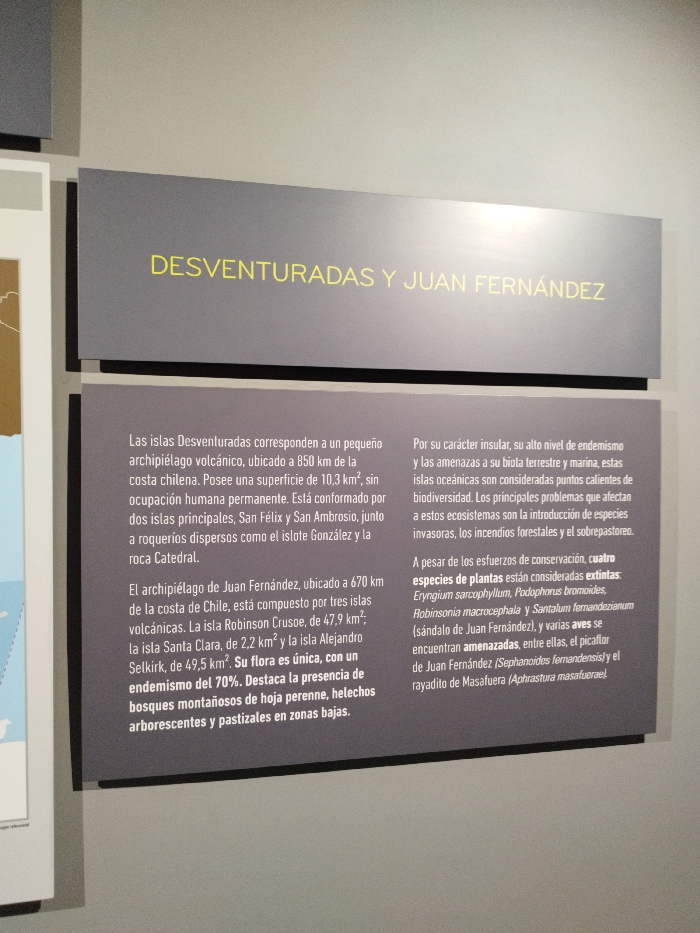
This image captures a section of an indoor exhibition, likely within a museum or educational center in Santiago, Chile, dedicated to the country's geography and biodiversity. The primary subjects are two informational panels mounted on a light grey wall.

The top, narrower panel serves as a title, displaying "DESVENTURADAS Y JUAN FERNÁNDEZ" in yellow uppercase letters against a darker grey background.

Below it, a larger, rectangular panel provides detailed information about these archipelagos. The text is presented in white against a dark grey background and is divided into two columns.

The left column describes the two island groups:
-   **Desventuradas Islands:** A small volcanic archipelago located 850 km off the Chilean coast, with a total surface area of 10.3 km² and no permanent human occupation. It comprises two main islands (San Félix and San Ambrosio) and several scattered islets like González and Catedral rock.
-   **Juan Fernández Archipelago:** Located 670 km from the Chilean coast, this volcanic archipelago consists of three islands: Robinson Crusoe (47.9 km²), Santa Clara (2.2 km²), and Alejandro Selkirk (49.5 km²). Its flora is unique, boasting 70% endemism, characterized by evergreen mountain forests, arborescent ferns, and low-lying grasslands.

The right column focuses on the ecological significance and threats:
-   Due to their insular nature, high endemism, and terrestrial and marine threats, these oceanic islands are considered biodiversity hotspots.
-   Key problems affecting these ecosystems include the introduction of invasive species, forest fires, and overgrazing.
-   Despite conservation efforts, four plant species are considered extinct: *Eryngium sarcophyllum*, *Podophorus bromoides*, *Robinsonia macrocephala*, and *Santalum fernandezianum* (Juan Fernández sandalwood).
-   Several bird species are also threatened, notably the Juan Fernández firecrown (*Sephanoides fernandensis*) and the Masafuera rayadito (*Aphrastura masafuerae*).

The overall setting appears well-lit, typical of a display area. A small portion of an adjacent display, possibly a map or another graphic, is visible on the far left.
Melani

Jan 7, 2025

Santiago, Chile

Stake attention in this memory

This image captures a section of an indoor exhibition, likely within a museum or educational center in Santiago, Chile, dedicated to the country's geography and biodiversity. The primary subjects are two informational panels mounted on a light grey wall. The top, narrower panel serves as a title, displaying "DESVENTURADAS Y JUAN FERNÁNDEZ" in yellow uppercase letters against a darker grey background. Below it, a larger, rectangular panel provides detailed information about these archipelagos. The text is presented in white against a dark grey background and is divided into two columns. The left column describes the two island groups: - **Desventuradas Islands:** A small volcanic archipelago located 850 km off the Chilean coast, with a total surface area of 10.3 km² and no permanent human occupation. It comprises two main islands (San Félix and San Ambrosio) and several scattered islets like González and Catedral rock. - **Juan Fernández Archipelago:** Located 670 km from the Chilean coast, this volcanic archipelago consists of three islands: Robinson Crusoe (47.9 km²), Santa Clara (2.2 km²), and Alejandro Selkirk (49.5 km²). Its flora is unique, boasting 70% endemism, characterized by evergreen mountain forests, arborescent ferns, and low-lying grasslands. The right column focuses on the ecological significance and threats: - Due to their insular nature, high endemism, and terrestrial and marine threats, these oceanic islands are considered biodiversity hotspots. - Key problems affecting these ecosystems include the introduction of invasive species, forest fires, and overgrazing. - Despite conservation efforts, four plant species are considered extinct: *Eryngium sarcophyllum*, *Podophorus bromoides*, *Robinsonia macrocephala*, and *Santalum fernandezianum* (Juan Fernández sandalwood). - Several bird species are also threatened, notably the Juan Fernández firecrown (*Sephanoides fernandensis*) and the Masafuera rayadito (*Aphrastura masafuerae*). The overall setting appears well-lit, typical of a display area. A small portion of an adjacent display, possibly a map or another graphic, is visible on the far left.

transactions
revenues
stakers
Earliest
Latest
Highest stake

No transactions found

More from this user

More from Santiago

Melani

Jan 7, 2025

Santiago, Chile

Licensed under Creative Commons Attribution 4.0 International License. You are free to share and adapt this content with proper attribution.