Sign in
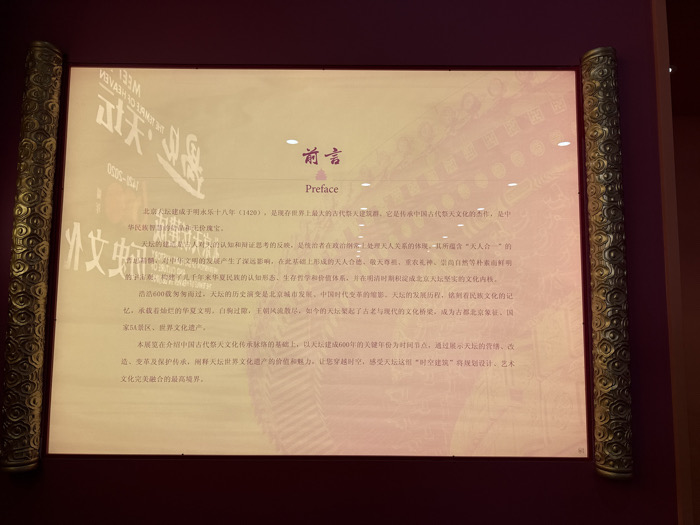
An illuminated informational panel, designed to resemble a traditional Chinese scroll, is displayed indoors. It is framed by decorative, ornate golden-brown pillars on either side, enhancing its scroll-like appearance. The background wall is a dark, warm reddish-brown.

The panel features a title "前言" (Qianyan), with an English subtitle "Preface." The main body of the text, in Chinese, introduces an exhibition about the Temple of Heaven (天坛, Tiantan) in Beijing. It states that the Temple of Heaven was completed in 1420 during the Ming Dynasty (Yongle 18th year) and is the world's largest ancient complex for worshipping heaven, representing a pinnacle of Chinese ancient heaven-worshipping culture.

The text elaborates on the Temple's profound cultural significance, describing it as an embodiment of the "unity of heaven and man" (天人合一) philosophy and a foundational element of Chinese cognition, philosophy, and value systems over thousands of years. It highlights the Temple's 600-year history as a reflection of Beijing's urban development and China's historical changes. The text notes that the Temple of Heaven currently serves as a bridge between ancient and modern culture, a symbol of Beijing, a national 5A tourist attraction, and a UNESCO World Heritage site. The exhibition aims to showcase the Temple's construction, transformations, preservation, and cultural value, inviting visitors to experience its "time-space architecture," which seamlessly integrates planning, design, art, and culture.

Reflected on the panel's surface, reversed English text "THE TEMPLE OF HEAVEN" and "Tiantan," along with numerical text "0505-1954," are partially visible. The indoor setting is brightly lit, illuminating the display text.
Laurent

Mar 5, 2025, 7:15 AM

Beijing, China

Stake attention in this memory

An illuminated informational panel, designed to resemble a traditional Chinese scroll, is displayed indoors. It is framed by decorative, ornate golden-brown pillars on either side, enhancing its scroll-like appearance. The background wall is a dark, warm reddish-brown. The panel features a title "前言" (Qianyan), with an English subtitle "Preface." The main body of the text, in Chinese, introduces an exhibition about the Temple of Heaven (天坛, Tiantan) in Beijing. It states that the Temple of Heaven was completed in 1420 during the Ming Dynasty (Yongle 18th year) and is the world's largest ancient complex for worshipping heaven, representing a pinnacle of Chinese ancient heaven-worshipping culture. The text elaborates on the Temple's profound cultural significance, describing it as an embodiment of the "unity of heaven and man" (天人合一) philosophy and a foundational element of Chinese cognition, philosophy, and value systems over thousands of years. It highlights the Temple's 600-year history as a reflection of Beijing's urban development and China's historical changes. The text notes that the Temple of Heaven currently serves as a bridge between ancient and modern culture, a symbol of Beijing, a national 5A tourist attraction, and a UNESCO World Heritage site. The exhibition aims to showcase the Temple's construction, transformations, preservation, and cultural value, inviting visitors to experience its "time-space architecture," which seamlessly integrates planning, design, art, and culture. Reflected on the panel's surface, reversed English text "THE TEMPLE OF HEAVEN" and "Tiantan," along with numerical text "0505-1954," are partially visible. The indoor setting is brightly lit, illuminating the display text.

Loading AttnAds…

transactions
revenues
stakers
Earliest
Latest
Highest stake

No transactions found

More from this user

More from Beijing

Laurent

Mar 5, 2025, 7:15 AM

Beijing, China

Licensed under Creative Commons Attribution 4.0 International License. You are free to share and adapt this content with proper attribution.