Sign in
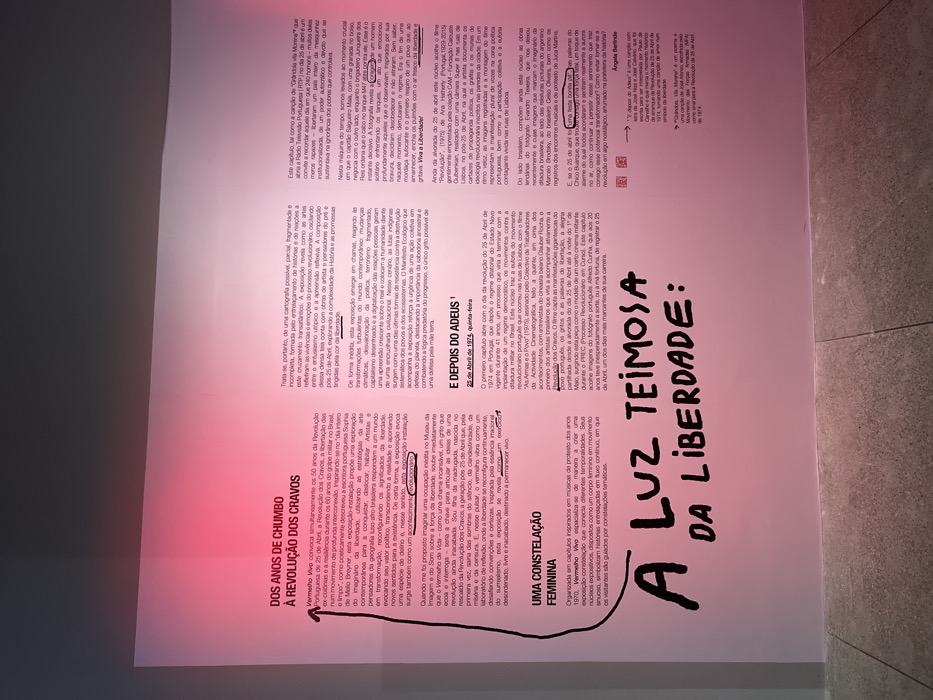
A large, vertical exhibition panel, predominantly pink and red, is displayed against a light-colored wall in what appears to be a museum or gallery setting in Fortaleza, Brazil. The panel is filled with text in Portuguese, describing an exhibition titled "Vermelho Vivo" (Vivid Red).

The main text is divided into several sections, discussing historical events and artistic responses. The prominent title reads "DOS ANOS DE CHUMBO À REVOLUÇÃO DOS CRAVOS" (From the Years of Lead to the Carnation Revolution), and a large handwritten-style title at the bottom right proclaims "A LUZ TEIMOSA DA LIBERDADE:" (The Stubborn Light of Freedom).

The content details the 50th anniversary of the Portuguese Carnation Revolution of April 25, 1974, the liberation of former colonies, and the resilience during 60 years of military dictatorship in Brazil. It explores how art reflected these revolutionary processes, featuring works by artists and thinkers from both pre and post-25 de Abril periods. The exhibition also addresses contemporary challenges like climate change and political instability, emphasizing indigenous struggles and an "Ecological Manifesto."

Specific sections include "UMA CONSTELAÇÃO FEMININA" (A Female Constellation) and "E DEPOIS DO ADEUS ¹" (And After the Goodbye ¹), with a footnote explaining the song "E Depois do Adeus" by Paulo de Carvalho. The text mentions the "Museu da Imagem e do Som," and refers to figures such as Sophia de Mello Breyner, Glauber Rocha, Evandro Teixeira, Marcelo Brodsky, Celso Olivera, Juca Martins, Alfredo Cunha, Ana Hatherly, and Chico Buarque. The panel describes themes of freedom, revolution, resistance, and the complex interplay of history and art.
F
FM-3Wd0j2

Feb 2, 2025

Fortaleza, Brazil

Stake attention in this memory

A large, vertical exhibition panel, predominantly pink and red, is displayed against a light-colored wall in what appears to be a museum or gallery setting in Fortaleza, Brazil. The panel is filled with text in Portuguese, describing an exhibition titled "Vermelho Vivo" (Vivid Red). The main text is divided into several sections, discussing historical events and artistic responses. The prominent title reads "DOS ANOS DE CHUMBO À REVOLUÇÃO DOS CRAVOS" (From the Years of Lead to the Carnation Revolution), and a large handwritten-style title at the bottom right proclaims "A LUZ TEIMOSA DA LIBERDADE:" (The Stubborn Light of Freedom). The content details the 50th anniversary of the Portuguese Carnation Revolution of April 25, 1974, the liberation of former colonies, and the resilience during 60 years of military dictatorship in Brazil. It explores how art reflected these revolutionary processes, featuring works by artists and thinkers from both pre and post-25 de Abril periods. The exhibition also addresses contemporary challenges like climate change and political instability, emphasizing indigenous struggles and an "Ecological Manifesto." Specific sections include "UMA CONSTELAÇÃO FEMININA" (A Female Constellation) and "E DEPOIS DO ADEUS ¹" (And After the Goodbye ¹), with a footnote explaining the song "E Depois do Adeus" by Paulo de Carvalho. The text mentions the "Museu da Imagem e do Som," and refers to figures such as Sophia de Mello Breyner, Glauber Rocha, Evandro Teixeira, Marcelo Brodsky, Celso Olivera, Juca Martins, Alfredo Cunha, Ana Hatherly, and Chico Buarque. The panel describes themes of freedom, revolution, resistance, and the complex interplay of history and art.

transactions
revenues
stakers
Earliest
Latest
Highest stake

No transactions found

More from this user

More from Fortaleza

FFM-3Wd0j2

Feb 2, 2025

Fortaleza, Brazil

Licensed under Creative Commons Attribution 4.0 International License. You are free to share and adapt this content with proper attribution.